
Skull
Cranium
The skull is the bony framework of the head. It is made of 22 bones: 8 cranial bones that enclose the brain and 14 facial bones that shape the face. The hyoid bone hangs below it in the neck.
Loading 3D model…
Free 3D model of the bones of the skull. Whole skull. Drag to rotate, zoom with + and − (or Ctrl + scroll), click a bone to highlight and name it.
- Cranial bones (8)
- Facial bones (14)
- Hyoid bone
Key points
- The adult skull has 22 bones: 8 cranial and 14 facial.
- The cranial bones form a protective case around the brain.
- Almost all skull bones are locked together by immovable joints called sutures.
- The mandible is the only skull bone that moves freely.
What is the skull?
The skull is the skeleton of the head. It protects the brain, houses the eyes, ears, nose and mouth, and gives the face its shape.
It is not one bone. An adult skull is built from 22 separate bones that have grown together along their edges. Anatomists divide them into two groups: the neurocranium, or braincase, and the facial skeleton.
What are the two parts of the skull?
The neurocranium is the rounded box that surrounds the brain. It is made of the 8 cranial bones. Its domed roof is called the skullcap or calvaria, and its floor is called the cranial base.
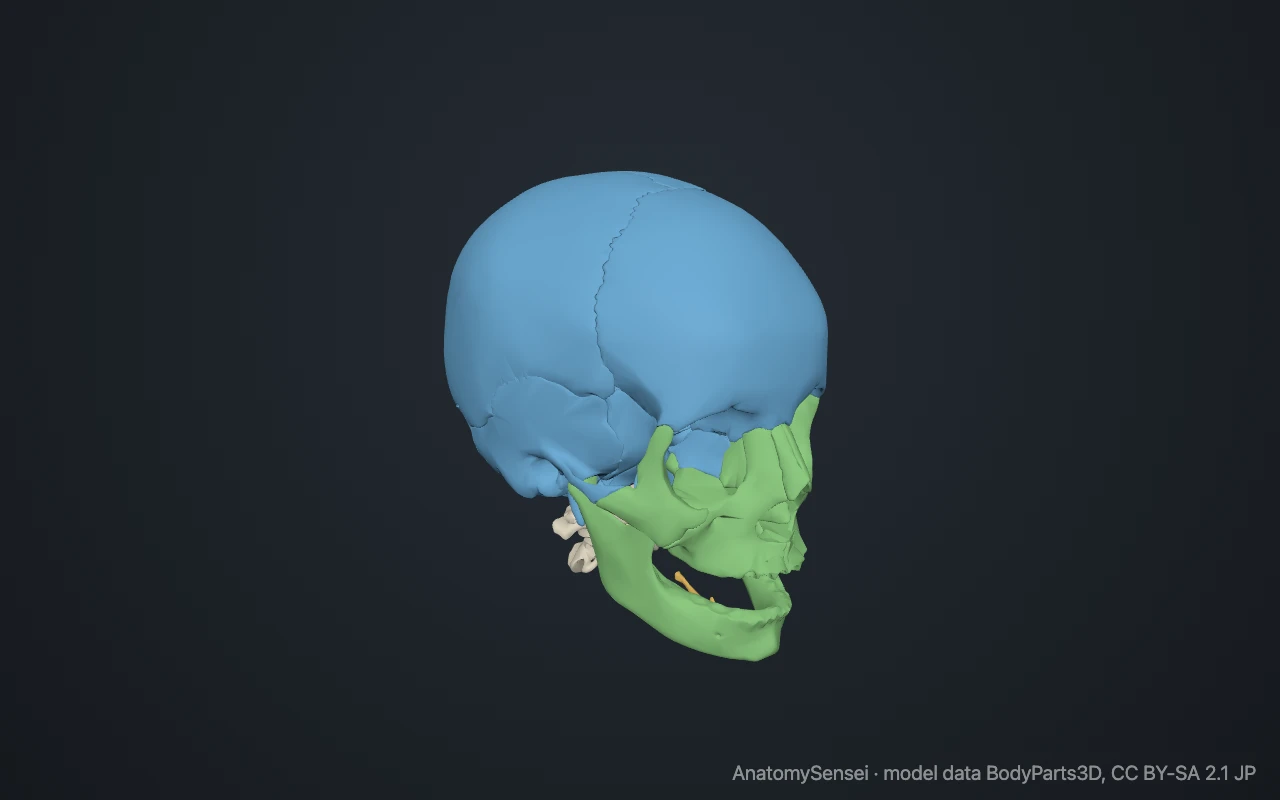
The facial skeleton, also called the viscerocranium, hangs from the front of the braincase. Its 14 bones form the eye sockets, the nose, the cheeks and both jaws.
In the model on this page the two groups have different colours, so the boundary between braincase and face is easy to follow.
Which are the 8 cranial bones?
There are four single bones and two pairs. The single bones are the frontal bone of the forehead, the occipital bone at the back, and the sphenoid and ethmoid bones deep in the base of the skull.
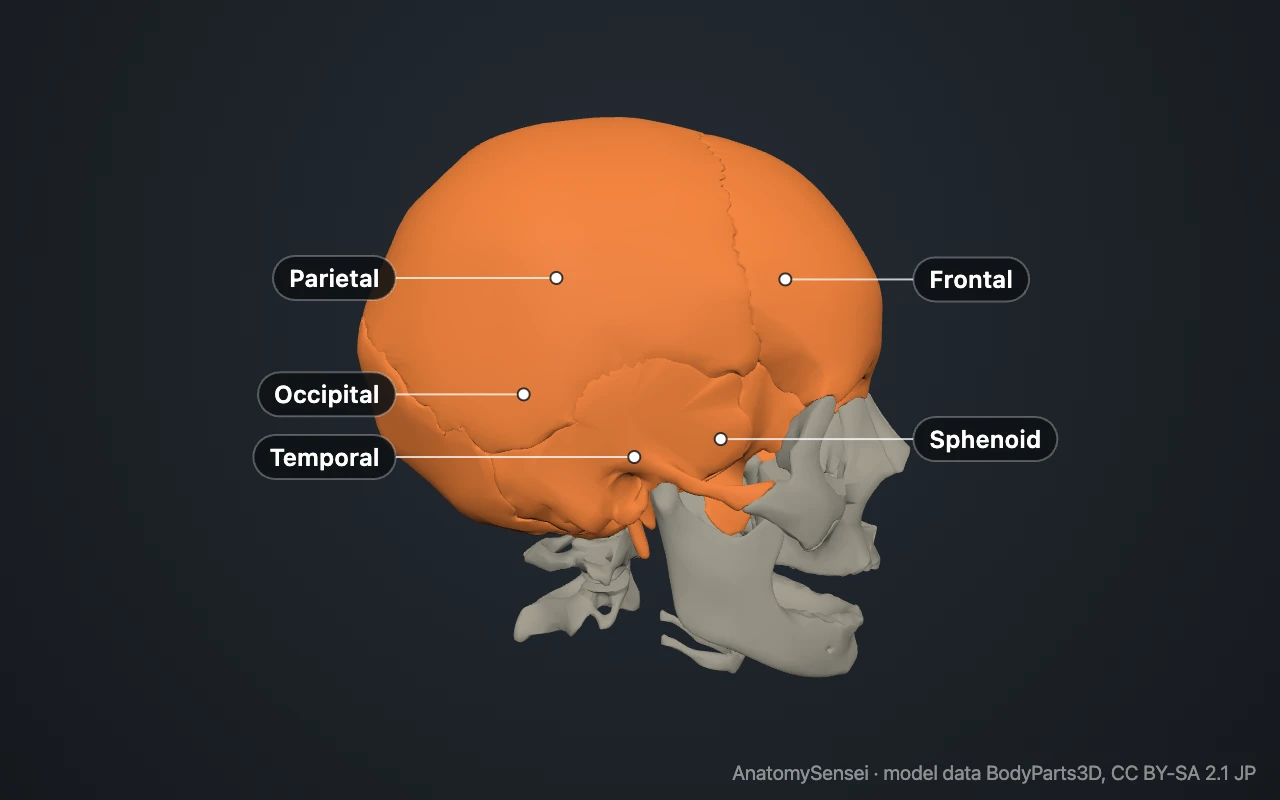
The paired bones are the two parietal bones, which form the roof and upper sides, and the two temporal bones, which form the lower sides around the ears.
Which are the 14 facial bones?
Two facial bones are single: the mandible, or lower jaw, and the vomer, a thin plate in the wall between the two halves of the nose.
The other twelve come as six pairs. They are the maxillae (upper jaw), the zygomatic bones (cheekbones), the nasal bones, the lacrimal bones, the palatine bones and the inferior nasal conchae.
What are the sutures of the skull?
A suture is a joint where two skull bones meet edge to edge. The edges are often jagged and interlock like the pieces of a jigsaw. A thin layer of tough fibrous tissue binds them, so the bones do not move against each other.
The largest sutures are on the skullcap. The coronal suture runs from side to side behind the frontal bone, the sagittal suture runs along the midline between the two parietal bones, and the lambdoid suture crosses the back of the head above the occipital bone.
In a baby the sutures are wide and flexible, which lets the head change shape during birth and lets the skull grow with the brain. In the model the sutures appear as the lines where one separate bone ends and the next begins.
Which skull bone can move?
The mandible is the only skull bone that moves freely. It meets the temporal bone on each side at the temporomandibular joint, just in front of the ear. This pair of joints lets the jaw open, close and slide for chewing and speech.
The skull as a whole also moves on the neck. Two smooth knobs on the occipital bone rest on the atlas, the first neck vertebra, which is shown in the model for orientation.
Is the hyoid bone part of the skull?
No. The hyoid is a small U-shaped bone in the front of the neck, below the lower jaw. It is not counted among the 22 skull bones and it touches no other bone. Muscles and ligaments hold it in place.
It is shown here because it works closely with the skull. It supports the tongue and moves with every swallow.
What does the 3D model show?
The model shows the whole skull with every bone as a separate piece, together with the hyoid and the first two neck vertebrae. Any bone can be selected to see its name and open its page.
It shows bones only. The teeth and the three tiny ear bones inside each temporal bone are not included, and neither are cartilage, muscles or ligaments.
Free 3D models of every skull bone
- Cranial bones 3D model
- Frontal bone 3D model
- Parietal bone 3D model
- Occipital bone 3D model
- Temporal bone 3D model
- Sphenoid bone 3D model
- Ethmoid bone 3D model
- Hyoid bone 3D model
- Facial bones 3D model
- Maxilla 3D model
- Mandible 3D model
- Zygomatic bone 3D model
- Nasal bone 3D model
- Lacrimal bone 3D model
- Palatine bone 3D model
- Vomer 3D model
- Inferior nasal concha 3D model
Common questions
How many bones are in the human skull?
22. Eight are cranial bones and fourteen are facial bones. Higher counts add the six small ear bones, the hyoid, or both.
Is the skull one bone?
No. It is 22 bones joined by sutures. They are so tightly bound in an adult that the skull behaves like a single piece.
What is the difference between the skull and the cranium?
The words are often used for the same thing. Some authors use cranium only for the part that encloses the brain, or for the skull without the mandible.
Which is the strongest bone of the skull?
The mandible is usually described as the largest and strongest bone of the face.
Are teeth bones?
No. Teeth are made of different tissues and are not counted as bones. They are not shown in this model.
Is this 3D model of the bones of the skull free?
Yes. The interactive 3D model on this page is free to view and use for study, with no account or download needed. Its geometry comes from the open BodyParts3D data set (CC BY-SA).
About this free 3D model of the bones of the skull
The interactive 3D model on this page is free to use in your browser, with no sign-up. It is built from scan-based anatomy data, so every bone is a separate, correctly placed shape you can turn and inspect from any side.