
Pelvis
Pelvis
The pelvis is the ring of bone at the base of the trunk. It is made of the two hip bones and the sacrum, and it links the spine to the legs.
Loading 3D model…
Free 3D model of the bones of the pelvis. Whole pelvis. Drag to rotate, zoom with + and − (or Ctrl + scroll), click a bone to highlight and name it.
- Right hip bone
- Left hip bone
- Sacrum
Key points
- The bony pelvis is a closed ring made of two hip bones and the sacrum.
- The ring is held together by two sacroiliac joints at the back and the pubic symphysis at the front.
- It passes the weight of the upper body from the spine to the legs.
- A typical female pelvis is wider and more open than a typical male pelvis.
What is the pelvis?
The pelvis is a basin-shaped ring of bone at the lower end of the trunk. The name is Latin for basin. It sits between the abdomen above and the thighs below.
Three bones form the ring. The two hip bones make its sides and front, and the sacrum closes it at the back. The coccyx, or tailbone, hangs from the lower end of the sacrum.
The two hip bones on their own are called the pelvic girdle. They attach the legs to the trunk in the same way that the shoulder girdle attaches the arms.
Where is the pelvis and how can it be felt?
The pelvis lies below the lumbar spine and above the thigh bones. The fifth lumbar vertebra rests on top of the sacrum, and the head of each femur fits into a socket on the outer side of each hip bone.
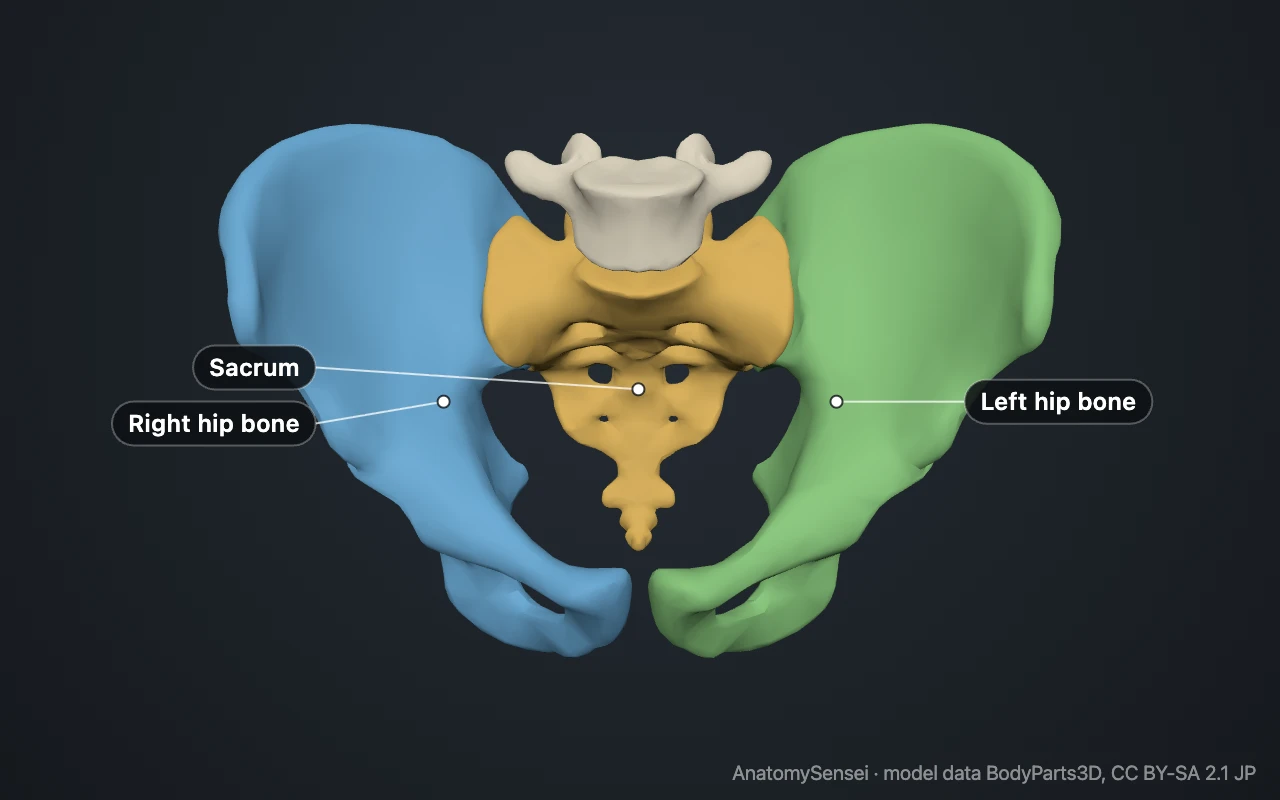
Several parts lie close to the skin. Put your hands on your hips and you are resting them on the iliac crests, the curved upper edges of the hip bones. Follow a crest forward and it ends in a bony point at the front of the hip.
In the midline at the front, just above the genitals, the firm bar of bone is where the two pubic bones meet. When you sit on a hard chair, the two bony points you feel beneath you are the ischial tuberosities, or sitting bones.
Which bones make up the pelvis?
Each hip bone is a large, irregular bone formed from three parts that fuse during the teenage years. The ilium is the broad upper blade, the ischium is the lower back part, and the pubis is the lower front part. All three meet in the acetabulum, the socket of the hip joint.
The sacrum is a triangular bone made of five fused vertebrae. It is wedged between the two hip bones at the back of the ring and forms the lowest weight-bearing part of the spine.
In the model, each hip bone is a single piece, so its three parts cannot be coloured separately. The model also has no separate coccyx.
What joints hold the pelvic ring together?
The ring has three joints of its own. At the back, a sacroiliac joint on each side joins the sacrum to the ilium. These joints are bound by some of the strongest ligaments in the body and allow only a very small amount of movement.
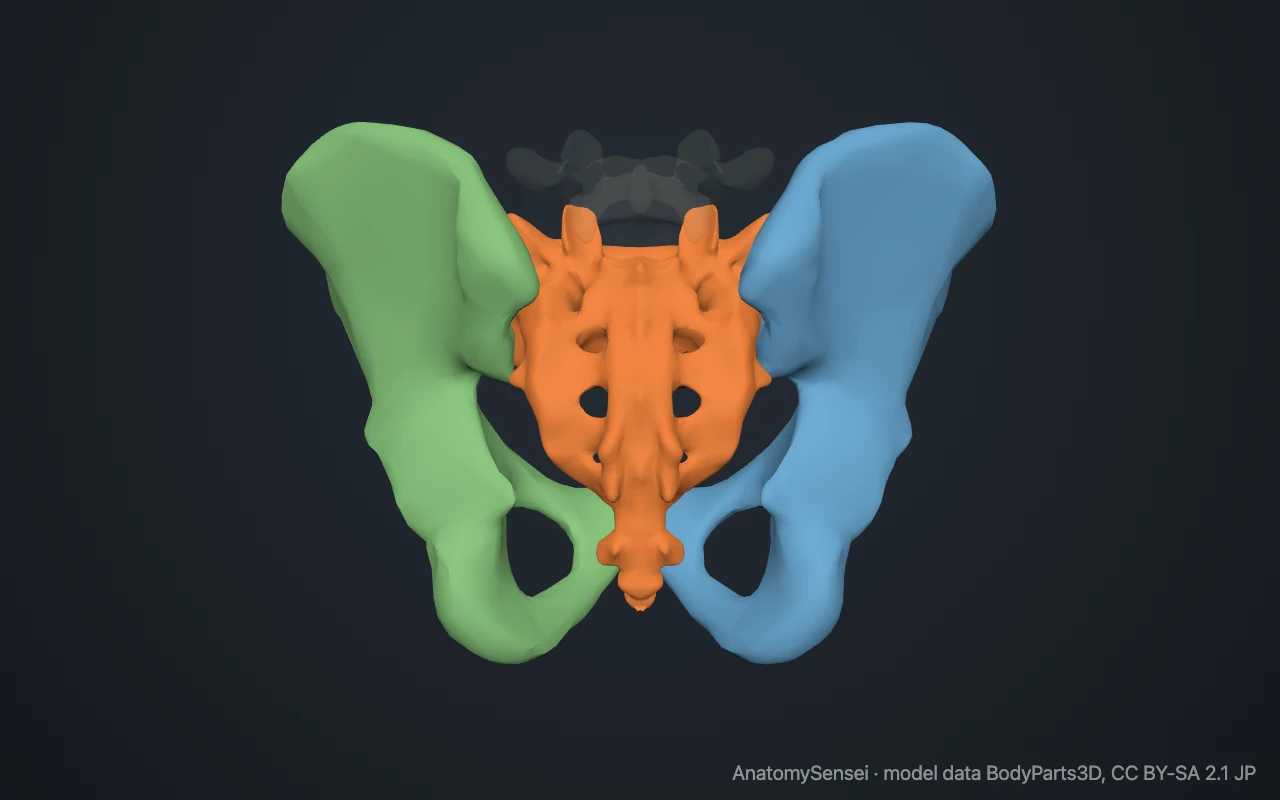
At the front, the two pubic bones meet at the pubic symphysis. A pad of fibrocartilage lies between them. The model shows bones only, so the pad appears as a narrow gap.
Three more joints connect the ring to its neighbours. The lumbosacral joint links the sacrum to the fifth lumbar vertebra, and a hip joint on each side links a hip bone to a femur.
What are the pelvic inlet and outlet?
The pelvic inlet is the upper opening of the ring. Its rim, the pelvic brim, runs from the front edge of the top of the sacrum, around the inside of each hip bone, to the top of the pubic symphysis.
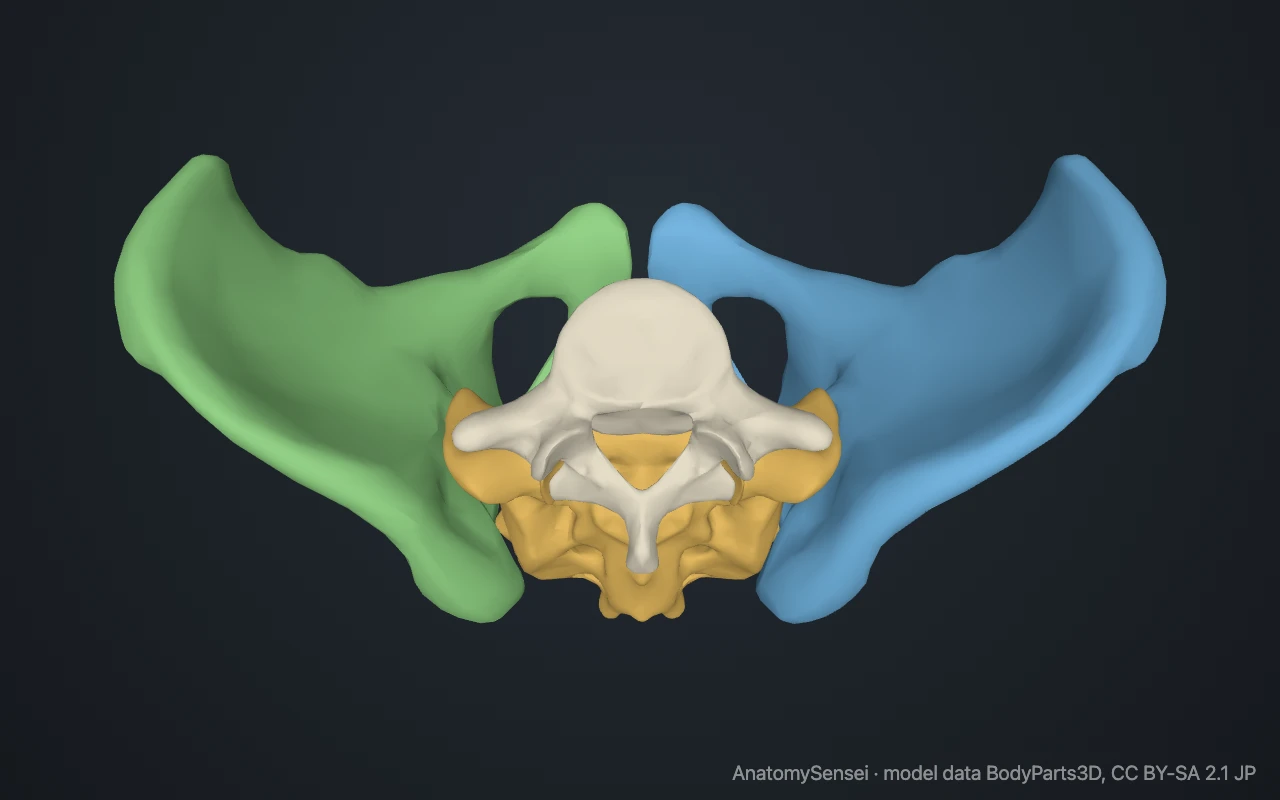
The inlet divides the pelvis in two. Above it, between the flared blades of the ilia, is the greater or false pelvis, which supports the lower abdominal organs. Below it is the lesser or true pelvis, which holds the bladder, the rectum and the internal reproductive organs.
The pelvic outlet is the lower opening. It is bounded by the lower edge of the pubic symphysis in front, the sitting bones at the sides and the tip of the coccyx behind. The muscles of the pelvic floor span it.
How do typical male and female pelves differ?
The pelvis shows more difference between the sexes than any other part of the skeleton. A typical female pelvis is wider, shallower and more open, which leaves room for childbirth. A typical male pelvis is narrower, deeper and more heavily built.
In a typical female pelvis the inlet is a wide oval and the angle beneath the pubic symphysis is broad. In a typical male pelvis the inlet is closer to a heart shape, because the top of the sacrum projects further forward, and the angle beneath the symphysis is narrow.
These are tendencies and not rules. Individual pelves vary, and many show a mixture of features. The model shows a single pelvis and does not compare the two forms.
What does the pelvis do?
Its first job is to carry weight. In standing, the load of the upper body passes from the spine into the sacrum, across the sacroiliac joints and through the hip bones to the femurs. In sitting, it passes to the sitting bones instead.
It also protects and supports the pelvic organs, and its broad surfaces give attachment to the muscles of the abdomen, the back, the buttock and the thigh.
Common problems with the pelvis
Pelvic fractures range from small breaks of the pubic bone after a fall in an older person to breaks of the whole ring after a road accident. Because the pelvis is a closed ring, a major injury often disrupts it in two places.
The sacroiliac joints can be a source of low back and buttock pain, and the pubic symphysis can become painful during pregnancy, when its ligaments soften. This page describes anatomy only.
Free 3D models of the pelvic bones
Common questions
How many bones are in the pelvis?
Three large bones form the ring: the two hip bones and the sacrum. Counting the coccyx gives four.
Is the pelvis the same as the hip?
Not quite. The pelvis is the whole ring of bone. The hip is the joint where the femur meets the socket of a hip bone.
Is the sacrum part of the spine or the pelvis?
Both. It is the lower end of the vertebral column and also the back wall of the pelvic ring.
Does the pelvis move?
The ring itself moves very little at its own joints. The whole pelvis tilts and rotates on the hip joints and the lumbar spine.
Is this 3D model of the bones of the pelvis free?
Yes. The interactive 3D model on this page is free to view and use for study, with no account or download needed. Its geometry comes from the open BodyParts3D data set (CC BY-SA).
About this free 3D model of the bones of the pelvis
The interactive 3D model on this page is free to use in your browser, with no sign-up. It is built from scan-based anatomy data, so every bone is a separate, correctly placed shape you can turn and inspect from any side.