
Hip bone (os coxae)
Os coxae
The hip bone, or os coxae, is the large flat bone on each side of the pelvis. It is formed from three fused parts, the ilium, ischium and pubis, and carries the socket of the hip joint.
Loading 3D model…
Free 3D model of the hip bone. Whole pelvis. Drag to rotate, zoom with + and − (or Ctrl + scroll), click a bone to highlight and name it.
Key points
- Each hip bone is made of three parts that fuse into one: the ilium, ischium and pubis.
- The three parts meet in the acetabulum, the socket for the head of the femur.
- The iliac crest is the rim felt with the hands on the hips, and the ischial tuberosity is the sitting bone.
- The two hip bones join each other at the pubic symphysis and the sacrum at the sacroiliac joints.
What is the hip bone?
The hip bone is the large, irregular bone that forms each side of the pelvis. There are two, a left and a right, and together with the sacrum they complete the pelvic ring.
Its shape is often compared to a propeller. A broad blade fans upward, a second, smaller part twists downward, and the two are joined at a narrow middle where the hip socket sits. Older texts call it the innominate bone, meaning the bone with no name.
Where is the hip bone and how can it be felt?
Each hip bone runs from the waist to the top of the thigh. Behind, it joins the sacrum. In front, it curves round to meet the opposite hip bone in the midline. On its outer side it carries the socket for the thigh bone.
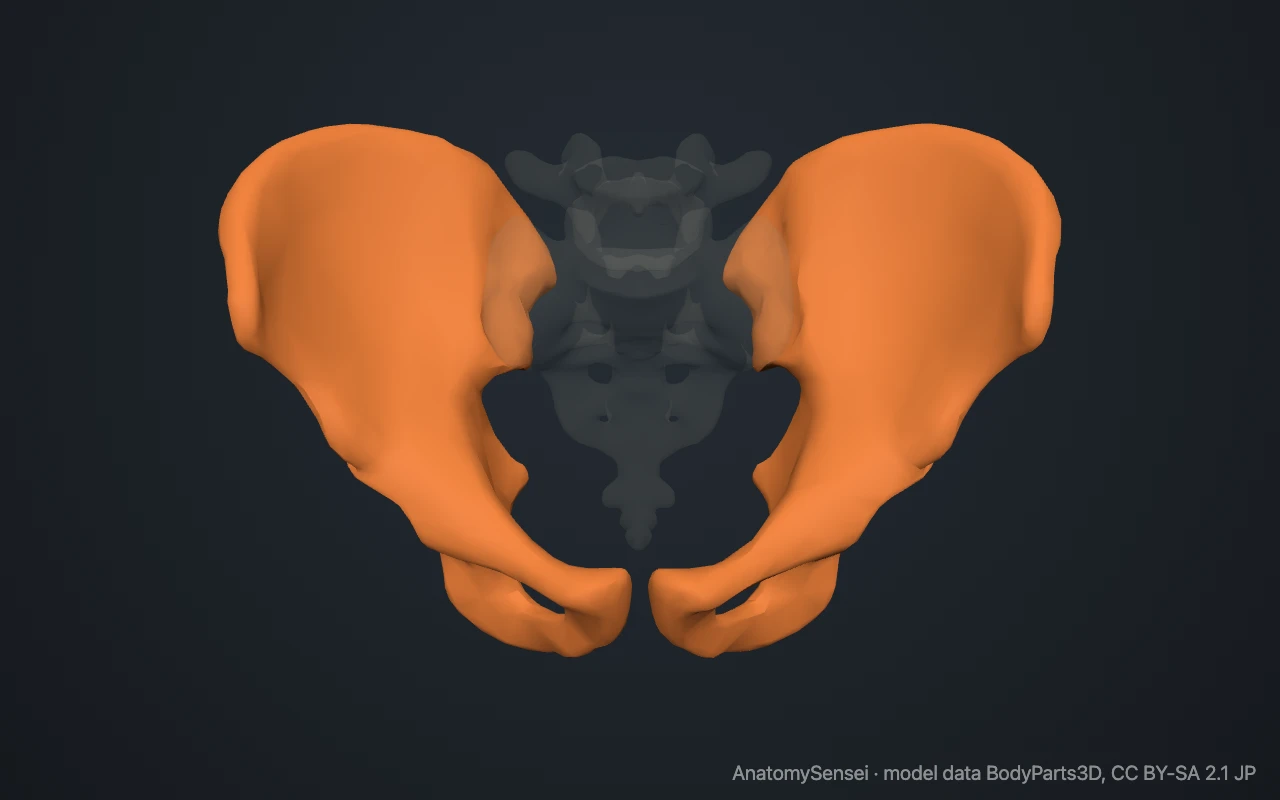
Much of it can be felt. Rest your hands on your hips and the curved ridge under them is the iliac crest. Trace it forward to a bony point at the front of the hip, the anterior superior iliac spine. Trace it backward and it ends beneath a skin dimple on each side of the lower back.
Sit on a hard surface and rock from side to side. The rounded lump you feel under each buttock is the ischial tuberosity.
What are the three parts of the hip bone?
In a child the hip bone is three separate bones joined by a Y-shaped plate of cartilage in the floor of the hip socket. They fuse into one bone during the teenage years. The names are kept for the three regions of the adult bone.
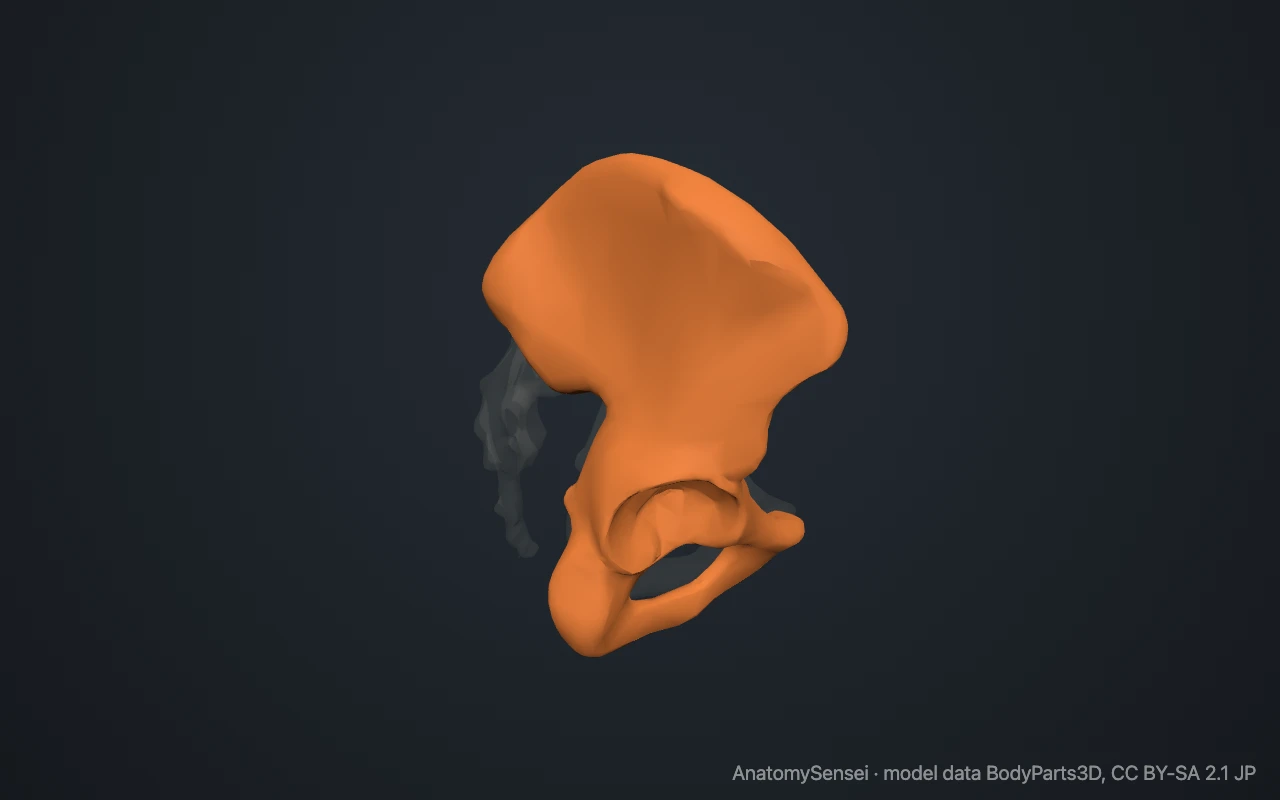
The ilium is the largest part. It forms the wide, fan-shaped blade above the socket and the upper part of the socket itself.
The ischium is the lower back part. It forms the back of the socket and then turns down to the heavy ischial tuberosity. The pubis is the lower front part. It forms the front of the socket and reaches forward to the midline. In the model the hip bone is a single piece, so the three parts are not coloured separately.
What are the main landmarks of the hip bone?
The acetabulum is the deep, cup-shaped socket on the outer side of the bone. Its name means "little vinegar cup". It faces outward, downward and slightly forward, and it holds the head of the femur.
The iliac crest is the thick upper border of the ilium. It runs from the anterior superior iliac spine in front to the posterior superior iliac spine behind. The highest points of the two crests lie at about the level of the fourth lumbar vertebra.
The ischial tuberosity, or sitting bone, is the roughened mass at the lowest point of the ischium. It takes the weight of the body in sitting.
The obturator foramen is the large opening below the socket, ringed by the ischium and the pubis. In life it is almost completely closed by a sheet of fibrous tissue, the obturator membrane. Behind the socket, the back edge of the bone is cut by the deep greater sciatic notch, through which the sciatic nerve leaves the pelvis.
What does the hip bone articulate with?
Each hip bone has three joints. At the back, an ear-shaped surface on the inner side of the ilium meets the sacrum at the sacroiliac joint. This joint moves very little and is built for stability.
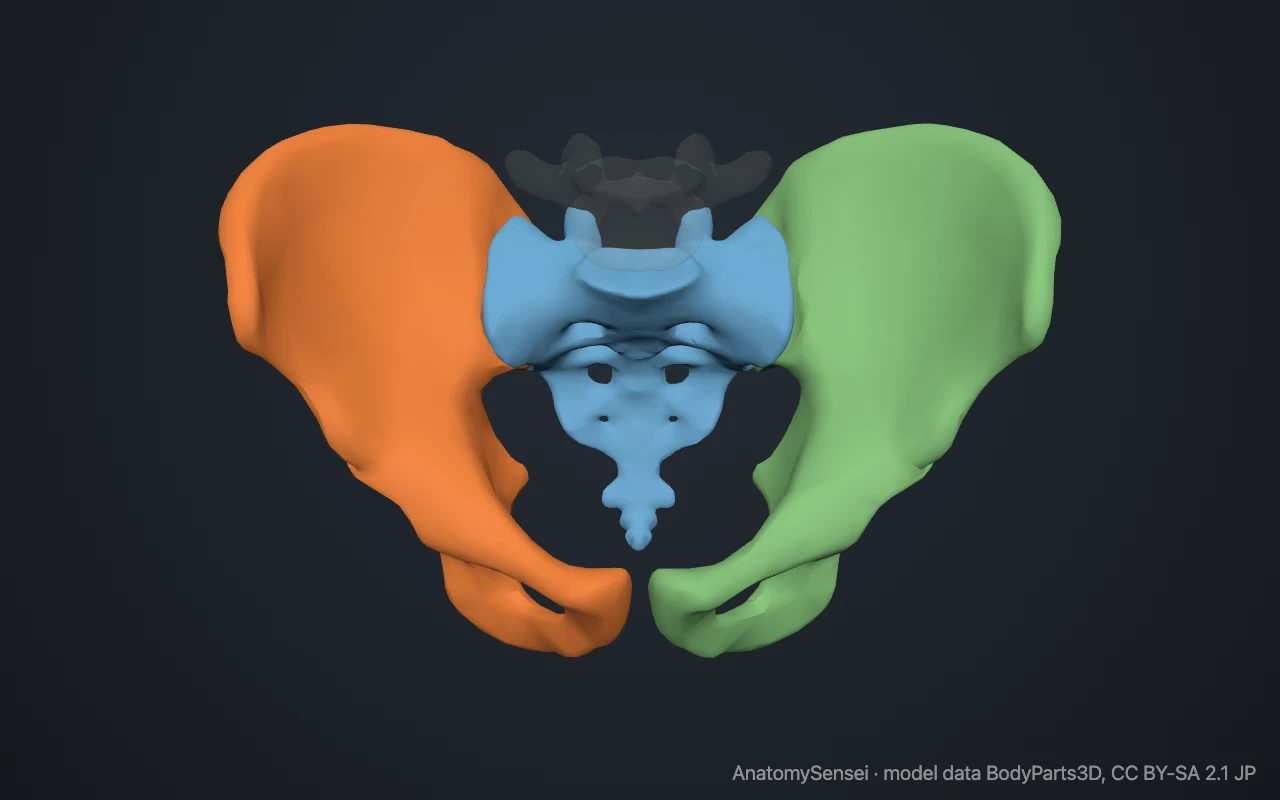
At the front, the two pubic bones meet at the pubic symphysis, with a pad of fibrocartilage between them.
On the outer side, the acetabulum receives the head of the femur to form the hip joint, a ball-and-socket joint. The femur is not part of this model. It is shown on the leg pages.
What attaches to the hip bone?
The broad surfaces of the hip bone anchor many muscles. The gluteal muscles arise from the outer surface of the ilium, and the iliacus muscle lines its inner surface. The muscles of the abdominal wall attach along the iliac crest.
The hamstrings arise from the ischial tuberosity. The adductor muscles of the inner thigh arise from the pubis and the bar of bone that joins it to the ischium.
The inguinal ligament, which marks the crease of the groin, stretches from the anterior superior iliac spine to a small bump on the pubis called the pubic tubercle.
What does the hip bone do?
The hip bone passes body weight from the spine to the leg. Load enters through the sacroiliac joint, travels through the thick bone above the socket and leaves through the acetabulum to the femur.
It also forms the side and front walls of the pelvis, which protect the pelvic organs, and it provides the fixed base from which the large muscles of the hip and thigh pull.
Common problems with the hip bone
Fractures of the pubic rami, the two bars of the pubis, are common in older people after a simple fall. Acetabular fractures involve the socket itself and usually follow a high-energy injury such as a road accident.
In young athletes, a strong muscle contraction can pull off a small piece of bone at its attachment, for example at the ischial tuberosity or the anterior iliac spines. A "hip pointer" is a bruise over the iliac crest. This page describes anatomy only.
Common questions
Is the hip bone one bone or three?
In an adult it is one bone. It forms from three, the ilium, ischium and pubis, which fuse during the teenage years.
Which bone do people sit on?
The ischial tuberosities, one at the bottom of each hip bone. They are often called the sitting bones.
Is the hip bone the same as the pelvis?
No. The pelvis is the whole ring. It is made of two hip bones plus the sacrum.
Why is it called the innominate bone?
The term means "nameless". Early anatomists found it resembled no familiar object and left it without a descriptive name.
Is this 3D model of the hip bone free?
Yes. The interactive 3D model on this page is free to view and use for study, with no account or download needed. Its geometry comes from the open BodyParts3D data set (CC BY-SA).
About this free 3D model of the hip bone
The interactive 3D model on this page is free to use in your browser, with no sign-up. It is built from scan-based anatomy data, so every bone is a separate, correctly placed shape you can turn and inspect from any side.