
Sacrum
Os sacrum
The sacrum is the triangular bone at the base of the spine. It is made of five fused vertebrae and sits between the two hip bones at the back of the pelvis.
Loading 3D model…
Free 3D model of the sacrum. Whole pelvis. Drag to rotate, zoom with + and − (or Ctrl + scroll), click a bone to highlight and name it.
Key points
- The sacrum is a single triangular bone formed from five fused vertebrae.
- Its wide base faces up to carry the fifth lumbar vertebra, and its narrow apex points down to the coccyx.
- It joins the hip bones at the two sacroiliac joints and forms the back wall of the pelvis.
- Four pairs of holes on each surface let the sacral nerves pass through.
What is the sacrum?
The sacrum is a large, wedge-shaped bone formed from five vertebrae that have fused together. The vertebrae are numbered S1 to S5 from the top. They are separate in childhood and fuse gradually, a process that is usually complete by early adulthood.
It belongs to two structures at once. It is the lowest weight-bearing segment of the vertebral column, and it is the back wall of the pelvic ring.
Where is the sacrum and how can it be felt?
The sacrum lies in the midline at the very bottom of the back, below the lumbar spine and between the two buttocks. It is tilted, so its upper end leans forward and its front surface faces downward as well as forward.
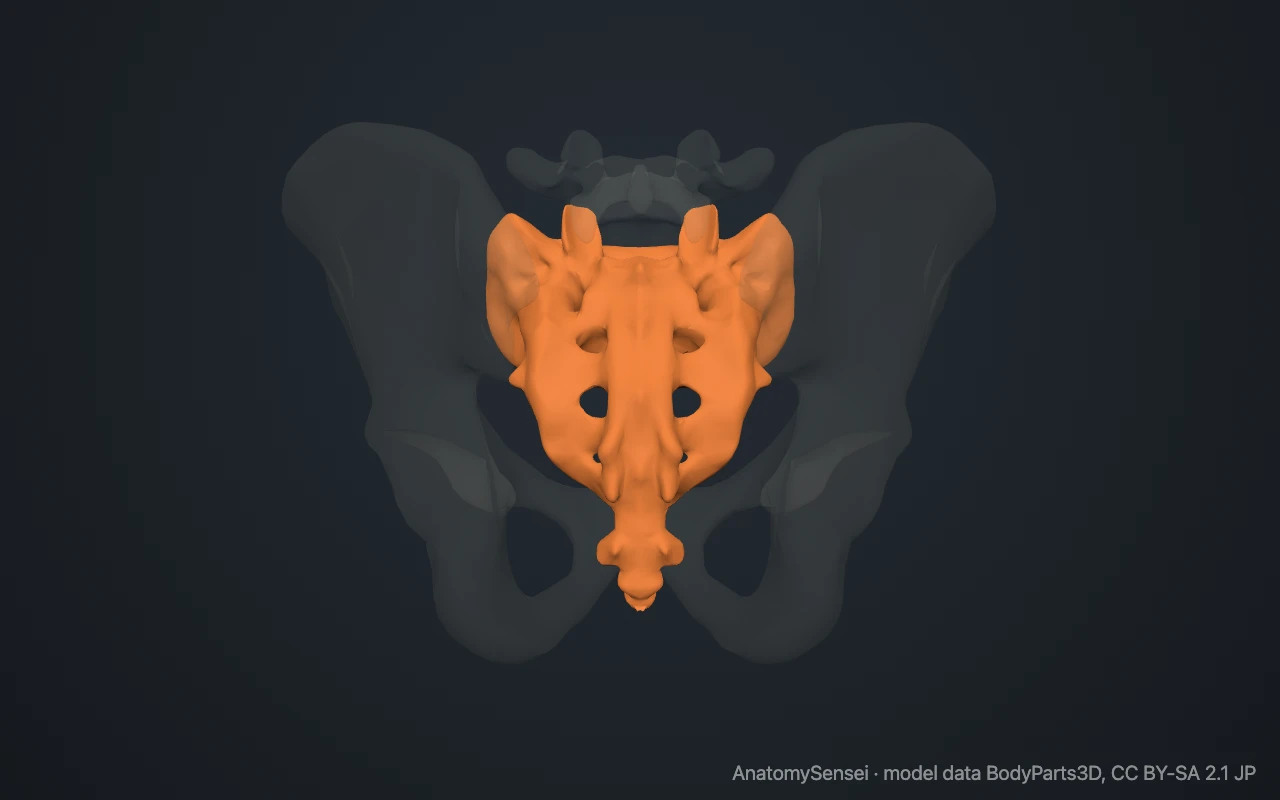
Its back surface lies just under the skin. Find the two dimples on either side of the lower back, which mark the back ends of the iliac crests. The flat, bony area between and below them is the sacrum. Follow it down toward the cleft of the buttocks and it narrows to meet the tailbone.
What are the parts of the sacrum?
The sacrum is a triangle turned upside down. Its wide upper end is the base. The oval surface in the middle of the base is the top of the first sacral vertebra, and it carries the disc beneath the fifth lumbar vertebra.
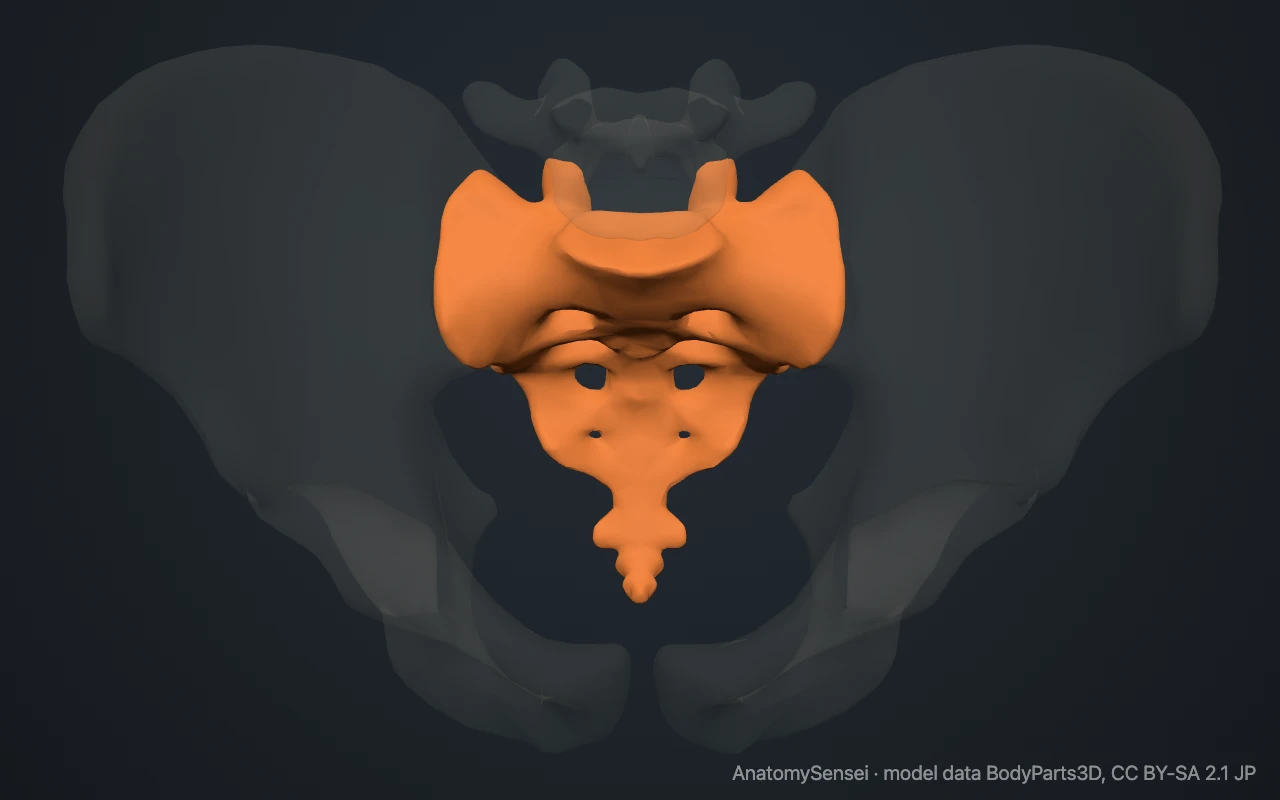
The front edge of that surface juts forward as the sacral promontory. It forms the back of the pelvic brim. On each side of it the base spreads out into a wing of bone called the ala.
The narrow lower end is the apex, which meets the coccyx. Between base and apex, the front or pelvic surface is smooth and hollow. Four faint ridges cross it and mark where the five vertebrae fused.
What are the sacral foramina?
On each side of the ridges, the front surface has four openings, the anterior sacral foramina. The back surface has four matching pairs, the posterior sacral foramina. Branches of the sacral spinal nerves leave the bone through them.
The foramina open from the sacral canal, the continuation of the vertebral canal, which runs down inside the bone. The canal holds the lowest nerve roots. It ends near the lower tip of the sacrum at a gap in the back wall called the sacral hiatus.
The back surface is rough. A ridge in the midline, the median sacral crest, is formed by the fused spinous processes of the sacral vertebrae.
What does the sacrum articulate with?
Above, the sacrum meets the fifth lumbar vertebra at the lumbosacral joint. A disc lies between the two vertebral bodies, and a pair of small facet joints links them behind.
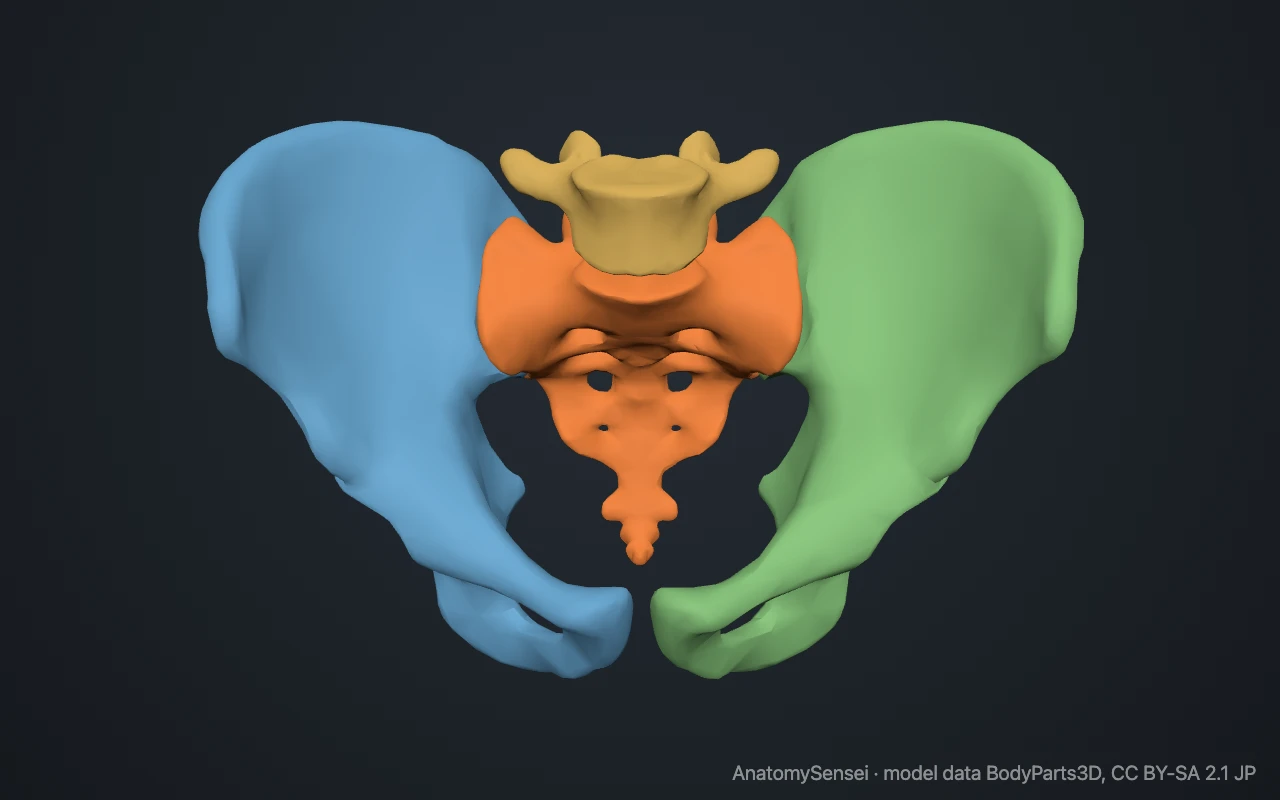
On each side, an ear-shaped surface called the auricular surface meets the ilium of the hip bone at the sacroiliac joint. The surfaces are uneven and interlock, and very strong ligaments bind them, so the joint allows only slight movement.
Below, the apex meets the coccyx at the sacrococcygeal joint.
What is the coccyx, or tailbone?
The coccyx is the small, tapering bone at the very end of the spine, attached below the apex of the sacrum. It is usually made of four tiny vertebrae, though three or five also occur. They are often partly or wholly fused.
It is the remnant of a tail. Despite its size it is useful. It gives attachment to muscles and ligaments of the pelvic floor, and it shares the load with the two sitting bones when a person sits and leans back.
The model on this page does not include a separate coccyx. The lowest point of the highlighted bone is the lower end of the sacrum, and the coccyx would continue below it.
What attaches to the sacrum?
The piriformis muscle arises from the front surface and passes out of the pelvis to the top of the femur. The deep muscles of the back and part of gluteus maximus arise from the back surface.
Strong ligaments run from the sides of the sacrum to the ischium of each hip bone. These are the sacrotuberous and sacrospinous ligaments. They stop the lower end of the sacrum from tipping backward under the weight of the body.
What does the sacrum do?
The sacrum passes the weight of the upper body from the spine to the pelvis. It is wedged between the hip bones like the keystone of an arch, and the load crosses the two sacroiliac joints to reach the legs.
It also protects the sacral nerves that run inside it and forms the back wall of the pelvic cavity.
Common problems with the sacrum and coccyx
Sacral fractures occur with major pelvic injuries. In older people with weakened bone, an insufficiency fracture can develop in the ala without a significant injury. Pain from the sacroiliac joint is felt over the back of the pelvis and the buttock.
In some people the fifth lumbar vertebra is partly or fully fused to the sacrum. This is called sacralisation and is a variation of normal. Coccydynia is pain at the tailbone, often after a fall onto the buttocks or after childbirth. This page describes anatomy only.
Common questions
How many vertebrae make up the sacrum?
Five. They are numbered S1 to S5 and are fused into a single bone in adults.
Is the sacrum the same as the tailbone?
No. The tailbone is the coccyx, a separate small bone attached below the sacrum.
Why is the sacrum curved?
Its hollow front surface adds room to the pelvic cavity. The curve is usually flatter in a typical female sacrum and more pronounced in a typical male one.
What does the word sacrum mean?
It comes from the Latin os sacrum, "sacred bone". The reason for the name is uncertain.
Is this 3D model of the sacrum free?
Yes. The interactive 3D model on this page is free to view and use for study, with no account or download needed. Its geometry comes from the open BodyParts3D data set (CC BY-SA).
About this free 3D model of the sacrum
The interactive 3D model on this page is free to use in your browser, with no sign-up. It is built from scan-based anatomy data, so every bone is a separate, correctly placed shape you can turn and inspect from any side.