
Rib cage (thoracic cage)
Cavea thoracis
The rib cage, or thoracic cage, is the bony frame of the chest. It is made of 12 pairs of ribs, the sternum in front and the 12 thoracic vertebrae behind.
Loading 3D model…
Free 3D model of the bones of the thorax. Whole rib cage. Drag to rotate, zoom with + and − (or Ctrl + scroll), click a bone to highlight and name it.
- Ribs
- Sternum
- Thoracic vertebrae
Key points
- The rib cage has 37 bones: 24 ribs, the sternum and 12 thoracic vertebrae.
- Every rib joins the spine behind, but only the first seven pairs reach the sternum directly.
- It shields the heart and lungs and also covers the liver, spleen and part of the kidneys.
- The ribs swing up and out on each breath in, which makes the chest larger.
What is the rib cage?
The rib cage is the bony cage that forms the wall of the chest. Anatomists call it the thoracic cage. It surrounds the thoracic cavity, the space that holds the heart and the lungs.
It is shaped like a barrel that is narrow at the top and wide at the bottom, and it is slightly flattened from front to back. It is not rigid. Its many small joints and its flexible cartilages let it change shape with every breath.
Which bones make up the rib cage?
Three groups of bones build the cage. There are 12 pairs of ribs, which makes 24 ribs in total. In front is the sternum, or breastbone, which has three parts: the manubrium, the body and the xiphoid process.
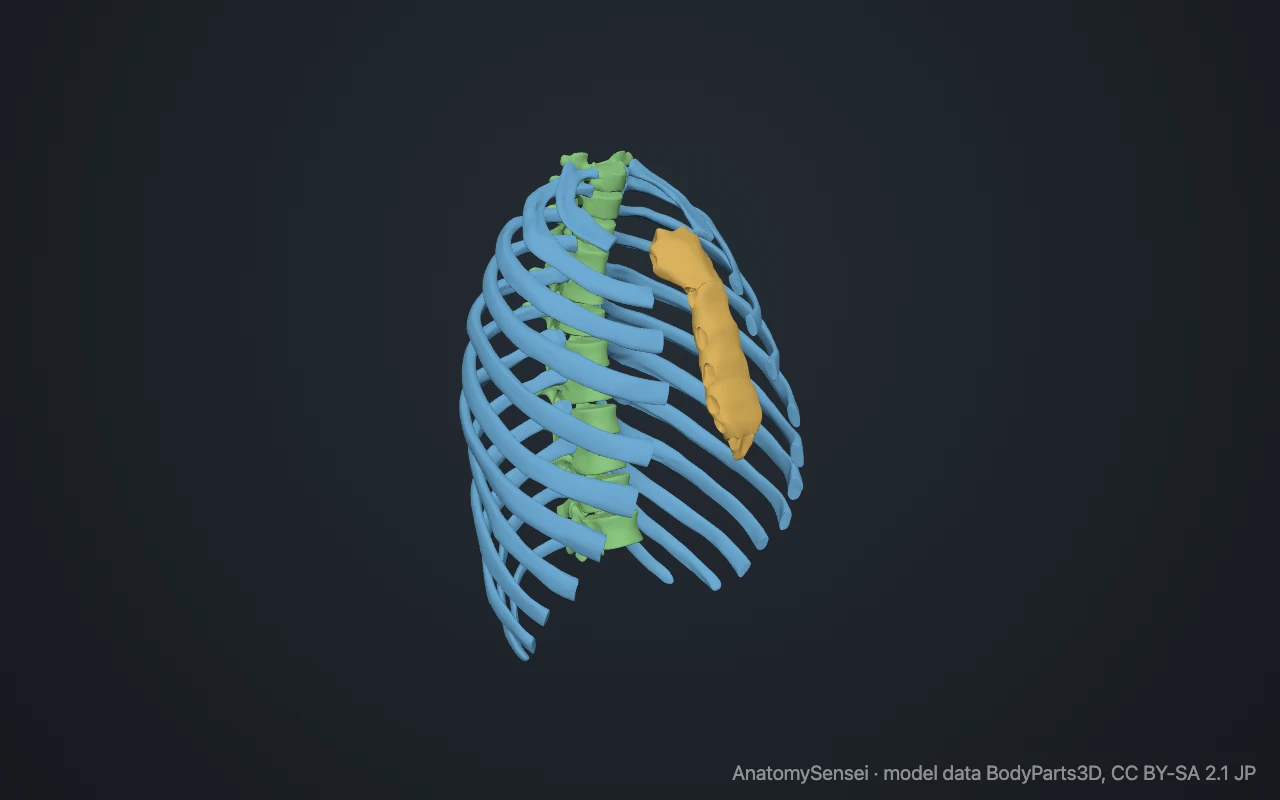
At the back are the 12 thoracic vertebrae, the middle section of the spine. Each pair of ribs is numbered after the vertebra it joins, so the first ribs meet the first thoracic vertebra and the twelfth ribs meet the twelfth.
In the living body, bars of cartilage called costal cartilages link the front ends of the ribs to the sternum. The model on this page shows bones only. It has no cartilage, so the ribs appear to stop short of the sternum.
How do the ribs attach at the front and back?
At the back, every rib joins the spine. The head of the rib meets the bodies of the vertebrae, and on most ribs a small bump called the tubercle also rests against the side process of the vertebra.
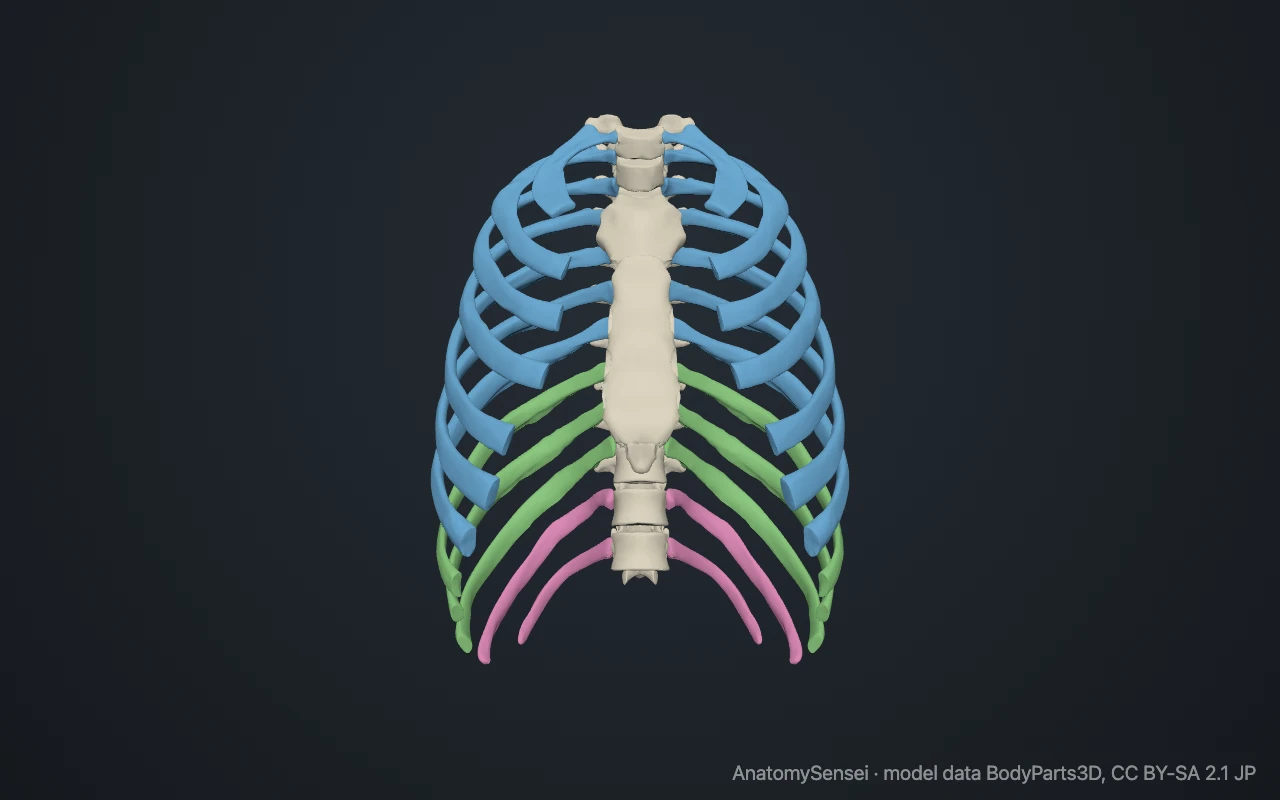
At the front the ribs differ. Ribs 1 to 7 are the true ribs. Each has its own cartilage that runs straight to the sternum. Ribs 8 to 10 are the false ribs. Their cartilages join the cartilage of the rib above instead. Ribs 11 and 12 are the floating ribs, which end freely in the muscles of the abdominal wall.
What are the openings at the top and bottom?
The cage is open at both ends. The small upper opening is ringed by the first thoracic vertebra, the first pair of ribs and the top of the manubrium. The windpipe, the gullet and the large vessels of the neck and arms pass through it.
The lower opening is much wider. It is bounded by the twelfth thoracic vertebra, the floating ribs, the curved lower edge of the rib cartilages and the xiphoid process. The diaphragm is attached around this rim and closes the chest off from the abdomen.
What does the rib cage protect?
Its first job is to guard the heart, the lungs and the great vessels that enter and leave the heart. The sternum lies directly in front of the heart, and the ribs wrap around the lungs on each side.
Because the diaphragm domes upward into the cage, the lower ribs also cover organs of the upper abdomen. These include the liver on the right, the spleen on the left and the upper parts of both kidneys at the back.
How does the rib cage move in breathing?
Each rib hinges on the spine at its rear end. On a breath in, the muscles between the ribs lift them. The upper ribs raise the sternum forward and upward, a movement compared to a pump handle. It makes the chest deeper from front to back.
The lower ribs swing outward like the handle of a bucket, which makes the chest wider. At the same time the diaphragm flattens and moves down. The chest gets larger in all three directions and air is drawn into the lungs. On a quiet breath out, the ribs sink back as the lungs recoil.
How can you feel your own rib cage?
Much of it lies just under the skin. Run a finger down the middle of your chest and you are on the sternum. The dip at its top, between the collarbones, is the jugular notch. A few centimetres lower is a low ridge across the bone, the sternal angle, which marks the level of the second ribs.
From there you can count the ribs downward along the side of the chest. The curved edge you feel where the chest meets the abdomen is the costal margin, formed by the cartilages of ribs 7 to 10.
Common problems of the rib cage
Rib fractures are the most common injury and usually follow a blow or a fall. Several ribs broken in two places can leave a loose section of chest wall, called a flail chest. The sternum can also fracture, typically from a direct impact to the front of the chest.
Pain where the ribs meet their cartilages is called costochondritis. Differences in shape also occur, such as a sunken breastbone (pectus excavatum) or a protruding one (pectus carinatum). This page describes anatomy only.
Free 3D models of the ribs and sternum
Common questions
How many bones are in the rib cage?
37. There are 24 ribs, one sternum and 12 thoracic vertebrae. The sternum itself forms from three parts that may fuse with age.
Do men and women have the same number of ribs?
Yes. Both normally have 12 pairs. A few people of either sex have an extra rib or a missing one as a normal variant.
Is the rib cage all bone?
No. The front ends of the ribs are completed by costal cartilage, which makes the cage springy. The 3D model shows only the bones.
Why do the ribs in the model not touch the sternum?
Because the costal cartilages that bridge the gap are not part of the model. In the body, ribs 1 to 7 reach the sternum through these cartilages.
Is this 3D model of the bones of the thorax free?
Yes. The interactive 3D model on this page is free to view and use for study, with no account or download needed. Its geometry comes from the open BodyParts3D data set (CC BY-SA).
About this free 3D model of the bones of the thorax
The interactive 3D model on this page is free to use in your browser, with no sign-up. It is built from scan-based anatomy data, so every bone is a separate, correctly placed shape you can turn and inspect from any side.