
Xiphoid process
Processus xiphoideus
The xiphoid process is the small, pointed lower end of the sternum, or breastbone. It is the smallest of the three parts and is made of cartilage in youth, turning to bone in adult life.
Loading 3D model…
Free 3D model of the xiphoid process. Whole rib cage. Drag to rotate, zoom with + and − (or Ctrl + scroll), click a bone to highlight and name it.
Key points
- The xiphoid process is the tip at the bottom of the breastbone.
- It is the smallest and most variable part of the sternum.
- It begins as cartilage and slowly turns to bone during adulthood.
- The diaphragm and the abdominal muscles attach to it.
What is the xiphoid process?
The xiphoid process is the lowest and smallest part of the sternum. The word xiphoid comes from the Greek for sword-shaped. It is also called the xiphisternum.
It is thin and flat and tapers downward. Unlike the manubrium and the body, no ribs attach to it, although the seventh rib cartilage joins the sternum right beside its upper end.
Where is the xiphoid process?
It lies in the midline where the chest meets the abdomen, in the angle between the right and left costal margins. Its joint with the body of the sternum is at about the level of the ninth thoracic vertebra.
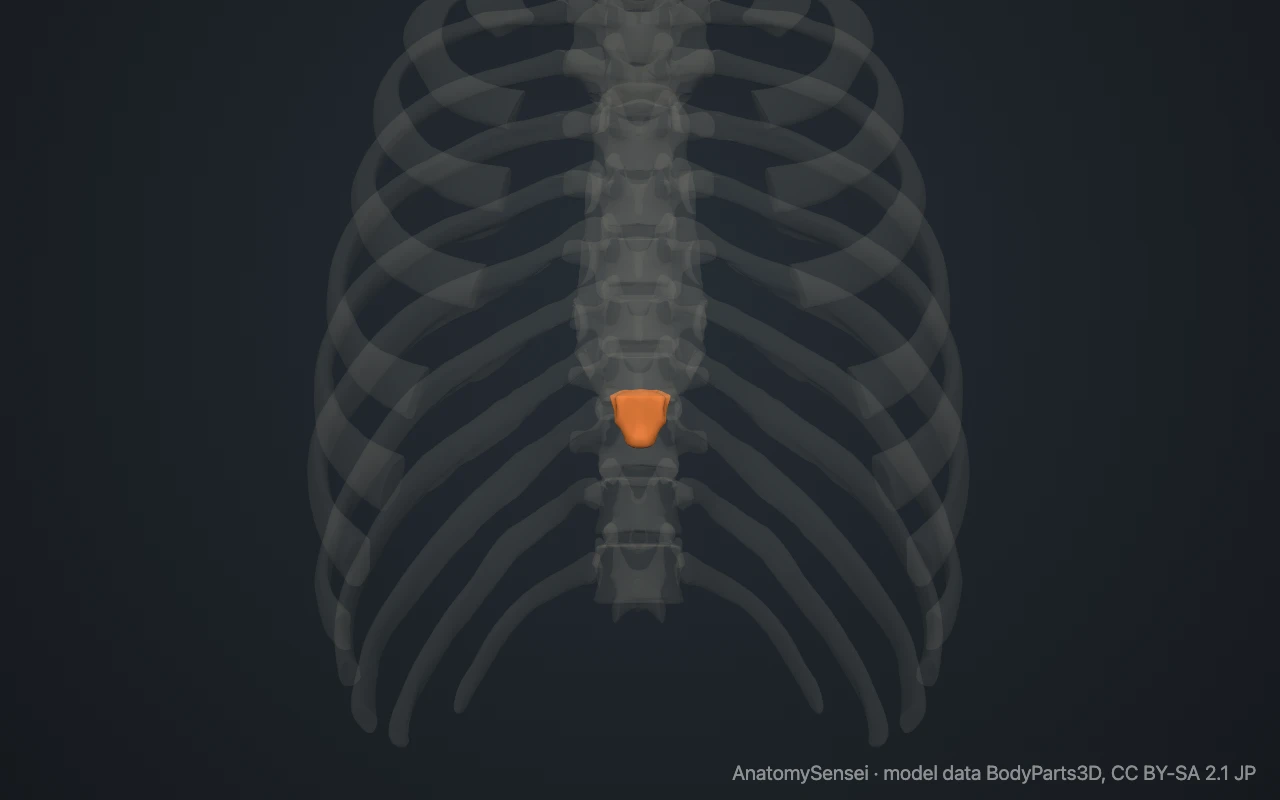
To find it, run a finger down the middle of your breastbone until the firm bone gives way to a soft hollow, often called the pit of the stomach. The small firm point at the top of that hollow is the xiphoid process. Press gently, because it can be tender.
What shape is the xiphoid process?
Its shape varies more than any other part of the sternum. It may be pointed, blunt, forked into two tips or pierced by a small hole. It may point straight down, curve forward or bend to one side.
These are normal differences between people. A xiphoid that tilts forward can be felt, or even seen, as a small lump under the skin at the top of the abdomen.
Is the xiphoid process bone or cartilage?
Both, depending on age. In children and young adults it is a plate of cartilage. Bone forms within it gradually during adult life, typically from the middle upward.
It is joined to the body of the sternum by cartilage at the xiphisternal joint. In later life this joint usually turns to bone as well, so that the xiphoid and the body become one piece.
What does the xiphoid process articulate with?
Its only joint is with the lower end of the body of the sternum. The cartilage of the seventh rib attaches at the corner where the two meet, and may touch the xiphoid slightly.
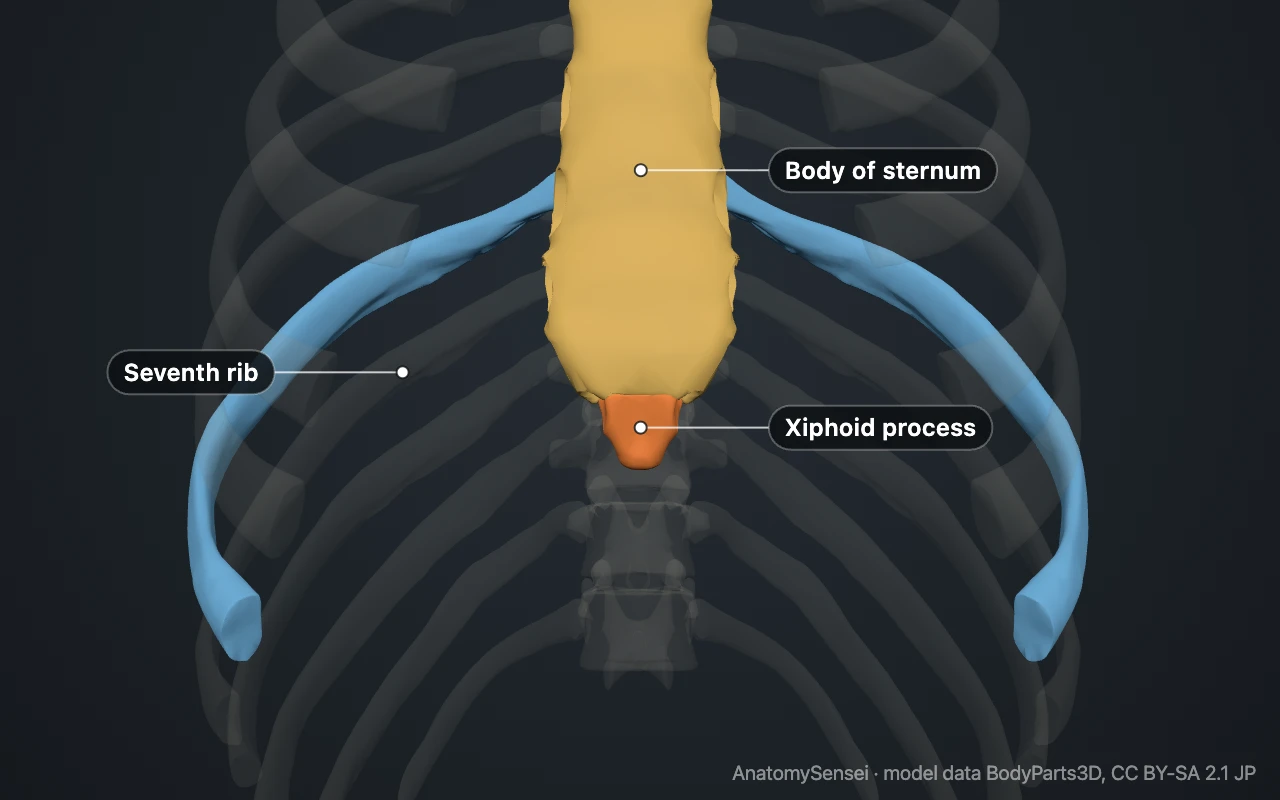
The model shows bone only. The seventh ribs therefore end well short of the sternum, and the cartilages that frame the xiphoid on each side are not drawn.
What attaches to the xiphoid process?
Despite its size it is a meeting point for several muscles. The diaphragm attaches to its back surface by two small slips. The rectus abdominis, the long muscle down the front of the abdomen, attaches partly to its front.
The linea alba, the fibrous seam down the middle of the abdominal wall, begins at the xiphoid process. The flat tendons of the other abdominal muscles blend into it there.
What does the xiphoid process do?
Its main role is as an anchor for the diaphragm and the abdominal wall. It adds little to the protection of the chest.
It is also a surface landmark. It marks the lower limit of the front of the chest cavity and the lower border of the heart, with the liver lying just beneath. In chest compressions, the hands are placed higher on the sternum so that pressure does not fall on the xiphoid.
Common problems with the xiphoid process
Pain and tenderness over the xiphoid is called xiphodynia, or xiphoid syndrome. The process can also be bent or broken by a blow to the lower chest.
A prominent xiphoid is often noticed for the first time in adulthood, for example after weight loss, and may be mistaken for a new lump. This page describes anatomy only.
Common questions
How do you pronounce xiphoid?
Usually "ZY-foyd" or "ZIF-oyd". Both are in common use.
Can you feel your xiphoid process?
Yes, in most people. It is the small firm point at the very bottom of the breastbone, above the soft upper abdomen.
At what age does the xiphoid process turn to bone?
There is no fixed age. It hardens gradually through adult life and the timing differs widely between people.
Do any ribs attach to the xiphoid process?
No. The seventh rib cartilage joins the sternum beside its upper end, but the xiphoid itself carries no ribs.
Is this 3D model of the xiphoid process free?
Yes. The interactive 3D model on this page is free to view and use for study, with no account or download needed. Its geometry comes from the open BodyParts3D data set (CC BY-SA).
About this free 3D model of the xiphoid process
The interactive 3D model on this page is free to use in your browser, with no sign-up. It is built from scan-based anatomy data, so every bone is a separate, correctly placed shape you can turn and inspect from any side.