
Bones of the foot
Ossa pedis
Each human foot has 26 bones: 7 tarsal bones, 5 metatarsal bones and 14 phalanges. Two small sesamoid bones under the big toe are almost always present as well.
Loading 3D model…
Free 3D model of the foot bones. Right foot. Drag to rotate, zoom with + and − (or Ctrl + scroll), click a bone to highlight and name it.
- Tarsal bones (7)
- Metatarsal bones (5)
- Phalanges (14)
- Sesamoid bones (2)
Key points
- Each foot has 26 bones, or 28 counting the two sesamoids under the big toe.
- They fall into three groups: 7 tarsals, 5 metatarsals and 14 phalanges.
- The foot is also described in three parts: hindfoot, midfoot and forefoot.
- The bones form three arches that absorb load and stiffen the foot for push-off.
How many bones are in the foot?
Each foot has 26 bones. Both feet together hold 52, about a quarter of the 206 bones in the adult body.
Two small sesamoid bones under the big toe joint are present in almost everyone, which is why some sources give the count as 28. A few people also have extra, harmless accessory bones that formed separately during growth.
The three groups of foot bones
Anatomists sort the foot bones by shape and position. The 7 tarsal bones are short, blocky bones at the back. The 5 metatarsals are long bones in the middle. The 14 phalanges are the small bones of the toes.
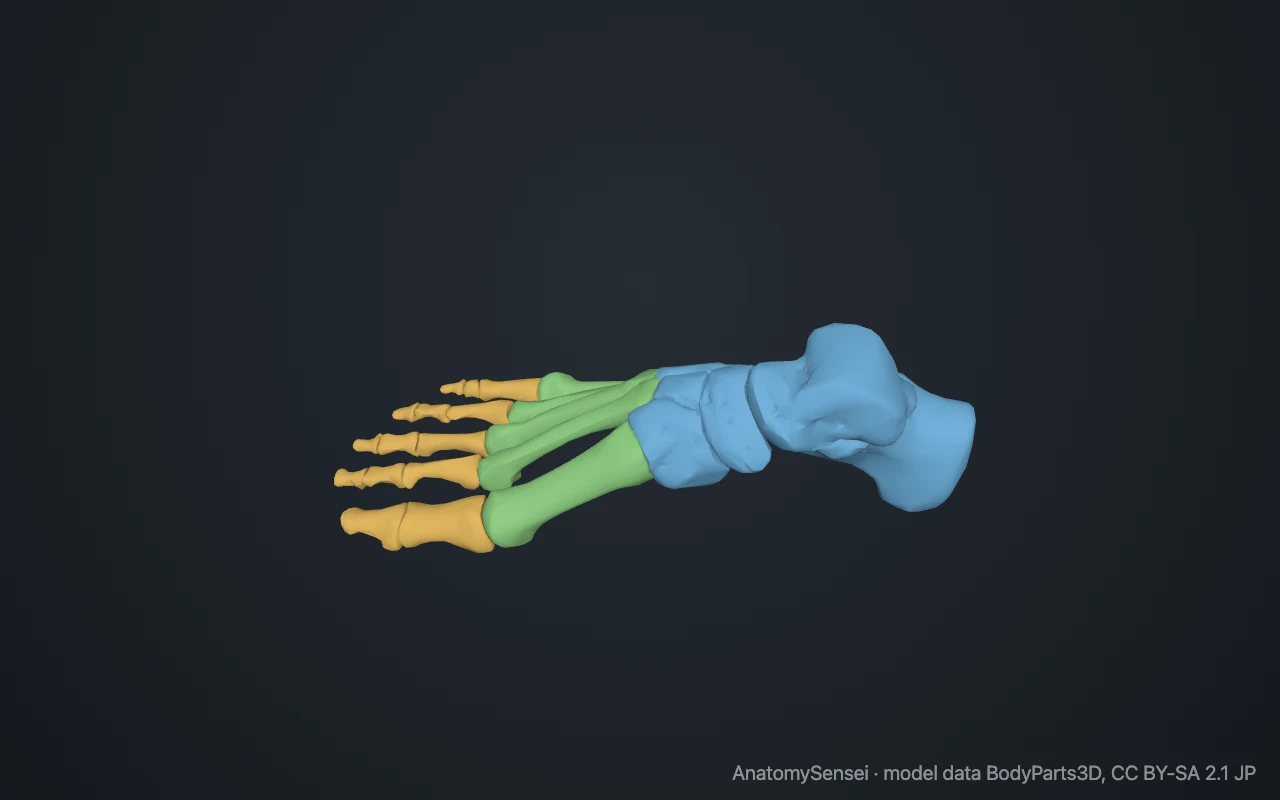
The same pattern appears in the hand, where the matching groups are the carpals, metacarpals and phalanges. The foot versions are larger and less mobile because they carry body weight.
The tarsal bones
The talus sits on top and joins the foot to the leg. Beneath it, the calcaneus forms the heel and is the largest bone in the foot.
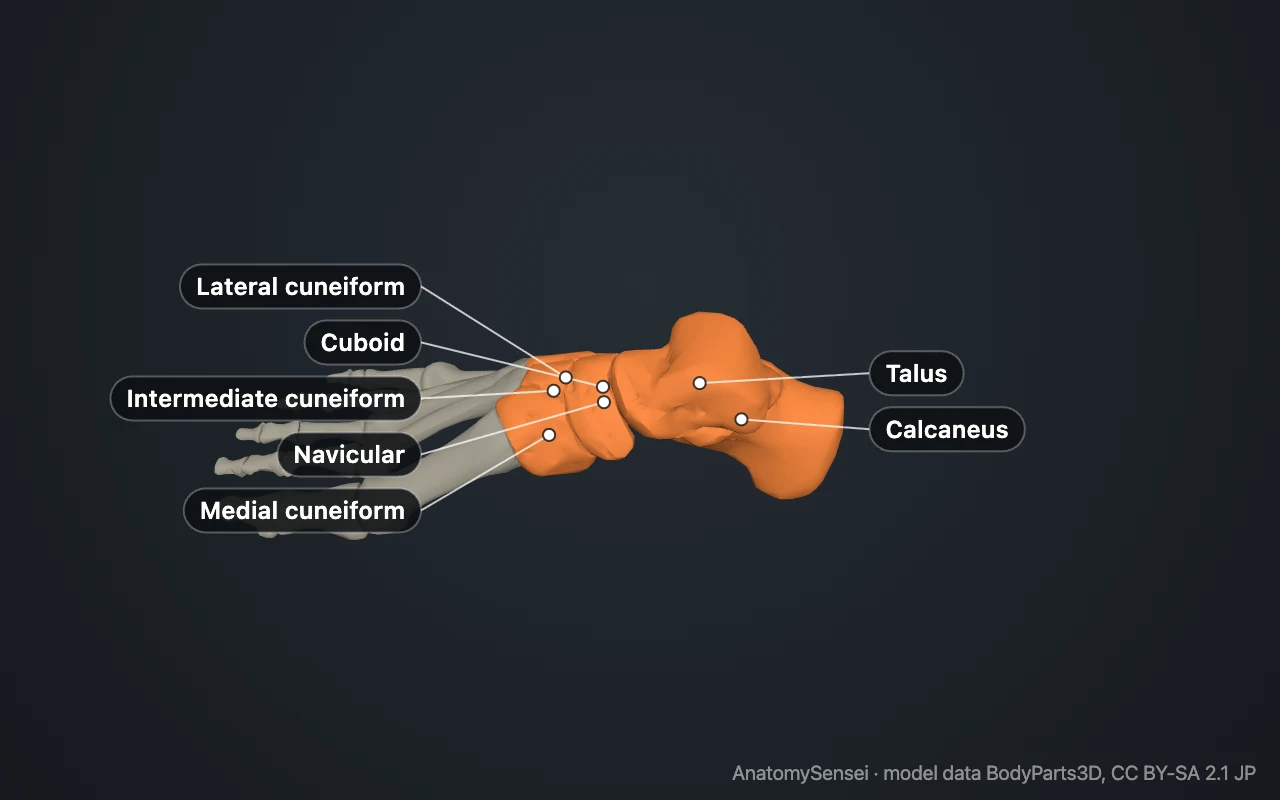
In front of the talus is the boat-shaped navicular, and in front of that the three wedge-shaped cuneiforms. On the outer side, the cuboid connects the heel bone to the outer two metatarsals.
The metatarsal bones
Five metatarsals run forward from the midfoot to the toes. They are numbered one to five starting at the big toe. Each has a base at the back, a shaft, and a rounded head at the front.
The five heads together form the ball of the foot. The first metatarsal is the shortest and thickest, the second is the longest, and the fifth has a bump at its base that you can feel on the outer edge of the foot.
The phalanges
The toe bones are called phalanges. The big toe has two, a proximal and a distal phalanx. The other four toes have three each: proximal, middle and distal.
That is why the big toe bends in one place and the smaller toes bend in two.
Hindfoot, midfoot and forefoot
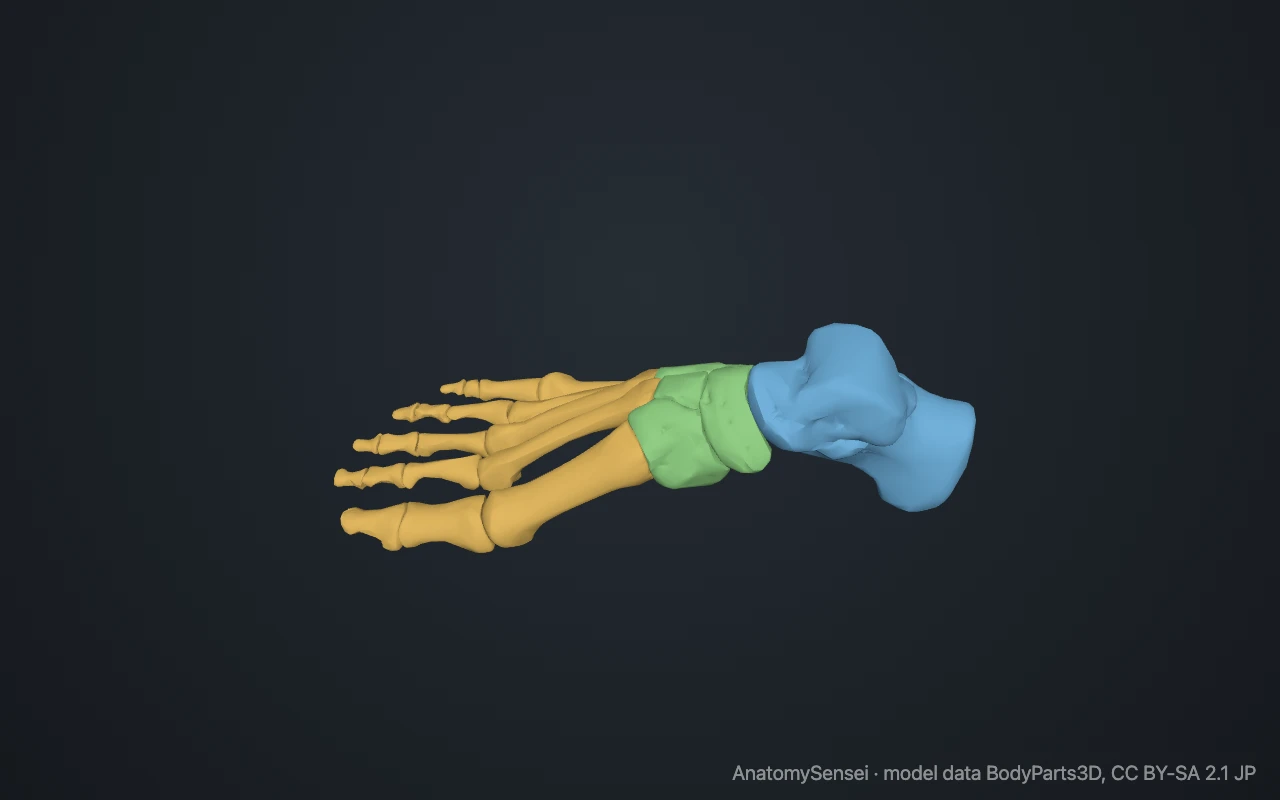
Clinicians often divide the foot by region instead of by bone type. The hindfoot is the talus and calcaneus. The midfoot is the navicular, cuboid and three cuneiforms. The forefoot is the metatarsals and phalanges.
The arches of the foot
The bones do not lie flat. They are held in three arches by their shapes, by ligaments and by tendons. The medial longitudinal arch on the inner side is the highest. It runs from the calcaneus through the talus, navicular and cuneiforms to the first three metatarsals.
The lateral longitudinal arch on the outer side is lower and runs through the cuboid to the fourth and fifth metatarsals. The transverse arch crosses the midfoot from side to side. Together they spread load when the foot lands and turn it into a stiff lever for push-off.
Which foot bones can you feel?
Several landmarks sit just under the skin. The back of the heel is the calcaneus. The bump on the inner side of the foot, a little in front of the ankle, is the tuberosity of the navicular. The bump halfway along the outer edge is the base of the fifth metatarsal. The ridges on top of the foot leading to each toe are the metatarsal shafts.
The two ankle bumps are not foot bones. They are the lower ends of the tibia and fibula, the bones of the leg.
Free 3D models of every foot bone
- Tarsal bones 3D model
- Metatarsal bones 3D model
- Talus 3D model
- Calcaneus 3D model
- Parts of the foot 3D model
- Sesamoid bones of the foot 3D model
- Navicular bone 3D model
- Cuneiform bones 3D model
- Cuboid bone 3D model
- Fifth metatarsal 3D model
- Phalanges of the foot 3D model
- First metatarsal 3D model
- Metatarsophalangeal joints 3D model
- Subtalar joint 3D model
- Bottom of the foot 3D model
- Top of the foot 3D model
- Tarsometatarsal joints 3D model
- Toe joints 3D model
- Transverse tarsal joint 3D model
- Medial cuneiform 3D model
- Intermediate cuneiform 3D model
- Lateral cuneiform 3D model
- Second metatarsal 3D model
- Third metatarsal 3D model
- Fourth metatarsal 3D model
Common questions
What is the largest bone in the foot?
The calcaneus, or heel bone.
How many bones are in both feet?
52, or 56 if the sesamoid bones are counted.
What are the toe bones called?
Phalanges. One of them is a phalanx.
Are the ankle bones part of the foot?
One is. The talus is a foot bone that forms the lower half of the ankle joint. The two bumps at the ankle belong to the tibia and fibula.
How many joints are in the foot?
About 33, counting the small joints between the tarsal bones and those in the toes.
Is this 3D model of the foot bones free?
Yes. The interactive 3D model on this page is free to view and use for study, with no account or download needed. Its geometry comes from the open BodyParts3D data set (CC BY-SA).
About this free 3D model of the foot bones
The interactive 3D model on this page is free to use in your browser, with no sign-up. It is built from scan-based anatomy data, so every bone is a separate, correctly placed shape you can turn and inspect from any side.