
Second metatarsal
Os metatarsi II
The second metatarsal is the long bone leading to the second toe. It is the longest of the five metatarsals and the least mobile.
Loading 3D model…
Free 3D model of the second metatarsal. Right foot. Drag to rotate, zoom with + and − (or Ctrl + scroll), click a bone to highlight and name it.
Key points
- The second metatarsal leads to the second toe.
- It is the longest metatarsal.
- Its base is locked between the cuneiforms, so it moves least.
- It is a classic site for stress fractures.
What is the second metatarsal?
The second metatarsal is the long bone that leads to the second toe. It is the longest of the five metatarsals and the most firmly fixed.
Where is the second metatarsal?
It lies next to the first metatarsal, in line with the second toe. Its shaft is the ridge you can feel on top of the foot running to that toe.
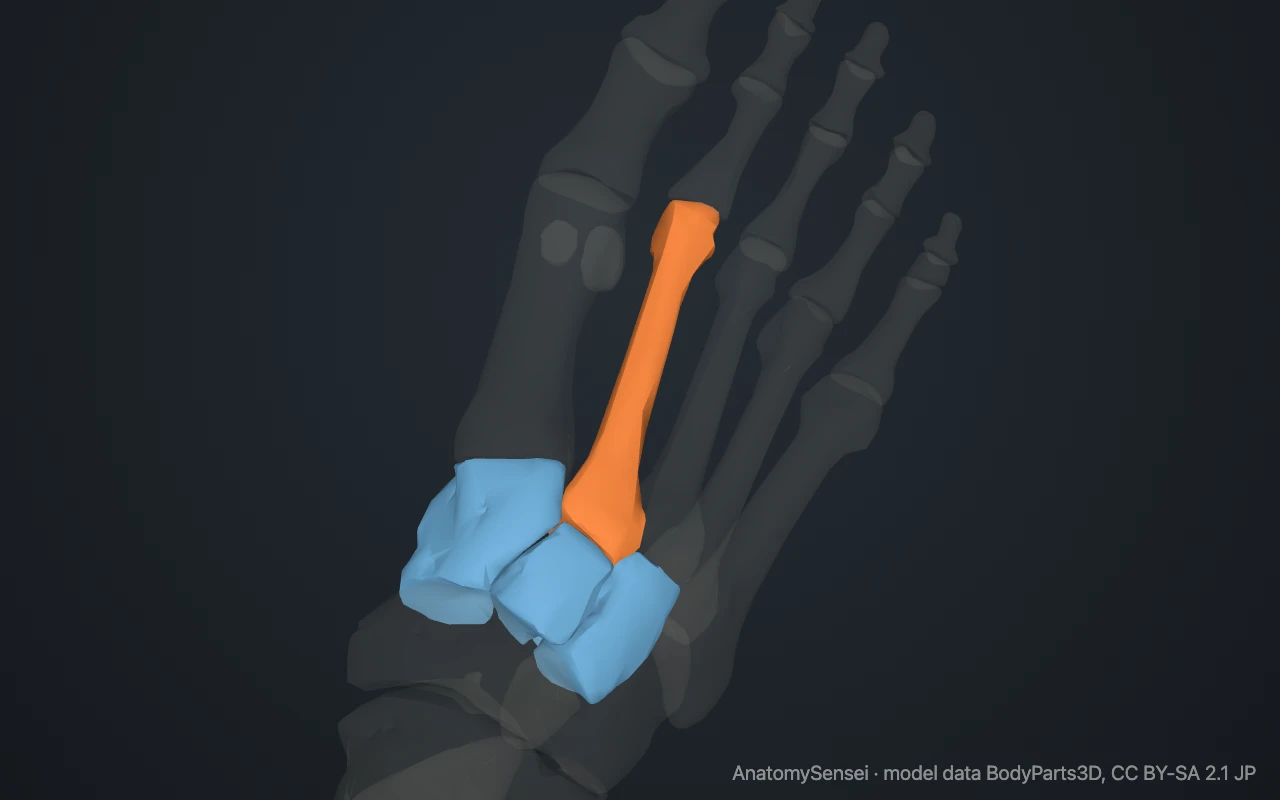
Why the second metatarsal barely moves
Its base reaches further back than its neighbours and sits in a slot between the medial and lateral cuneiforms, resting against the intermediate cuneiform. It touches all three.
A strong ligament from the medial cuneiform attaches to this base. The result is the stiffest ray in the foot.
What does the second metatarsal articulate with?
At its base it meets all three cuneiforms and the third metatarsal. At its head it meets the proximal phalanx of the second toe.
Parts of the second metatarsal
It has a wedge-shaped base, a long, slender shaft and a rounded head. The small muscles that spread the toes start from both sides of the shaft.
What does the second metatarsal do?
Because it is the longest, its head reaches furthest forward and stays on the ground late in each step. It takes a large share of load at push-off, second only to the first metatarsal.
If the first metatarsal is short or unstable, more of that load shifts to the second. In some people the second toe is longer than the big toe for the same reason.
Common problems with the second metatarsal
Because it is long, thin and rigidly held, it takes repeated bending load. Its shaft is the classic site of a "march" stress fracture, first described in soldiers.
In adolescents the head of the second metatarsal can lose part of its blood supply and flatten. This page describes anatomy only.
Common questions
Which metatarsal is the longest?
The second.
Where is the second metatarsal?
Behind the second toe, next to the first metatarsal.
Why does the second metatarsal get stress fractures?
It is the longest and least mobile, so it bends under repeated load instead of giving way.
Is this 3D model of the second metatarsal free?
Yes. The interactive 3D model on this page is free to view and use for study, with no account or download needed. Its geometry comes from the open BodyParts3D data set (CC BY-SA).
About this free 3D model of the second metatarsal
The interactive 3D model on this page is free to use in your browser, with no sign-up. It is built from scan-based anatomy data, so every bone is a separate, correctly placed shape you can turn and inspect from any side.