
Metatarsal bones
Ossa metatarsi
The metatarsals are the five long bones of the forefoot. They run from the midfoot to the base of each toe and are numbered one to five, starting at the big toe.
Loading 3D model…
Free 3D model of the metatarsal bones. Right foot. Drag to rotate, zoom with + and − (or Ctrl + scroll), click a bone to highlight and name it.
Key points
- There are five metatarsals in each foot, numbered from the big toe outward.
- Each has a base, a shaft and a head; the heads form the ball of the foot.
- The first is the shortest and strongest; the second is the longest.
- The first three join the cuneiforms; the fourth and fifth join the cuboid.
What are the metatarsal bones?
The metatarsals are the five long bones of the forefoot. They connect the midfoot to the toes and can be felt as ridges along the top of the foot.
How the metatarsals are numbered
They are numbered one to five from the inner side. The first metatarsal leads to the big toe and the fifth to the little toe.
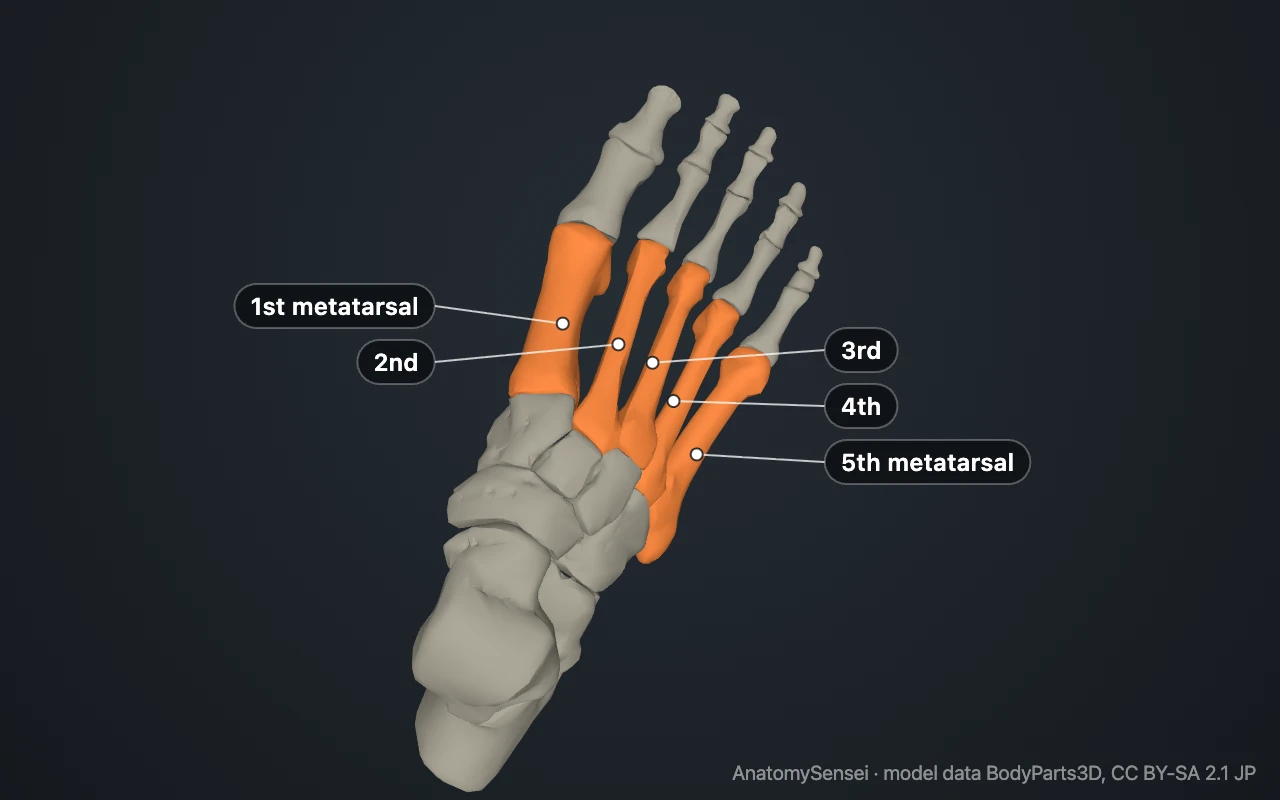
Each has three parts. The base is the wider end nearest the ankle. The shaft is the long middle. The head is the rounded end that meets the toe.
What makes each metatarsal different
The first is the shortest and thickest, with two sesamoid bones under its head. The second is the longest, and its base is locked between the cuneiforms, so it moves least.
The third and fourth are slimmer and similar in shape. The fifth has a bump at its base, the tuberosity, where a tendon from the outer leg attaches.
What do the metatarsals connect to?
At the back, the first three metatarsals meet one cuneiform each, and the fourth and fifth share the cuboid. These are the tarsometatarsal joints, and they move very little.
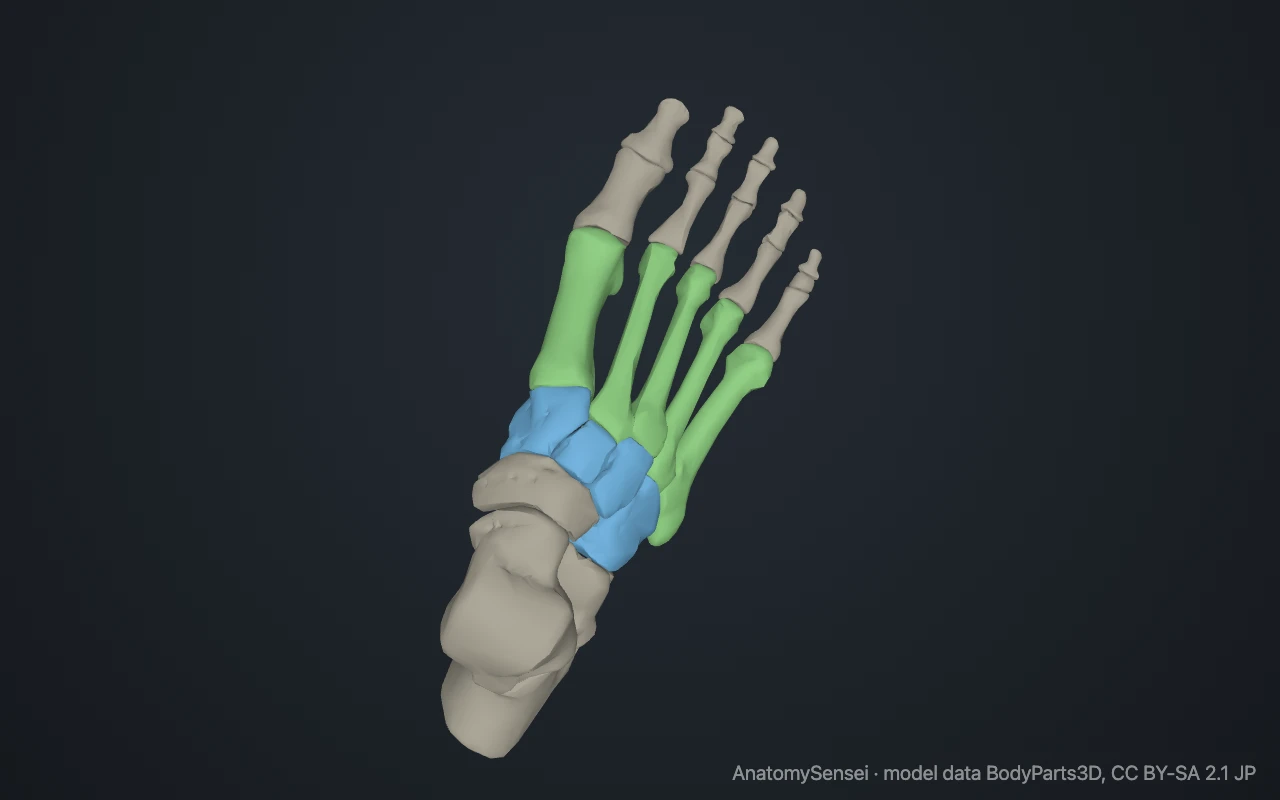
At the front, each head meets the first bone of a toe at a metatarsophalangeal joint. These joints bend upward every time the heel lifts.
What do the metatarsals do?
They form the front half of the arches and act as a lever for push-off. When the heel rises, body weight rolls onto the metatarsal heads, with the first taking the largest share.
They also spread to widen the forefoot under load and give attachment to the small muscles between them.
Common problems with the metatarsals
Long, thin bones under repeated load are prone to stress fractures, especially the second and third. The fifth is the metatarsal most often broken in a twisting injury.
Metatarsalgia is pain under the metatarsal heads. A bunion is a prominence at the head of the first metatarsal. This page describes anatomy only.
Common questions
How many metatarsals are there?
Five in each foot.
Which metatarsal is the longest?
The second. The first is the shortest.
What is the difference between metatarsals and metacarpals?
Metatarsals are in the foot. Metacarpals are the matching bones in the hand.
Which metatarsal is most often broken?
The fifth, on the outer edge of the foot.
Is this 3D model of the metatarsal bones free?
Yes. The interactive 3D model on this page is free to view and use for study, with no account or download needed. Its geometry comes from the open BodyParts3D data set (CC BY-SA).
About this free 3D model of the metatarsal bones
The interactive 3D model on this page is free to use in your browser, with no sign-up. It is built from scan-based anatomy data, so every bone is a separate, correctly placed shape you can turn and inspect from any side.