
Phalanges of the foot (toe bones)
Phalanges pedis
The bones of the toes are called phalanges. Each foot has 14: two in the big toe and three in each of the other four toes.
Loading 3D model…
Free 3D model of the phalanges of the foot. Right foot. Drag to rotate, zoom with + and − (or Ctrl + scroll), click a bone to highlight and name it.
Key points
- The toe bones are called phalanges, and each foot has 14.
- The big toe has two; each of the other toes has three.
- They are named proximal, middle and distal, from the foot outward.
- The big toe's phalanges are far thicker because they carry more load.
What are the phalanges of the foot?
The phalanges are the bones of the toes. A single one is a phalanx. They correspond to the finger bones of the hand but are shorter and, apart from the big toe, much smaller.
How many toe bones are there?
Each foot has 14 phalanges. The big toe has two. The second, third, fourth and little toes have three each.
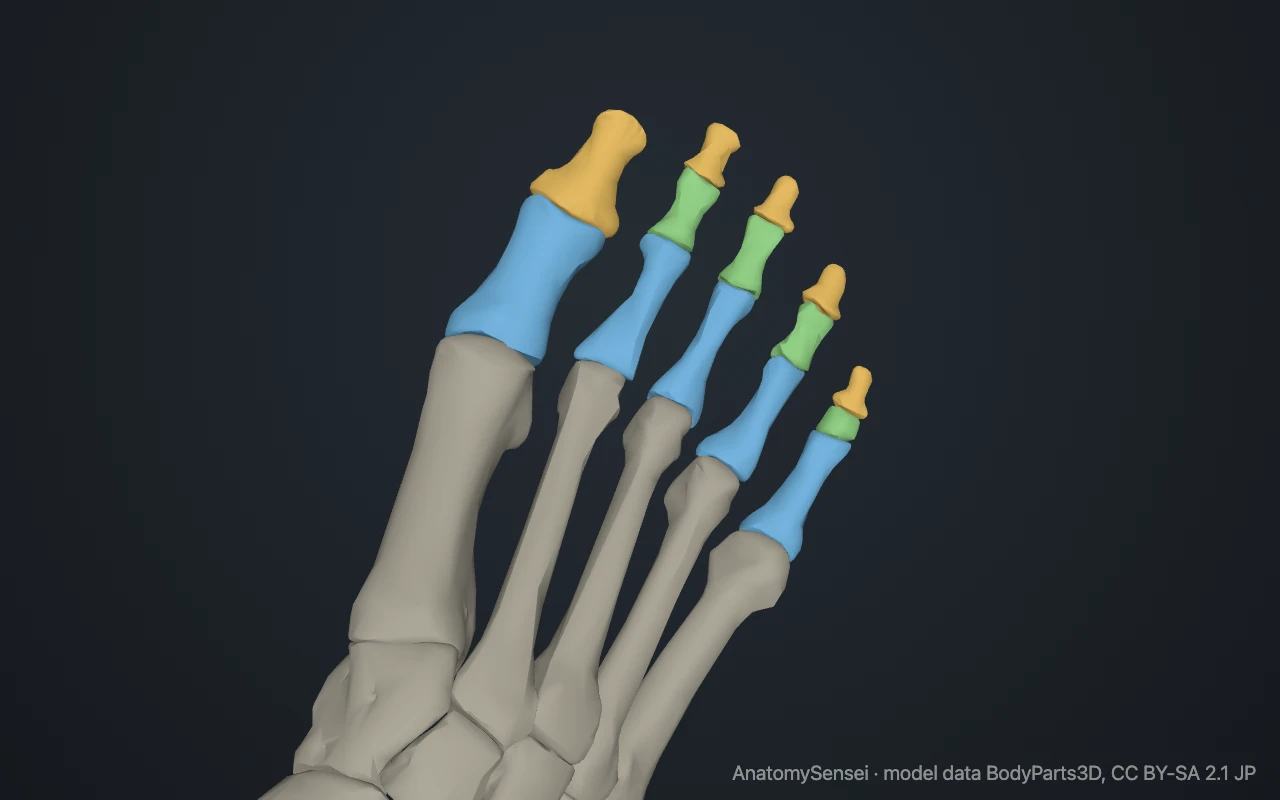
They are named by position. The proximal phalanx is nearest the foot. The distal phalanx is at the tip, under the nail. The middle phalanx lies between them in the four smaller toes.
Parts of a phalanx
Each phalanx is a miniature long bone with a base, a shaft and a head. The base is the end nearer the foot.
The distal phalanges end in a flattened, roughened tip that supports the pad of the toe and the nail.
The big toe
The big toe is called the hallux. It has no middle phalanx, so it bends in one place where the other toes bend in two.
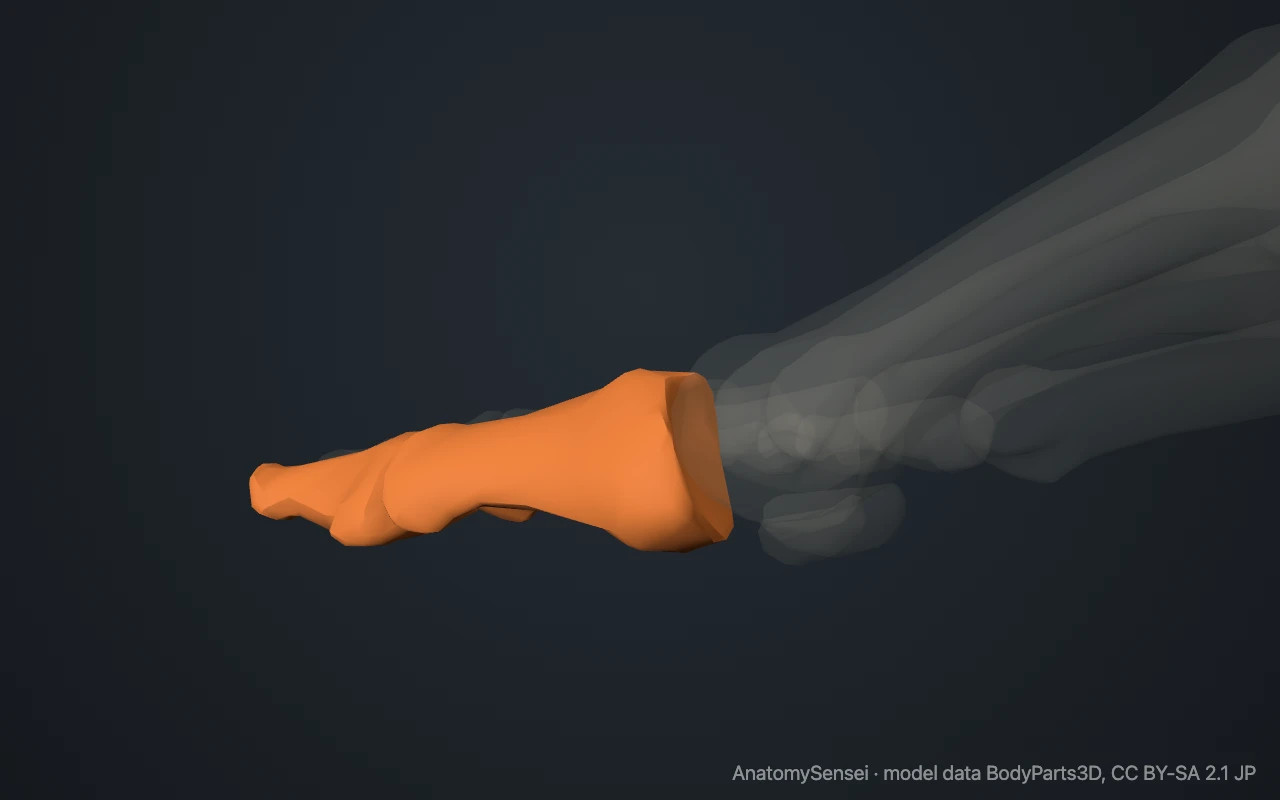
Its two phalanges are much broader than the rest because the big toe carries a large share of the load at push-off.
The joints of the toes
The base of each proximal phalanx meets a metatarsal head at a metatarsophalangeal joint. The joints between phalanges are interphalangeal joints: one in the big toe and two in each smaller toe.
What do the toe bones do?
The toes widen the base of support and steady the body when you stand. In walking they press into the ground as the heel lifts and give the final push.
Common problems with the toe bones
Broken toes are among the most common foot fractures, usually from stubbing or dropping something on them.
Toe deformities are named by which joint stays bent: hammer toe at the middle joint and mallet toe at the joint near the tip. In the little toe, the middle and distal phalanges are often fused, which is a normal variant. This page describes anatomy only.
Common questions
How many bones are in the toes?
Fourteen in each foot.
How many bones are in the big toe?
Two phalanges. The two sesamoids under its joint bring the count to four.
What is the medical term for the toes?
The digits of the foot. The big toe is the hallux.
What is the difference between phalanx and phalanges?
Phalanx is one bone; phalanges is the plural.
Is this 3D model of the phalanges of the foot free?
Yes. The interactive 3D model on this page is free to view and use for study, with no account or download needed. Its geometry comes from the open BodyParts3D data set (CC BY-SA).
About this free 3D model of the phalanges of the foot
The interactive 3D model on this page is free to use in your browser, with no sign-up. It is built from scan-based anatomy data, so every bone is a separate, correctly placed shape you can turn and inspect from any side.