
Bones of the hand
Ossa manus
Each hand has 27 bones. Eight carpal bones form the wrist, five metacarpals form the palm, and fourteen phalanges form the thumb and fingers.
Loading 3D model…
Free 3D model of the bones of the hand. Right hand. Drag to rotate, zoom with + and − (or Ctrl + scroll), click a bone to highlight and name it.
- Carpals (8 wrist bones)
- Metacarpals (5 palm bones)
- Phalanges (14 finger bones)
Key points
- The hand has 27 bones in three groups: carpals, metacarpals and phalanges.
- The eight carpals sit in two rows of four and make up the wrist.
- The five metacarpals form the palm, and their heads are the knuckles.
- Each finger has three phalanges and the thumb has two, which makes fourteen.
What are the bones of the hand?
The skeleton of the hand is built from 27 bones in three groups. From the wrist to the fingertips these are the carpals, the metacarpals and the phalanges. Together the two hands hold 54 bones, which is about a quarter of all the bones in the adult body.
So many small bones give the hand two qualities at once. It can grip with force, and it can make fine, precise movements such as writing or picking up a pin.
How are the hand bones grouped?
The carpal bones are eight small bones packed together at the wrist. The metacarpals are five long bones that fan out from the wrist to the knuckles and form the palm. The phalanges are the fourteen bones of the thumb and fingers.
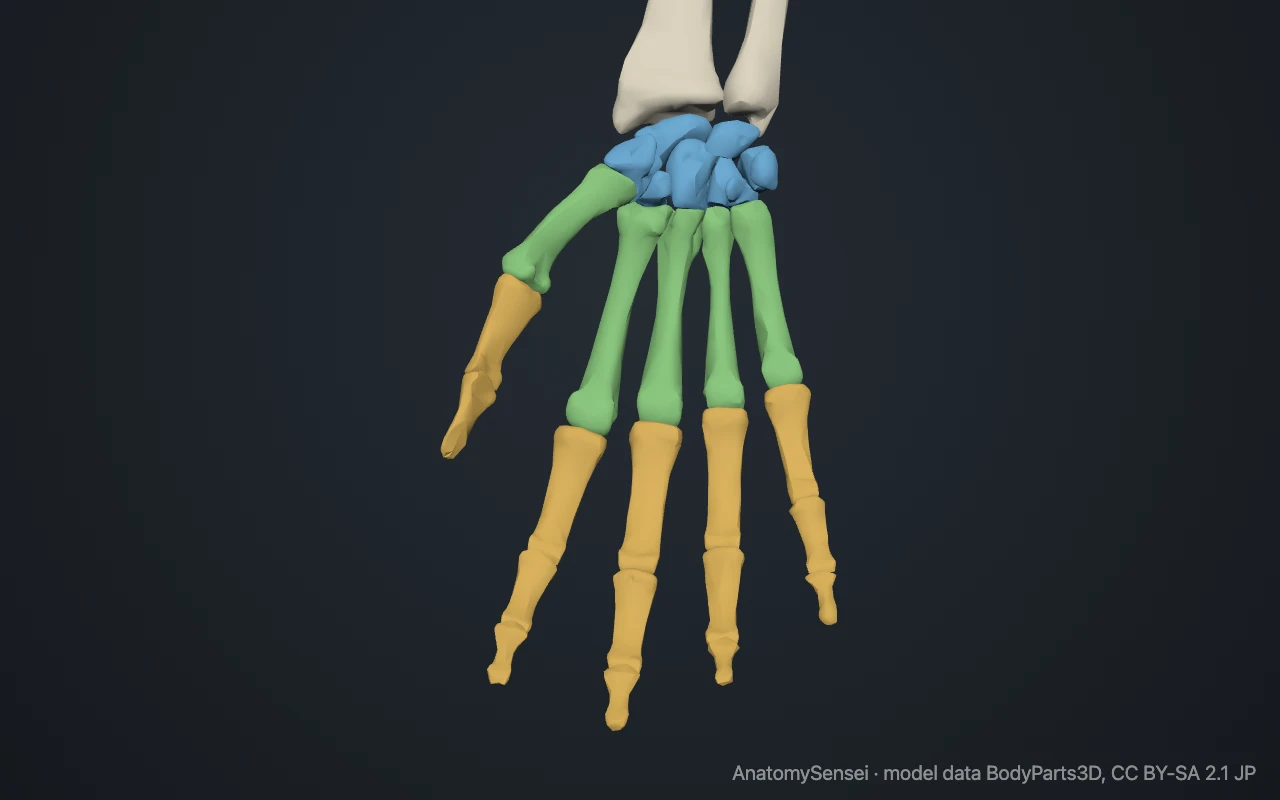
Bones and digits are numbered from the thumb side. The thumb is the first digit and the little finger is the fifth. The first metacarpal therefore belongs to the thumb and the fifth to the little finger.
Which bones make up the wrist?
The eight carpals lie in two rows of four. The row next to the forearm holds the scaphoid, lunate, triquetrum and pisiform. The row next to the palm holds the trapezium, trapezoid, capitate and hamate.
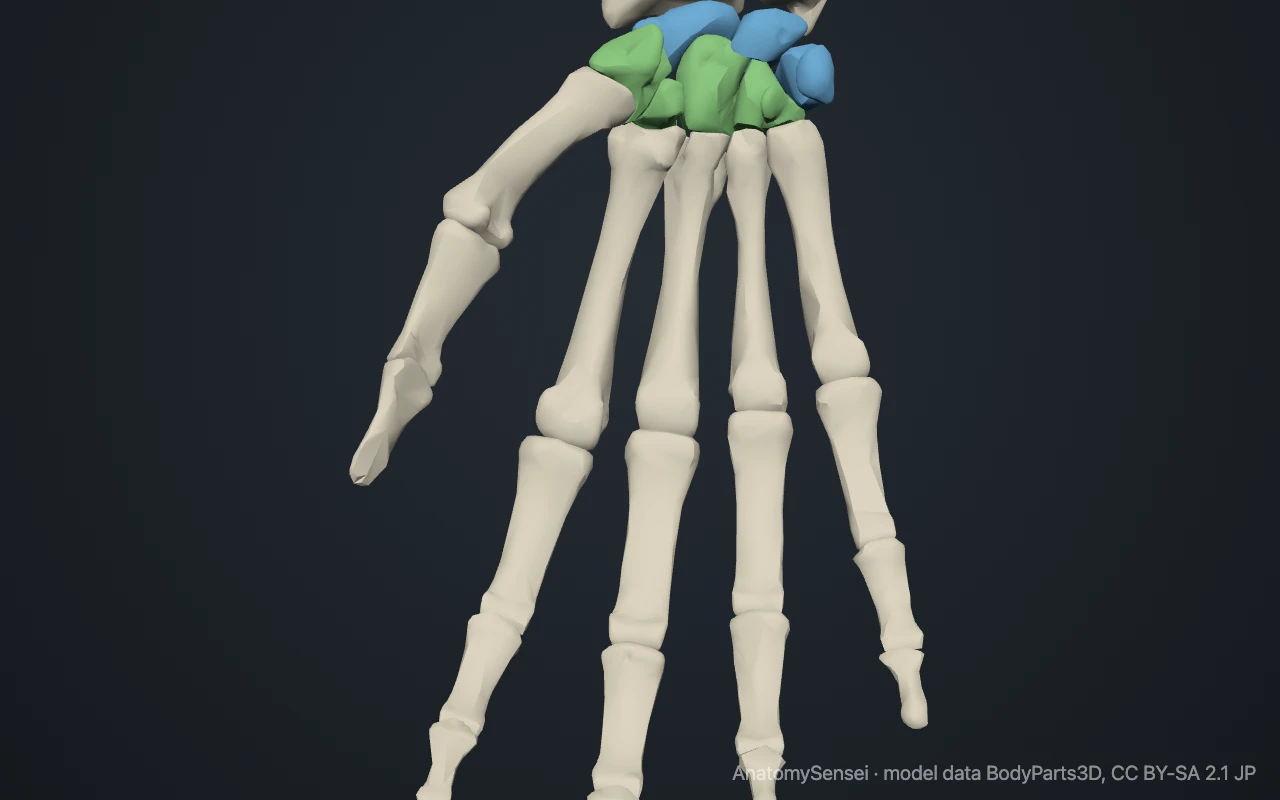
The carpals are short, roughly cube-shaped bones. They glide a little on one another, and the sum of these small movements lets the wrist bend, straighten and tilt from side to side.
Which bones form the palm?
The palm is supported by five metacarpal bones. Each has a base at the wrist, a shaft, and a rounded head at the far end. The heads are the knuckles that stand out when the hand makes a fist.
The first metacarpal, at the base of the thumb, is the shortest and by far the most mobile. The other four are bound closely together and form a firm frame for the palm.
How many bones are in the fingers?
There are fourteen phalanges in each hand. Each of the four fingers has three: a proximal, a middle and a distal phalanx. The thumb has only two, a proximal and a distal.
The distal phalanges are the bones at the fingertips. Each ends in a flattened, roughened tip that supports the pulp of the finger and the nail.
How does the hand join the forearm?
The hand meets the forearm at the wrist joint, also called the radiocarpal joint. Here the broad lower end of the radius forms a shallow socket for the scaphoid and the lunate.
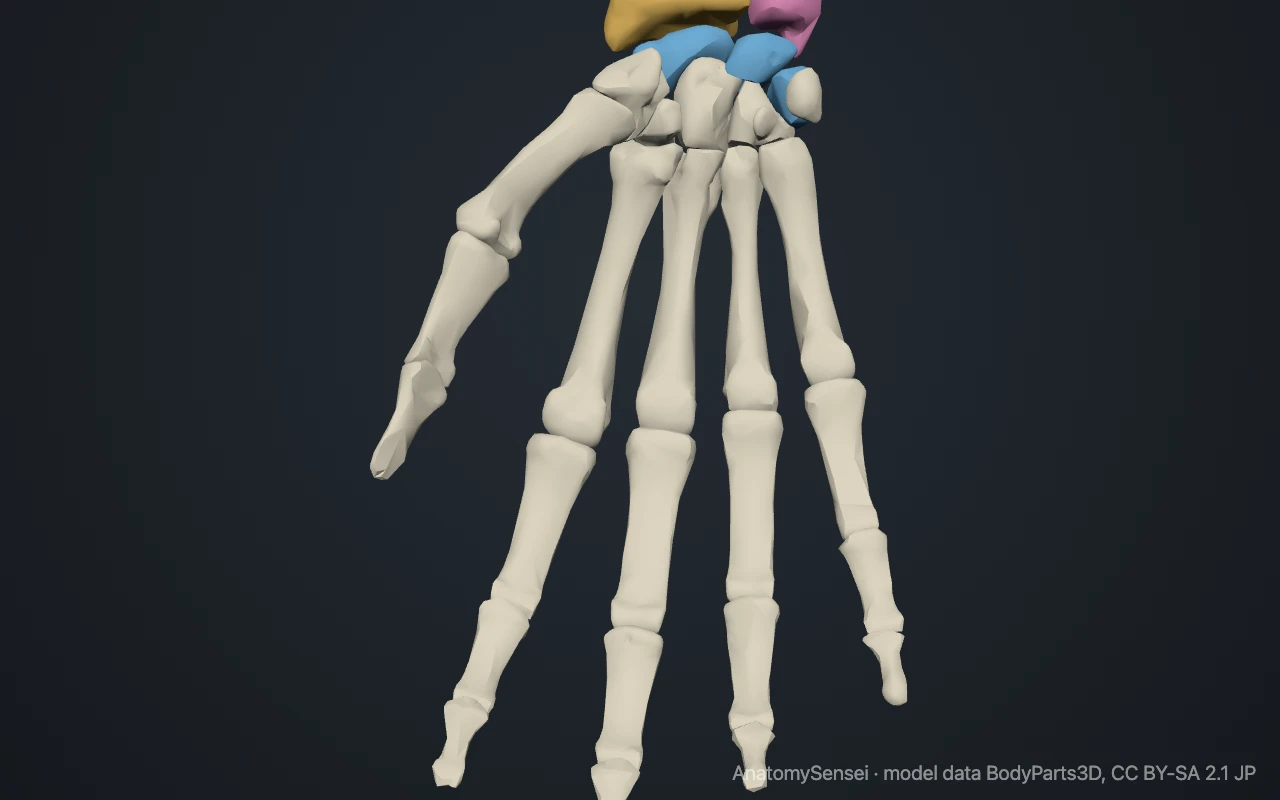
The ulna, the forearm bone on the little finger side, does not touch the carpals directly. A disc of cartilage lies between its head and the triquetrum. The model shows the bones only, so this appears as a gap.
What do the hand bones do?
The bones give the hand a frame that is both stable and adjustable. The carpals and the bases of the metacarpals form a curved arch across the wrist. The fingers can curl around an object of almost any shape.
The thumb is the key to the human grip. Its saddle-shaped joint with the trapezium lets it swing across the palm to meet each fingertip, a movement called opposition.
Common problems with the hand bones
A fall on an outstretched hand is the classic cause of wrist injuries. It can break the lower end of the radius or the scaphoid, the carpal most often fractured. A punch against a hard surface typically breaks the neck of the fifth metacarpal.
The small joints of the hand are also common sites of arthritis, especially the base of the thumb and the joints near the fingertips. This page describes anatomy only.
Free 3D models of every hand bone
Common questions
How many bones are in the hand?
27 in each hand: 8 carpals, 5 metacarpals and 14 phalanges. The radius and ulna belong to the forearm and are not counted.
How many bones are in both hands?
54. Each hand has 27.
Are the wrist bones part of the hand?
Yes. In anatomy the eight carpal bones of the wrist are counted as bones of the hand.
Which hand does the 3D model show?
The right hand, in the anatomical position with the palm facing forward.
What is the smallest bone in the hand?
Among the carpals it is the pisiform, a pea-sized bone at the base of the palm on the little finger side.
Is this 3D model of the bones of the hand free?
Yes. The interactive 3D model on this page is free to view and use for study, with no account or download needed. Its geometry comes from the open BodyParts3D data set (CC BY-SA).
About this free 3D model of the bones of the hand
The interactive 3D model on this page is free to use in your browser, with no sign-up. It is built from scan-based anatomy data, so every bone is a separate, correctly placed shape you can turn and inspect from any side.