
Bones of the thumb
Ossa pollicis
The thumb has three bones: the first metacarpal and two phalanges. It rests on a wrist bone called the trapezium, and the saddle-shaped joint between them lets the thumb swing across the palm.
Loading 3D model…
Free 3D model of the bones of the thumb. Right hand. Drag to rotate, zoom with + and − (or Ctrl + scroll), click a bone to highlight and name it.
- Trapezium (wrist bone under the thumb)
Key points
- The thumb has three bones: one metacarpal and two phalanges.
- It has no middle phalanx, unlike the four fingers.
- Its base forms a saddle joint with the trapezium.
- The saddle joint allows opposition, the movement that brings the thumb to the fingertips.
What are the bones of the thumb?
The thumb, or pollex, is the first digit of the hand. Its skeleton has three bones in a row: the first metacarpal, the proximal phalanx and the distal phalanx.
The first metacarpal lies inside the fleshy base of the thumb, so the thumb looks shorter than it is. Only the two phalanges are in the free part of the thumb.
Where are the thumb bones?
They lie on the lateral side of the hand, the outer side when the palm faces forward. The thumb is set in front of the palm and turned, so its pad faces across the hand instead of forward.
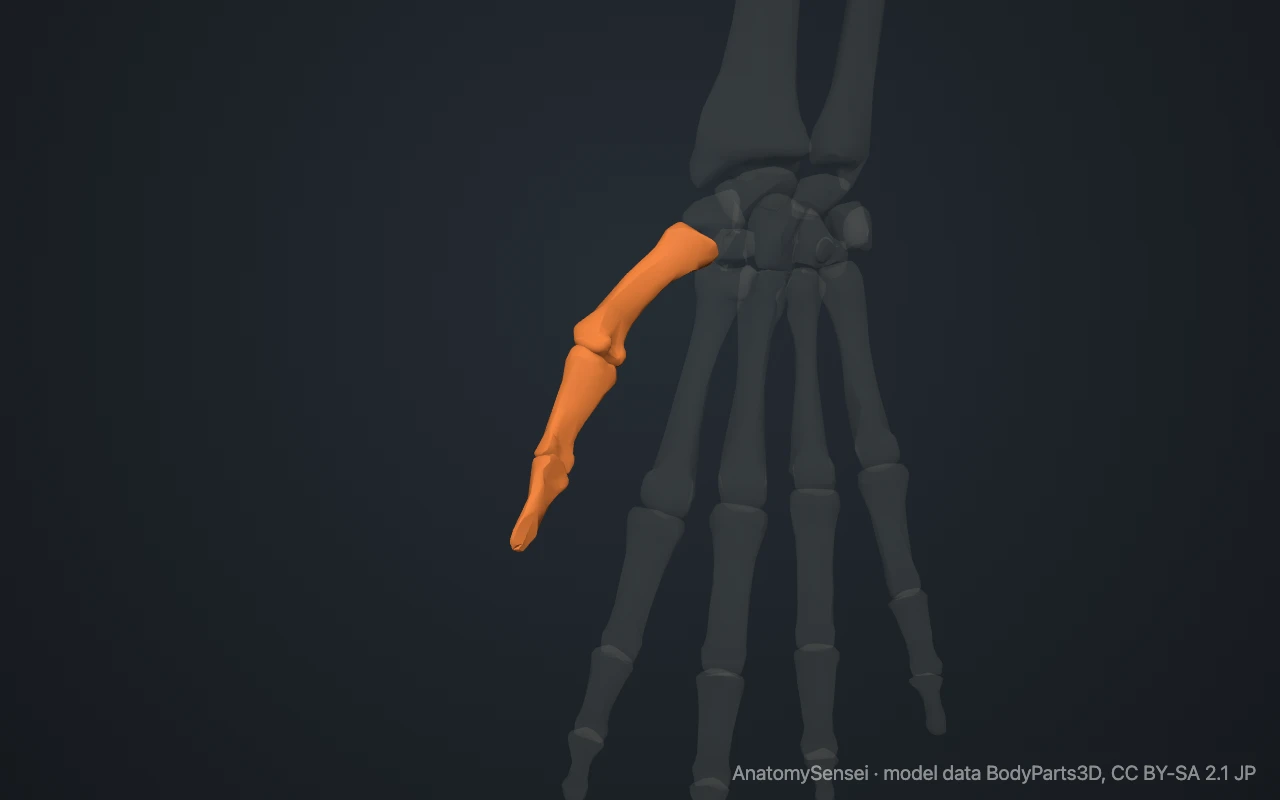
You can trace all three on your own thumb. The tip section, under the nail, holds the distal phalanx. The next section holds the proximal phalanx. Beyond the knuckle at the edge of the palm, the firm bone that runs to the wrist is the first metacarpal.
What is each thumb bone like?
The first metacarpal is the shortest and stoutest of the five metacarpals. Its base is saddle-shaped, and its head is broader and flatter than the heads of the others.
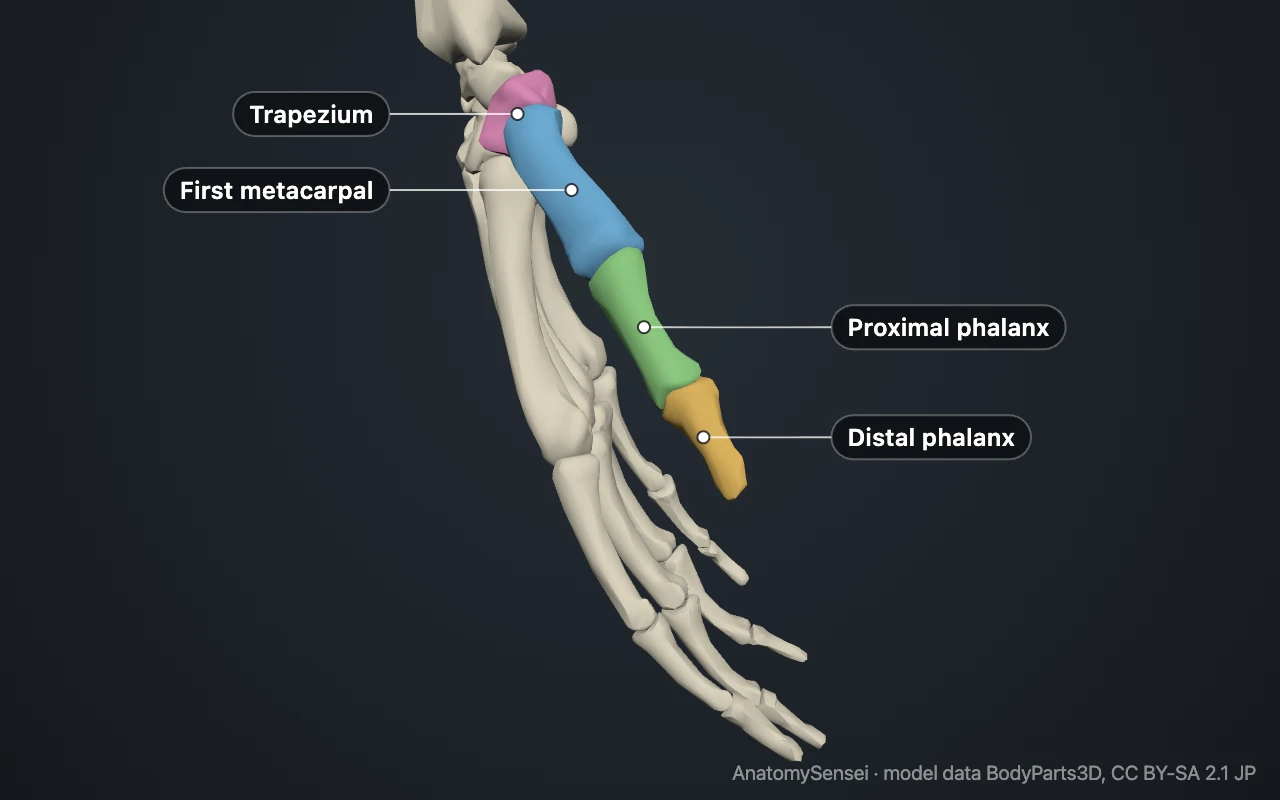
The proximal phalanx is short and strong. The distal phalanx is broad and flat, with a wide, rough tip that supports the pad of the thumb and the thumbnail. There is no middle phalanx.
What is the saddle joint of the thumb?
The base of the first metacarpal meets the trapezium at the first carpometacarpal joint. Both surfaces are shaped like a saddle. Each is concave in one direction and convex in the other, and the two sit across each other like a rider on a horse.
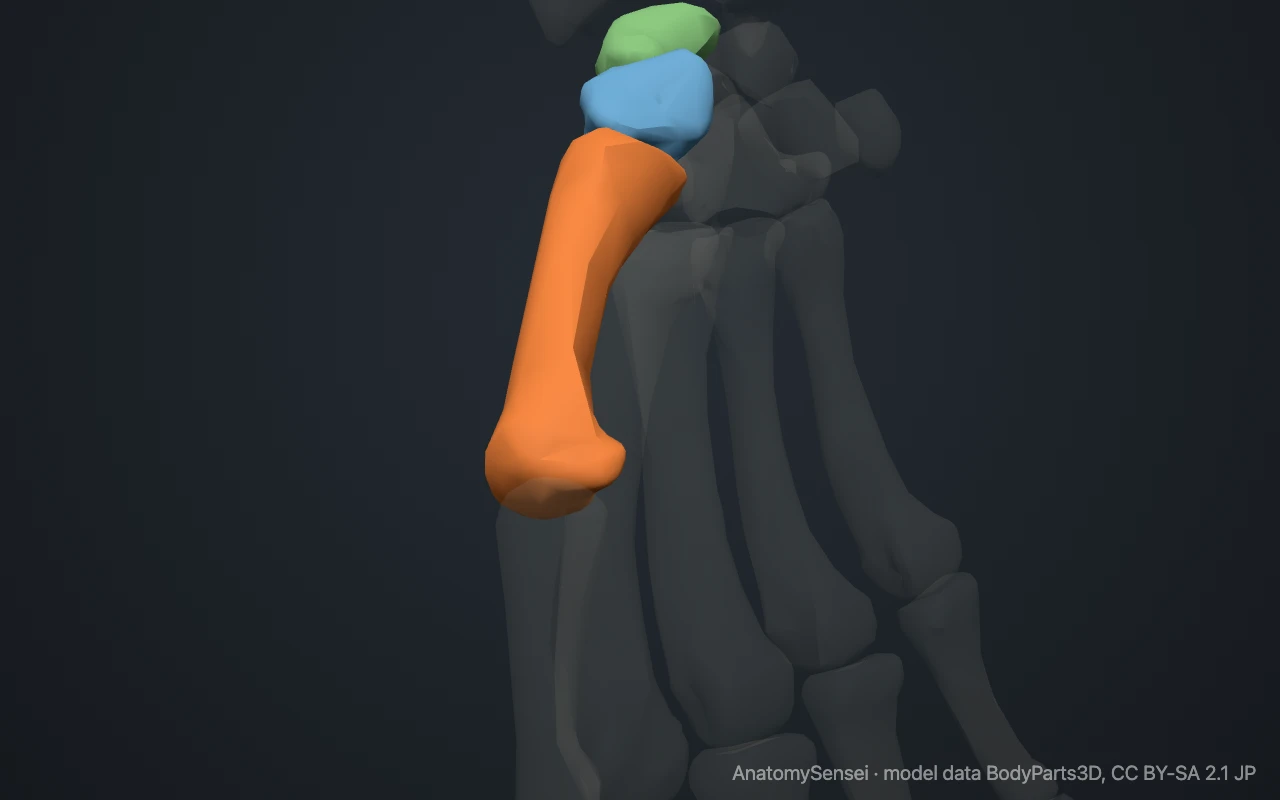
This shape allows movement in two planes. The thumb can move forward and back, and towards and away from the index finger. A little rotation is added as the surfaces slide. No other metacarpal has this freedom.
What other joints does the thumb have?
The head of the first metacarpal meets the proximal phalanx at the metacarpophalangeal joint, the knuckle of the thumb. It mostly bends and straightens, with far less sideways movement than a finger knuckle.
The two phalanges meet at the interphalangeal joint, a simple hinge. Two small sesamoid bones usually lie in the tendons on the palm side of the thumb knuckle. The model does not show them.
What is opposition of the thumb?
Opposition is the movement that brings the pad of the thumb to face the pads of the fingers. It combines swinging the thumb forward from the palm, drawing it across, and rotating it. Nearly all of it takes place at the saddle joint.
Opposition makes the precision grip possible, as in holding a pen or a needle. It also strengthens the power grip, because the thumb can lock over the fingers around a handle.
What attaches to the thumb bones?
The thumb is moved by more muscles than any finger. Four long muscles reach it from the forearm. Flexor pollicis longus bends the tip and ends on the distal phalanx. Two extensors straighten it, and abductor pollicis longus ends on the base of the first metacarpal.
Short muscles in the palm complete the set. The three muscles of the thumb pad, called the thenar muscles, attach to the first metacarpal and the proximal phalanx. Adductor pollicis pulls the thumb back towards the palm.
Common problems with the thumb bones
The saddle joint is a very common site of osteoarthritis, which causes pain at the base of the thumb on pinching. A fracture through the base of the first metacarpal that enters this joint is called a Bennett fracture.
At the thumb knuckle, a fall that forces the thumb outward can tear the ligament on its inner side. This injury is known as skier's thumb. This page describes anatomy only.
Common questions
How many bones are in the thumb?
Three: the first metacarpal, a proximal phalanx and a distal phalanx. Counting only the phalanges, there are two.
Does the thumb have a middle phalanx?
No. It has only a proximal and a distal phalanx.
Which wrist bone does the thumb sit on?
The trapezium.
Is the thumb a finger?
In anatomy it is the first digit of the hand. It is usually named separately from the four fingers because of its different structure and movement.
Why is the thumb so mobile?
Because of the saddle joint between the first metacarpal and the trapezium, which moves in two planes and rotates slightly.
Is this 3D model of the bones of the thumb free?
Yes. The interactive 3D model on this page is free to view and use for study, with no account or download needed. Its geometry comes from the open BodyParts3D data set (CC BY-SA).
About this free 3D model of the bones of the thumb
The interactive 3D model on this page is free to use in your browser, with no sign-up. It is built from scan-based anatomy data, so every bone is a separate, correctly placed shape you can turn and inspect from any side.