
Carpal bones (wrist bones)
Ossa carpi
The carpal bones are the eight small bones of the wrist. They lie in two rows of four between the forearm and the palm.
Loading 3D model…
Free 3D model of the carpal bones. Right hand. Drag to rotate, zoom with + and − (or Ctrl + scroll), click a bone to highlight and name it.
- Proximal row: scaphoid, lunate, triquetrum, pisiform
- Distal row: trapezium, trapezoid, capitate, hamate
Key points
- There are eight carpal bones in each wrist, arranged in two rows of four.
- The proximal row meets the radius and the distal row meets the metacarpals.
- The carpals form an arch that is roofed over to make the carpal tunnel.
- The scaphoid is the carpal most often broken and the lunate the one most often dislocated.
What are the carpal bones?
The carpal bones are eight small bones that make up the wrist. The word comes from the Greek karpos, meaning wrist. Together they are called the carpus.
They are short bones, about as wide as they are long. Each is covered with smooth cartilage on the surfaces where it meets its neighbours, and is rough on the palm and back surfaces where ligaments attach.
Where are the carpal bones?
They sit between the forearm bones and the metacarpals. The carpus is further into the hand than many people expect. It lies beyond the skin creases at the wrist, under the heel of the hand.
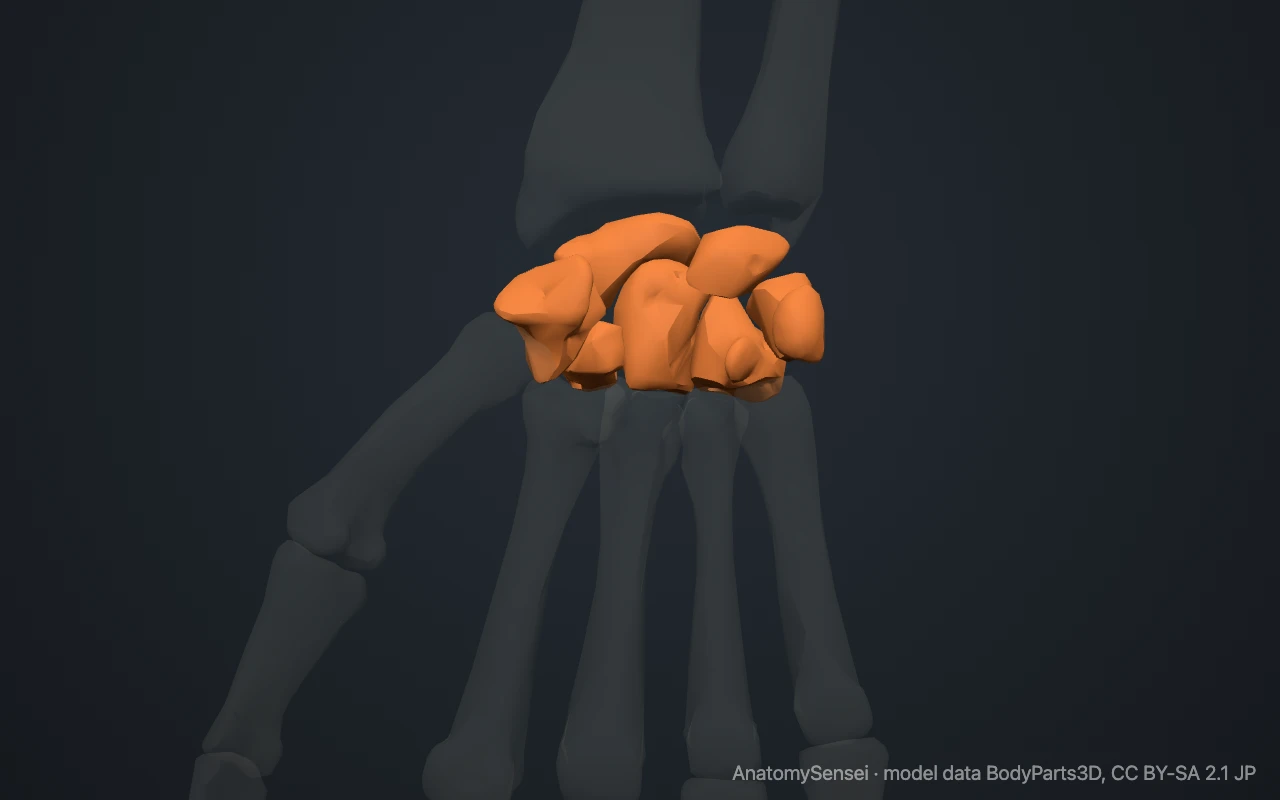
To find them, feel for the bony knob on each side of your wrist. These are the ends of the radius and ulna. The carpal bones fill the space between those knobs and the bases of the long bones of the palm, a little further on.
What are the eight carpal bones called?
The proximal row, next to the forearm, runs from the thumb side to the little finger side: scaphoid, lunate, triquetrum and pisiform. The pisiform sits on the palm surface of the triquetrum instead of beside it.
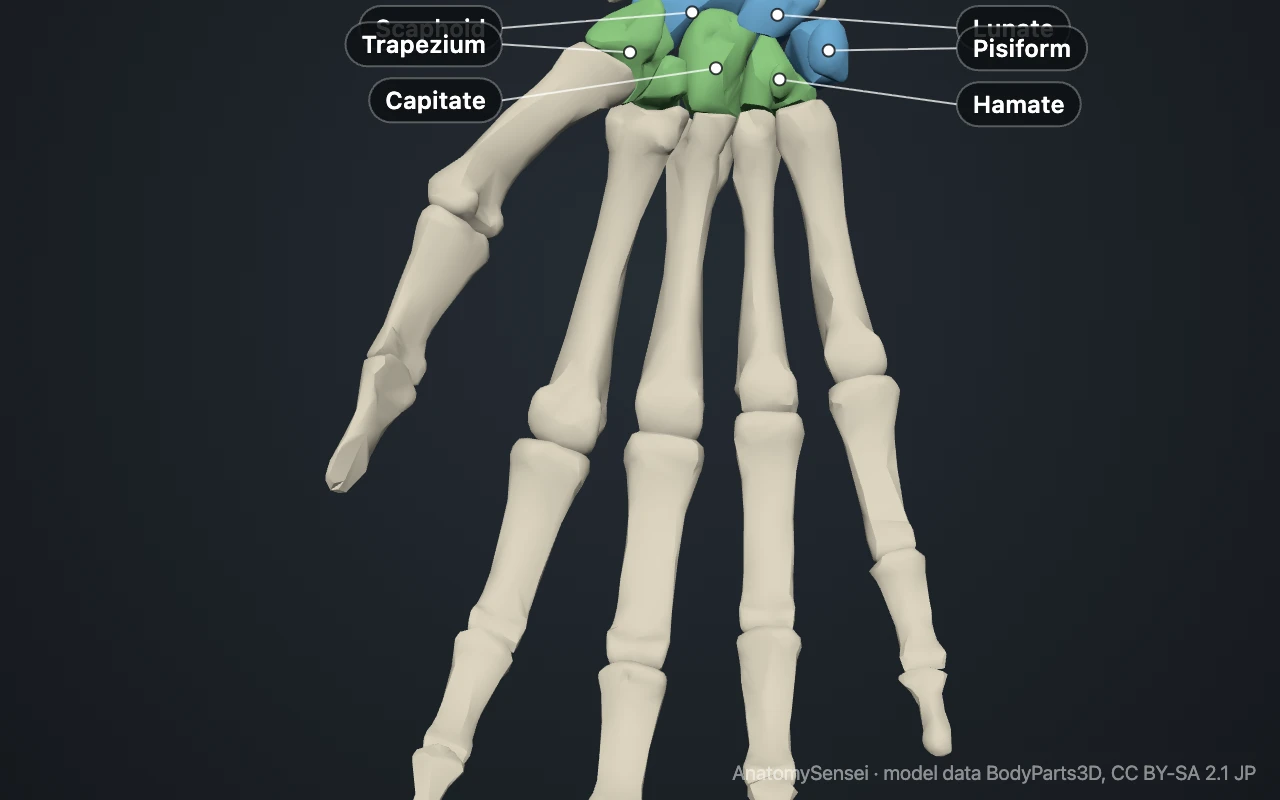
The distal row, next to the palm, runs in the same direction: trapezium, trapezoid, capitate and hamate. The capitate is the largest carpal and sits in the centre of the wrist.
How can the carpal bones be remembered?
A widely used mnemonic is "So Long To Pinky, Here Comes The Thumb". The first four words give the proximal row from the thumb side: Scaphoid, Lunate, Triquetrum, Pisiform.
The last four words give the distal row in the opposite direction, starting from the little finger side: Hamate, Capitate, Trapezoid, Trapezium. The two bones that begin with T are easy to mix up. The trapezium is the one next to the thumb.
What do the carpal bones articulate with?
On the forearm side, the scaphoid and lunate meet the lower end of the radius at the wrist joint. The triquetrum faces a disc of cartilage that separates it from the ulna.
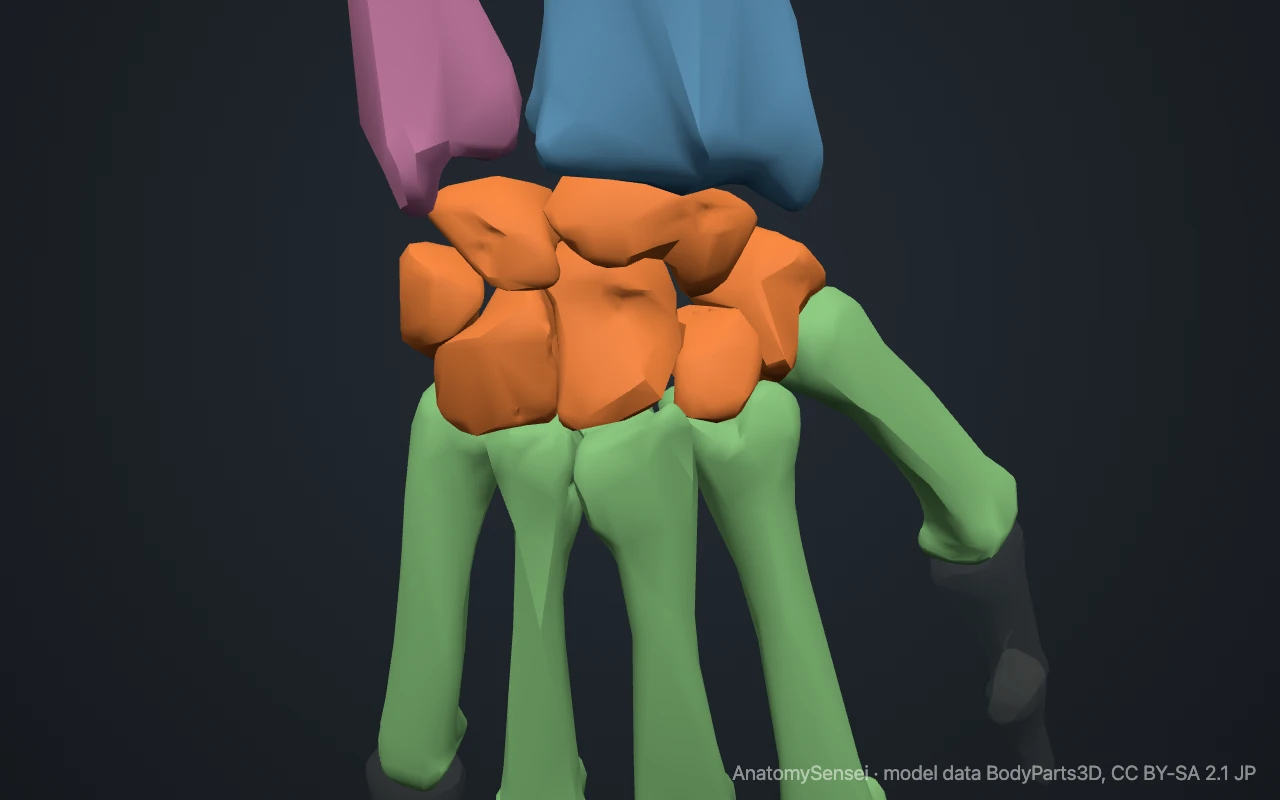
Between the two rows lies the midcarpal joint. On the palm side, the distal row meets the bases of the five metacarpals. The trapezium carries the thumb, and the hamate carries the ring and little fingers.
What is the carpal tunnel?
Seen from the end, the carpus is not flat. It is curved like a shallow gutter, hollow on the palm side. The edges of the gutter are the scaphoid and trapezium on the thumb side, and the pisiform and the hook of the hamate on the little finger side.
A strong band, the flexor retinaculum, stretches across these four points and turns the gutter into a tunnel. Through it pass the median nerve and nine tendons that bend the fingers and thumb. The model shows the bony floor and walls of the tunnel but not the band or its contents.
What do the carpal bones do?
The carpals let the wrist move in several directions while staying strong. Each bone slides only slightly, but the movements add up across the two rows. The result is a wrist that can bend forward and back and tilt to either side.
They also pass force from the hand to the forearm. When a person pushes or leans on the hand, most of the load travels through the capitate, scaphoid and lunate to the radius.
Common problems with the carpal bones
The scaphoid is the carpal most often fractured, usually in a fall on an outstretched hand. The lunate is the carpal most often dislocated. The hook of the hamate can break in sports that use a club, bat or racket.
In carpal tunnel syndrome, the median nerve is squeezed inside the tunnel, which causes numbness and tingling in the thumb, index and middle fingers. This page describes anatomy only.
Common questions
How many carpal bones are there?
Eight in each wrist, sixteen in total.
Which carpal bone is the largest?
The capitate, in the centre of the distal row.
Which carpal bone is the smallest?
The pisiform, a pea-shaped bone on the palm side of the triquetrum.
Which carpal bones touch the radius?
The scaphoid and the lunate. The triquetrum faces a cartilage disc at the end of the ulna.
What is the difference between carpals and tarsals?
Carpals are the eight bones of the wrist. Tarsals are the seven bones of the ankle and rear of the foot.
Is this 3D model of the carpal bones free?
Yes. The interactive 3D model on this page is free to view and use for study, with no account or download needed. Its geometry comes from the open BodyParts3D data set (CC BY-SA).
About this free 3D model of the carpal bones
The interactive 3D model on this page is free to use in your browser, with no sign-up. It is built from scan-based anatomy data, so every bone is a separate, correctly placed shape you can turn and inspect from any side.