
Scaphoid bone
Os scaphoideum
The scaphoid is a boat-shaped carpal bone on the thumb side of the wrist. It is the largest bone of the proximal row and the wrist bone most often fractured.
Loading 3D model…
Free 3D model of the scaphoid bone. Right hand. Drag to rotate, zoom with + and − (or Ctrl + scroll), click a bone to highlight and name it.
Key points
- The scaphoid is the carpal bone on the thumb side of the proximal row.
- It joins the radius and bridges the two rows of carpal bones.
- It can be felt in the hollow at the base of the thumb called the anatomical snuffbox.
- It is the most commonly fractured carpal bone, usually across its narrow waist.
What is the scaphoid bone?
The scaphoid is one of the eight carpal bones of the wrist. Its name comes from the Greek skaphe, a boat, after its hollowed, elongated shape. Older texts call it the navicular bone of the hand.
It is the largest bone in the proximal row, the row next to the forearm. It matters clinically far more than its size suggests, because it is the wrist bone that breaks most often.
Where is the scaphoid bone?
It lies on the thumb side of the wrist, just beyond the end of the radius. It is tilted, so that its far end points towards the palm and the base of the thumb.
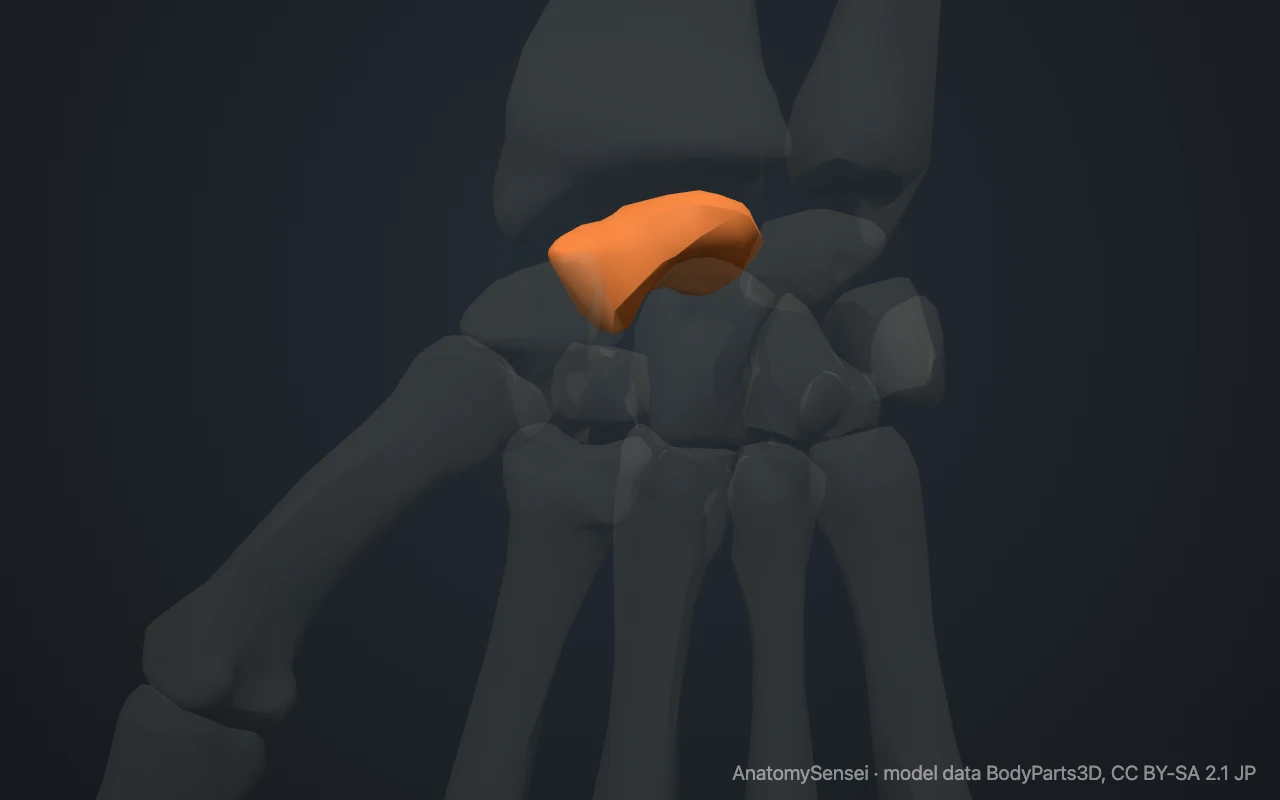
You can feel it in two places. Stretch your thumb out and back, and a small hollow appears on the thumb side of the wrist between two tendons. This is the anatomical snuffbox, and the scaphoid forms its floor. On the palm side, the firm bump at the base of the thumb pad, level with the wrist crease, is the scaphoid tubercle.
What does the scaphoid look like?
The bone has three regions. The proximal pole is the rounded end nearest the radius. The distal pole is the end nearest the thumb and carries the tubercle, a blunt projection on the palm side. Between them is a narrower middle part called the waist.
Most of the surface is covered with joint cartilage. Only a small strip around the waist and the tubercle is rough, and this is where blood vessels enter the bone.
What does the scaphoid articulate with?
The scaphoid touches five bones. Its convex proximal surface sits in a shallow socket on the radius and forms a large part of the wrist joint. On its inner side it meets the lunate, and its hollow surface cups the head of the capitate.
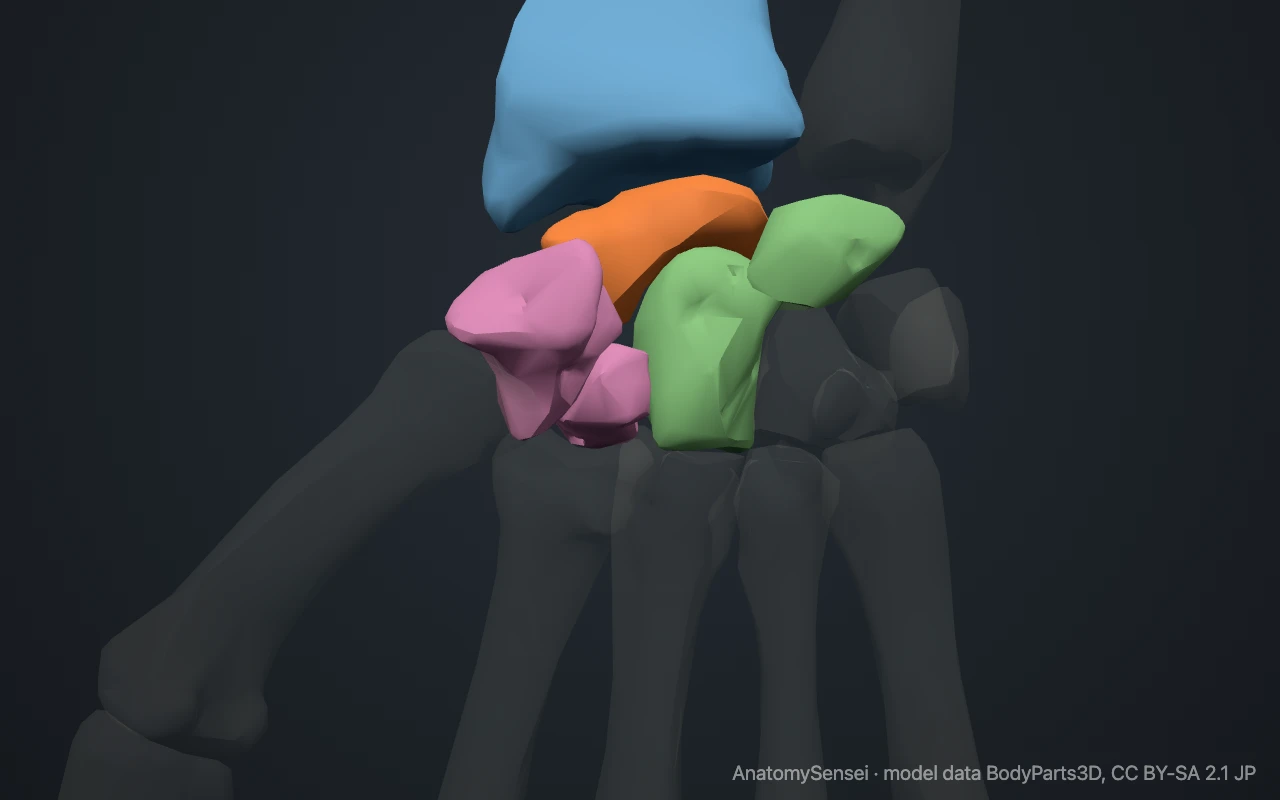
At its far end it meets the trapezium and the trapezoid. Because it spans both rows, the scaphoid acts as a link between the proximal and distal rows of the carpus.
What attaches to the scaphoid?
The flexor retinaculum, the band that roofs the carpal tunnel, is fixed to the scaphoid tubercle on the thumb side. Strong ligaments tie the scaphoid to the radius, to the lunate and to the bones of the distal row.
The radial artery crosses the scaphoid in the floor of the anatomical snuffbox. Small branches from it supply the bone, and most of them enter at the distal end and run back towards the proximal pole.
What does the scaphoid do?
It passes load from the thumb side of the hand to the radius. When someone leans or falls on the hand, much of the force goes through the scaphoid.
It also steadies the wrist. By bridging the two carpal rows, it keeps them moving together as the wrist bends and tilts. It flexes forward when the hand tilts towards the thumb and straightens when the hand tilts the other way.
Common problems with the scaphoid
A scaphoid fracture typically follows a fall on an outstretched hand. The break is usually across the waist. Tenderness in the anatomical snuffbox is the classic sign, and the fracture can be hard to see on early X-rays.
Because the blood supply enters from the far end, a break at the waist can cut off the proximal pole. This can lead to slow healing, failure to unite, or avascular necrosis, in which part of the bone dies. This page describes anatomy only.
Common questions
Why does the scaphoid heal slowly?
Its blood supply enters mainly at the far end and runs backwards. A fracture across the waist can leave the proximal pole with little blood.
Is the scaphoid the same as the navicular?
The scaphoid was once called the navicular bone of the hand. Today navicular refers only to a bone in the foot.
Can you feel your scaphoid?
Yes. It forms the floor of the anatomical snuffbox, and its tubercle can be felt at the base of the thumb pad.
How many bones touch the scaphoid?
Five: the radius, lunate, capitate, trapezium and trapezoid.
Is this 3D model of the scaphoid bone free?
Yes. The interactive 3D model on this page is free to view and use for study, with no account or download needed. Its geometry comes from the open BodyParts3D data set (CC BY-SA).
About this free 3D model of the scaphoid bone
The interactive 3D model on this page is free to use in your browser, with no sign-up. It is built from scan-based anatomy data, so every bone is a separate, correctly placed shape you can turn and inspect from any side.