
Trapezium bone
Os trapezium
The trapezium is the carpal bone at the base of the thumb, on the thumb side of the distal row. Its saddle-shaped joint with the first metacarpal gives the thumb its wide range of movement.
Loading 3D model…
Free 3D model of the trapezium bone. Right hand. Drag to rotate, zoom with + and − (or Ctrl + scroll), click a bone to highlight and name it.
Key points
- The trapezium is the carpal bone directly under the thumb.
- It joins the first metacarpal at a saddle joint, which gives the thumb its freedom of movement.
- A groove on its palm surface carries the tendon of flexor carpi radialis.
- The joint at the base of the thumb is a common site of osteoarthritis.
What is the trapezium?
The trapezium is one of the eight carpal bones. It is the bone on the thumb side of the distal row, the row next to the palm. Older texts call it the greater multangular bone.
Its importance comes from what rests on it. The trapezium is the platform for the thumb, and the shape of its joint surface is what lets the thumb swing across the palm.
Where is the trapezium?
It lies between the scaphoid and the first metacarpal, with the trapezoid on its inner side. It is set slightly forward of the other carpals, so the thumb stands in front of the palm instead of beside it.
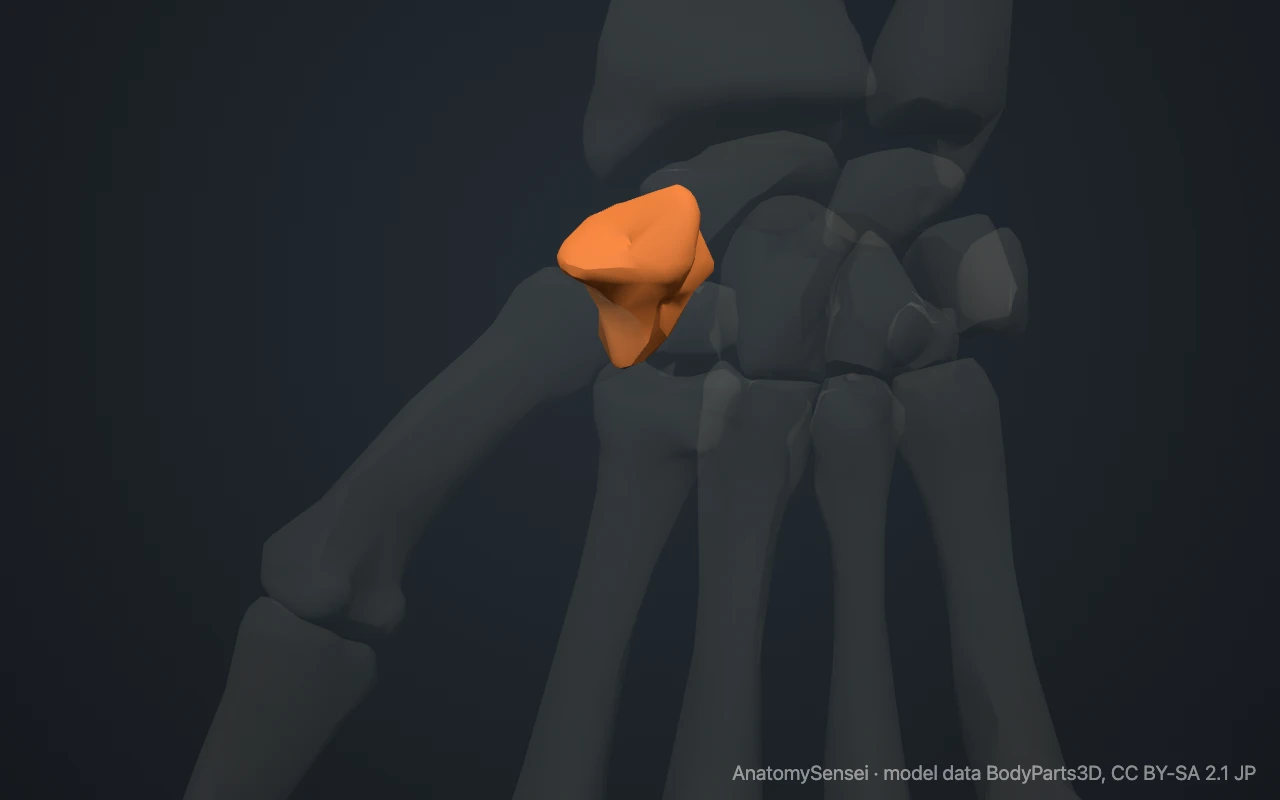
To find it, run a finger down the back of your thumb to the base of its long bone, the first metacarpal. Move the thumb in a circle. The joint that moves under the finger is the joint with the trapezium, and the firm bone just beyond it, towards the wrist, is the trapezium itself.
What does the trapezium look like?
The bone is irregular, with four joint surfaces. The most important faces the thumb. It is shaped like a saddle, concave from side to side and convex from front to back.
On the palm surface is a ridge called the tubercle of the trapezium. Beside it runs a deep groove. The tendon of flexor carpi radialis, a muscle that bends the wrist, lies in this groove.
What does the trapezium articulate with?
The trapezium touches four bones. Towards the forearm it meets the scaphoid. On its inner side it meets the trapezoid and, by a small facet, the base of the second metacarpal.
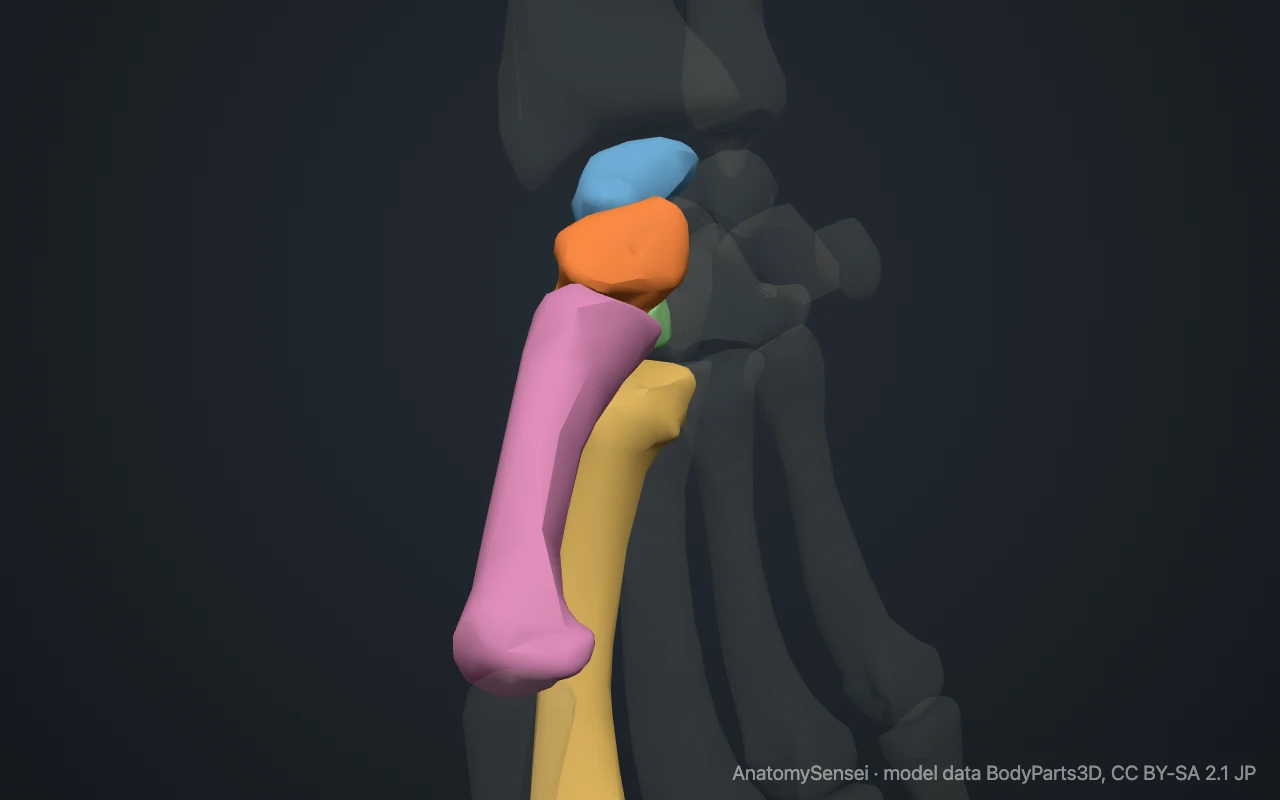
Towards the thumb it meets the base of the first metacarpal. This is the first carpometacarpal joint, the classic example of a saddle joint. The two saddle-shaped surfaces fit across each other and allow movement in two planes plus a little rotation.
What attaches to the trapezium?
The flexor retinaculum, the roof of the carpal tunnel, is fixed to the tubercle of the trapezium on the thumb side. The trapezium is therefore one of the four bony posts of the tunnel.
Three small muscles of the thumb pad take part of their origin from the tubercle and the retinaculum beside it: abductor pollicis brevis, flexor pollicis brevis and opponens pollicis. Strong ligaments hold the trapezium to the first metacarpal.
What does the trapezium do?
The trapezium makes opposition of the thumb possible. Its saddle joint lets the thumb move away from the palm, across it, and round to face the fingers, so that the pad of the thumb can meet the pad of each finger.
It also carries heavy load. In a pinch grip, the force at the tip of the thumb is multiplied several times by the time it reaches the base of the thumb and the trapezium.
Common problems with the trapezium
The joint between the trapezium and the first metacarpal is one of the most common sites of osteoarthritis in the hand. It causes pain at the base of the thumb, especially on pinching and twisting.
Fractures of the trapezium are uncommon. They tend to occur together with a break at the base of the first metacarpal, when force is driven down the length of the thumb. This page describes anatomy only.
Common questions
What is the difference between the trapezium and the trapezoid?
The trapezium is under the thumb and is the larger of the two. The trapezoid lies beside it, under the index finger.
What type of joint is at the base of the thumb?
A saddle joint, between the trapezium and the first metacarpal.
Which tendon runs in the groove of the trapezium?
The tendon of flexor carpi radialis.
How many bones touch the trapezium?
Four: the scaphoid, the trapezoid and the first and second metacarpals.
Is this 3D model of the trapezium bone free?
Yes. The interactive 3D model on this page is free to view and use for study, with no account or download needed. Its geometry comes from the open BodyParts3D data set (CC BY-SA).
About this free 3D model of the trapezium bone
The interactive 3D model on this page is free to use in your browser, with no sign-up. It is built from scan-based anatomy data, so every bone is a separate, correctly placed shape you can turn and inspect from any side.