
Phalanges of the hand (finger bones)
Phalanges manus
The phalanges are the bones of the fingers and thumb. Each hand has fourteen: three in each finger and two in the thumb.
Loading 3D model…
Free 3D model of the phalanges of the hand. Right hand. Drag to rotate, zoom with + and − (or Ctrl + scroll), click a bone to highlight and name it.
- Proximal phalanges (5)
- Middle phalanges (4)
- Distal phalanges (5)
Key points
- Each hand has fourteen phalanges.
- Every finger has a proximal, a middle and a distal phalanx.
- The thumb has only a proximal and a distal phalanx.
- The joints between the phalanges are hinges that bend and straighten only.
What are the phalanges of the hand?
The phalanges are the bones inside the fingers and thumb. One of them is called a phalanx. The word is Greek for a line of soldiers, after the way the bones stand in rows.
Despite their size they are classed as long bones, because each has a shaft and two ends. The toes have a matching set of phalanges with the same names.
Where are the phalanges?
They begin at the knuckles and run to the fingertips. Each proximal phalanx sits on the head of a metacarpal.
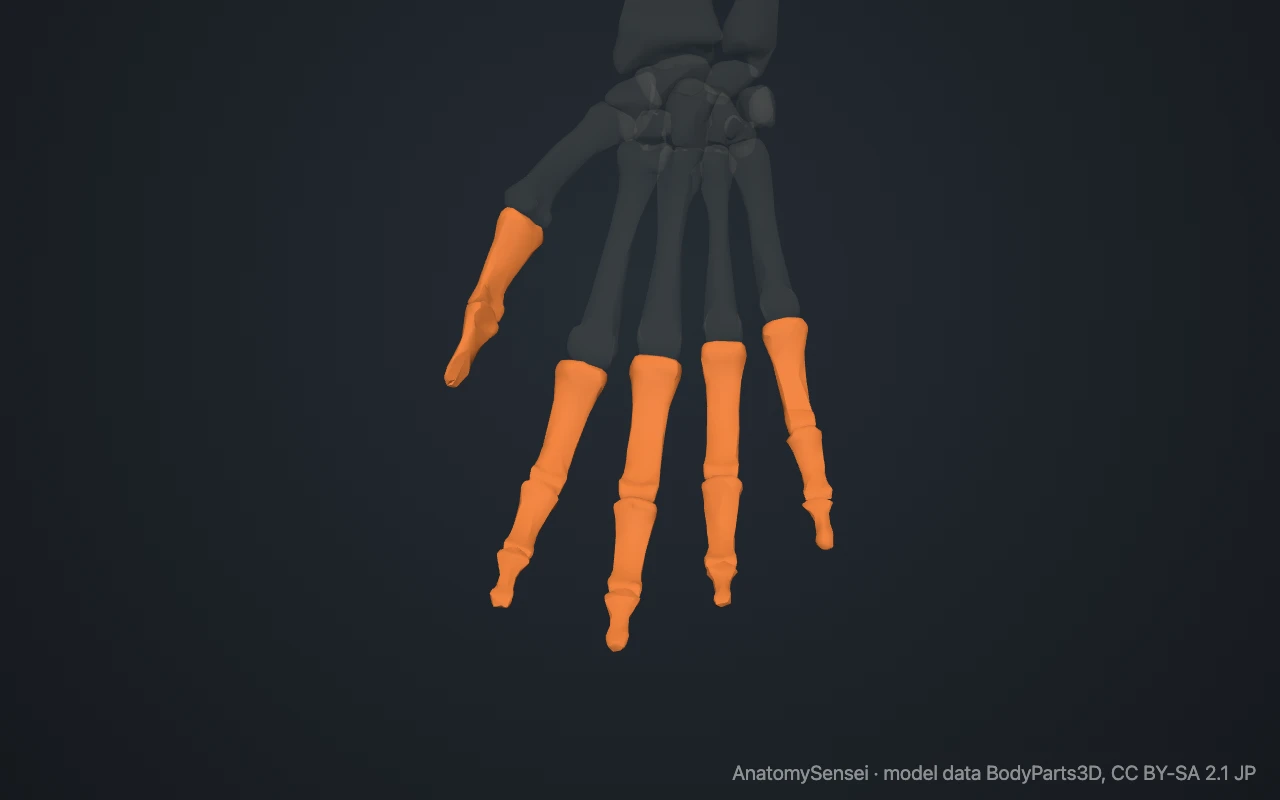
They are simple to find on your own hand. Each section of a finger between two creases contains one phalanx. A finger has three sections and three bones. The thumb has two sections and two bones.
What are the proximal, middle and distal phalanges?
The proximal phalanges are nearest the palm. There are five, and they are the longest. The middle phalanges come next. There are only four, because the thumb has none.
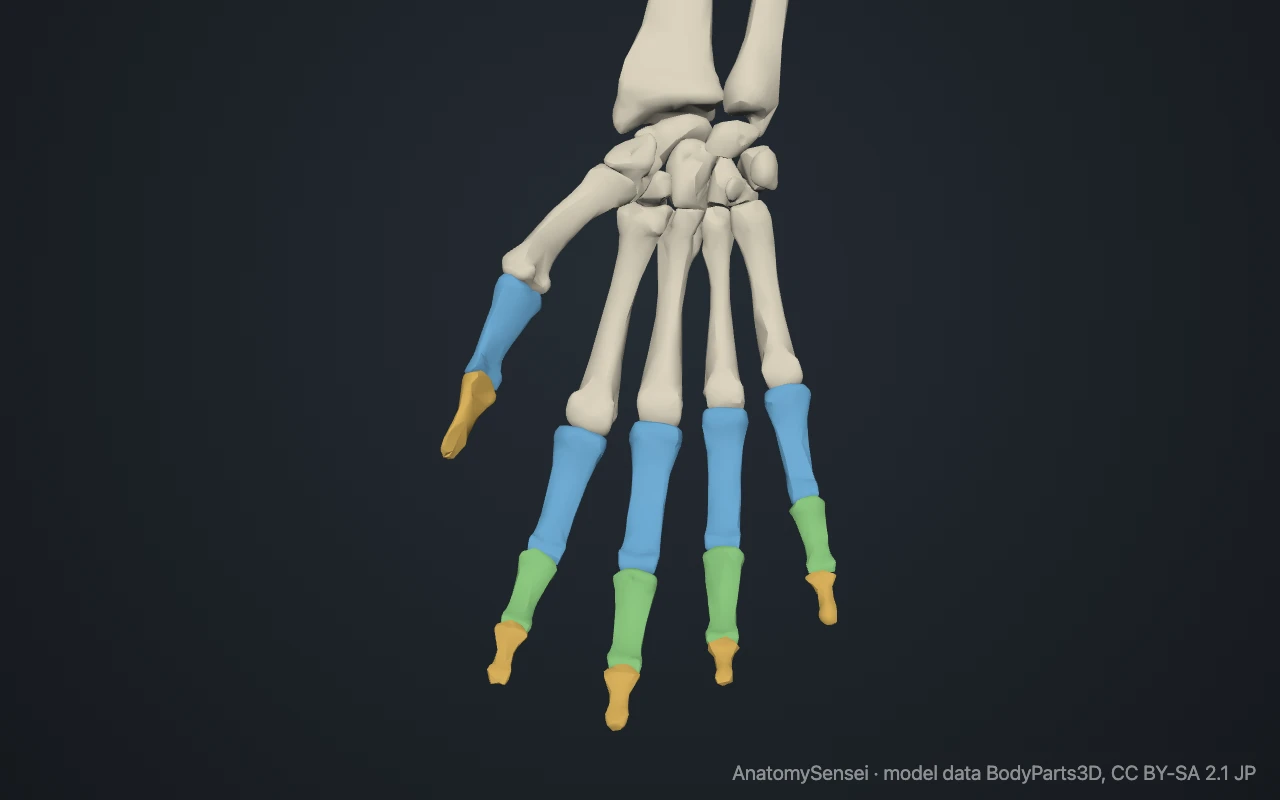
The distal phalanges are at the tips. There are five, and they are the shortest. Within each row, the bone of the middle finger is the longest and that of the little finger the shortest among the fingers.
What are the parts of a phalanx?
Every phalanx has a base, a shaft and a head. The base is the wider end nearer the wrist. The shaft is flat on the palm side and rounded on the back. The head is the far end.
The heads of the proximal and middle phalanges are shaped like a pulley, with two small knuckles and a groove between them. A distal phalanx has no joint at its far end. It finishes in a rough, spade-shaped tip called the tuft, which supports the fingertip and the nail.
What do the phalanges articulate with?
Each proximal phalanx meets a metacarpal head at a metacarpophalangeal joint, the knuckle. These joints bend, straighten and allow the fingers to spread.
The joints between the phalanges are interphalangeal joints. Each finger has two, a proximal one and a distal one. The thumb has a single one. They are hinge joints and move in one plane only.
Why does the thumb have only two phalanges?
The thumb has a proximal and a distal phalanx and no middle one. The same is true of the big toe. With its metacarpal the thumb still has three bones in a row, like the three phalanges of a finger.
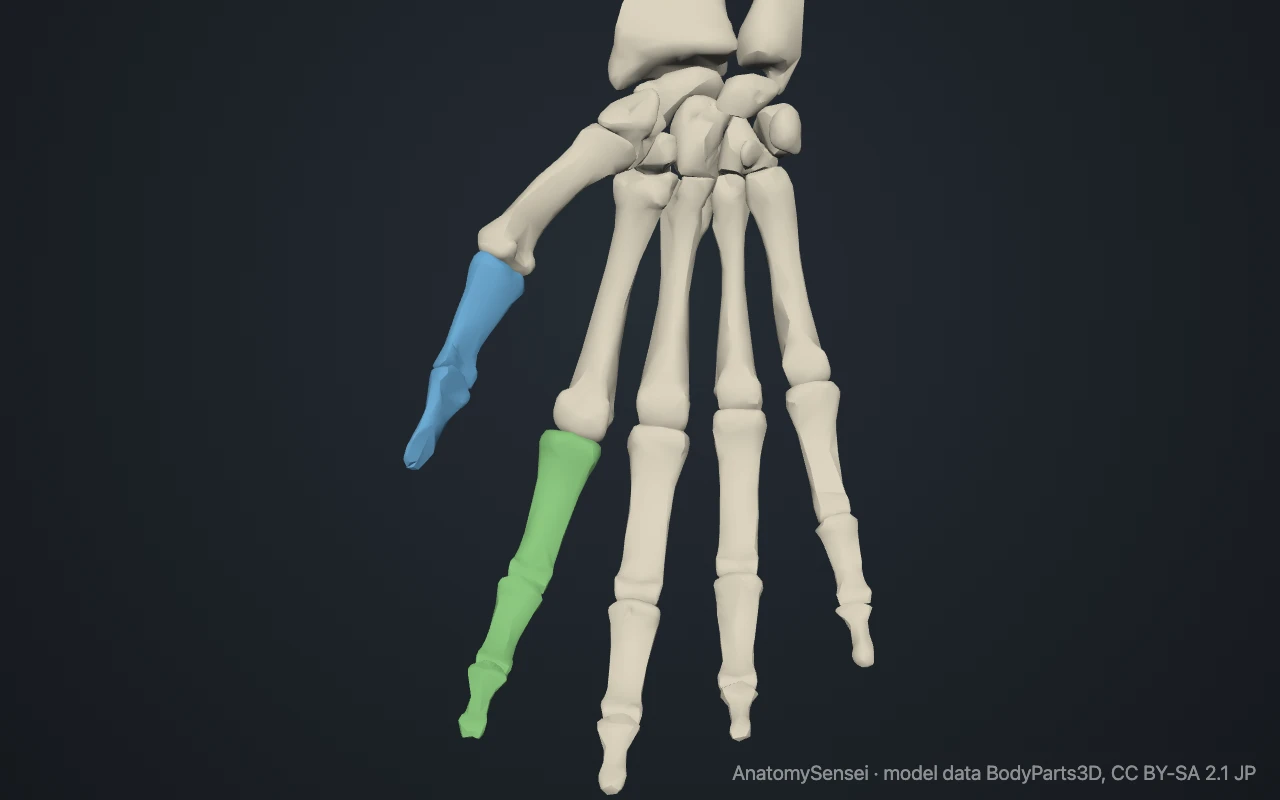
The thumb phalanges are shorter and broader than those of the fingers. The distal phalanx of the thumb is the widest of all the distal phalanges.
What attaches to the phalanges?
The fingers contain no muscle bellies. They are moved by long tendons from the forearm and by small muscles in the palm. On the palm side, one flexor tendon ends on the middle phalanx and a deeper one ends on the base of the distal phalanx.
On the back, the extensor tendon spreads into a flat sheet that attaches to the middle and distal phalanges. Fibrous tunnels fixed to the edges of the shafts hold the flexor tendons close to the bone.
What do the phalanges do?
The phalanges let the fingers curl around objects and work independently. Three segments in a row allow a finger to wrap round a handle or straighten to reach.
The distal phalanges support the finger pads, which are among the most sensitive areas of skin on the body. Their broad tips also back up the nails.
Common problems with the phalanges
Finger fractures are very common. The distal phalanx is broken most often, usually by a crush injury such as a finger caught in a door. A ball striking the fingertip can pull the extensor tendon off its base and leave the tip drooping, an injury called mallet finger.
The joints between the phalanges can dislocate, most often the proximal one. They are also frequent sites of osteoarthritis, which can produce small bony lumps beside the joints. This page describes anatomy only.
Common questions
How many phalanges are in the hand?
Fourteen in each hand: three in each of the four fingers and two in the thumb.
What is the singular of phalanges?
Phalanx.
Which finger bone is at the fingertip?
The distal phalanx.
Do the phalanges of the hand and foot have the same names?
Yes. Both have proximal, middle and distal phalanges, and both total fourteen.
Are the knuckles phalanges?
The main knuckles are the heads of the metacarpals. The smaller knuckles along the finger are the heads of the phalanges.
Is this 3D model of the phalanges of the hand free?
Yes. The interactive 3D model on this page is free to view and use for study, with no account or download needed. Its geometry comes from the open BodyParts3D data set (CC BY-SA).
About this free 3D model of the phalanges of the hand
The interactive 3D model on this page is free to use in your browser, with no sign-up. It is built from scan-based anatomy data, so every bone is a separate, correctly placed shape you can turn and inspect from any side.