
Bones of the leg
Ossa membri inferioris
Four bones lie between the hip and the ankle: the femur in the thigh, the patella at the knee, and the tibia and fibula in the leg. Together they carry the weight of the body to the foot.
Loading 3D model…
Free 3D model of the bones of the leg. Right leg. Drag to rotate, zoom with + and − (or Ctrl + scroll), click a bone to highlight and name it.
- Femur
- Patella
- Tibia
- Fibula
Key points
- The thigh has one bone, the femur, and the leg has two, the tibia and the fibula.
- The patella, or kneecap, sits in front of the knee joint.
- In anatomy the word leg means only the part between the knee and the ankle.
- The tibia carries nearly all of the body weight, and the fibula mainly anchors muscles and steadies the ankle.
What are the bones of the leg?
Between the hip and the ankle there are four bones. The femur is the thigh bone. The patella is the kneecap. The tibia, or shin bone, and the fibula lie side by side below the knee.
These four bones, with the 26 bones of the foot, make up the 30 bones of each lower limb. The model on this page shows the right limb, with the hip bone above and the foot below for orientation.
What is the difference between the thigh and the leg?
In everyday speech the leg is the whole limb. In anatomy the word is narrower. The thigh runs from the hip to the knee, and the leg runs from the knee to the ankle.
The thigh has a single bone, the femur. The leg has two, the tibia and the fibula. This pattern of one bone followed by two is the same as in the arm and forearm.
How are the four bones arranged?
The femur is the longest bone in the body. It slants inward from the hip to the knee, which brings the knees and feet under the trunk.
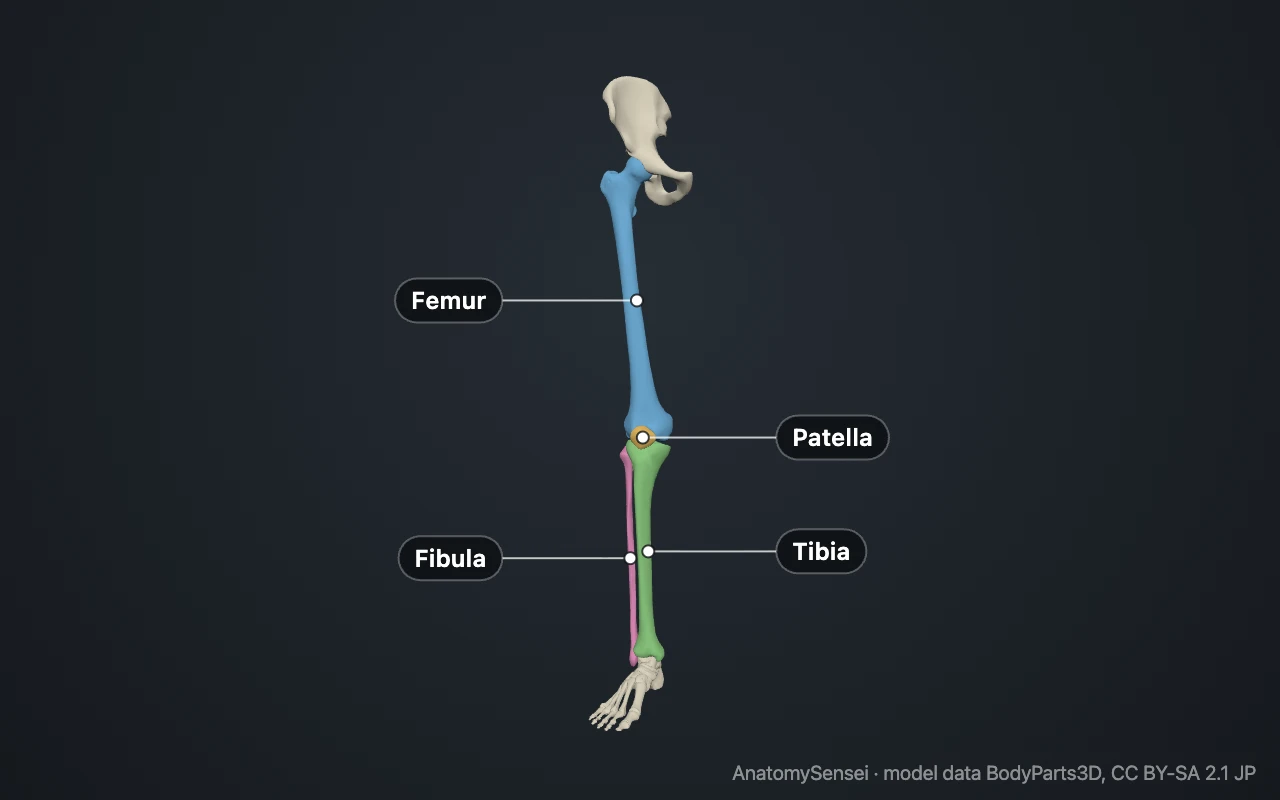
The patella is a small triangular bone in front of the lower end of the femur. It lies inside the tendon of the large muscle on the front of the thigh.
The tibia is the thick bone on the inner side of the leg, and its front edge is the shin. The fibula is the thin bone on the outer side. The two are bound together along their whole length.
How does the femur join the pelvis?
The upper end of the femur carries a rounded head on an angled neck. The head fits into a deep socket on the side of the hip bone called the acetabulum.
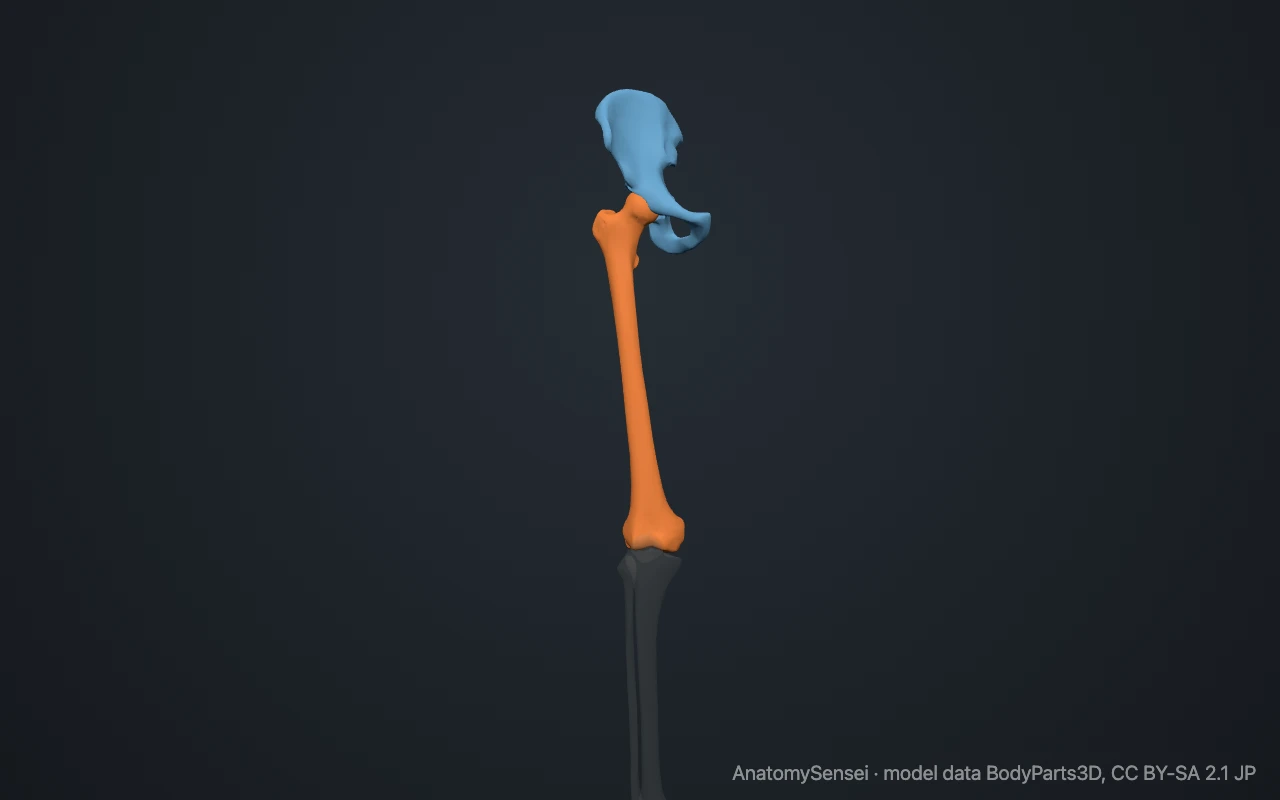
This is the hip joint, a ball-and-socket joint. It allows the thigh to swing forward and back, move out to the side and rotate, while staying stable enough to carry the body.
Which bones form the knee?
The knee is formed by three bones: the femur, the tibia and the patella. The two rounded condyles at the lower end of the femur rest on the flat top of the tibia. The patella glides in a groove on the front of the femur.
The fibula is not part of the knee joint. Its head lies just below the joint, against the outer side of the tibia.
Which bones form the ankle?
At the ankle the lower ends of the tibia and fibula form a bracket around the talus, the uppermost bone of the foot. The tibia covers the top and inner side of the talus, and the fibula covers the outer side.
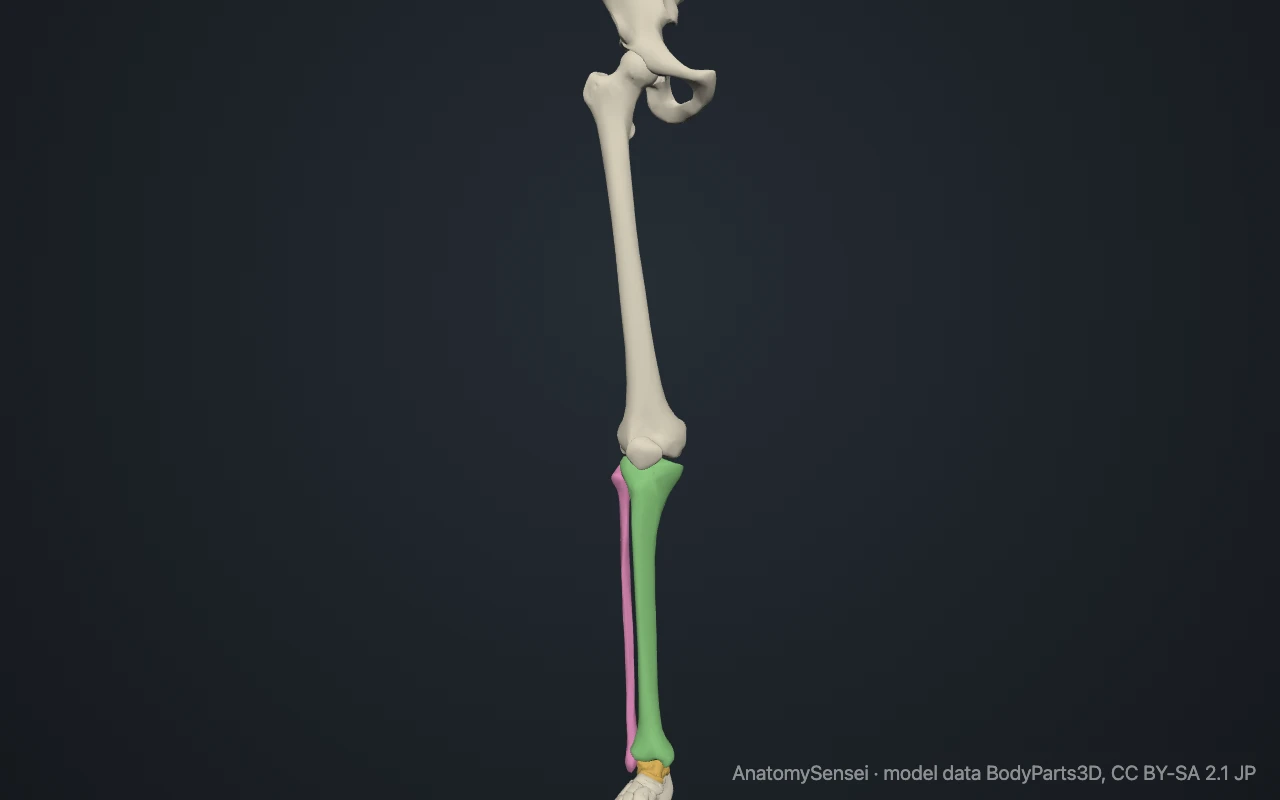
The bony bumps on each side of the ankle belong to the leg bones, not the foot. The inner one is the medial malleolus of the tibia. The outer one is the lateral malleolus of the fibula.
What do the leg bones do?
Their first job is support. Body weight passes from the pelvis through the femur, across the knee to the tibia and down to the talus. The fibula carries only a small share.
Their second job is movement. The long bones act as levers for the muscles of walking, running and jumping, and the patella improves the leverage of the muscle that straightens the knee.
Common problems with the leg bones
Fractures are the best known problems. A hip fracture is a break of the upper femur near the hip joint and is most common in older people. Breaks of the shaft of the tibia and of the malleoli at the ankle are also frequent.
The knee and hip are common sites of osteoarthritis, in which the joint surfaces wear. Overuse can cause stress fractures, most often in the tibia. This page describes anatomy only.
Free 3D models of every leg bone
Common questions
How many bones are in the leg?
Four between the hip and the ankle: the femur, patella, tibia and fibula. In the strict anatomical sense the leg, from knee to ankle, has two: the tibia and the fibula.
Which is the longest bone in the leg?
The femur. It is the longest bone in the whole body. The tibia is the second longest.
Is the kneecap a separate bone?
Yes. The patella is a separate bone that sits inside the tendon in front of the knee.
Which bone is the shin bone?
The tibia. Its sharp front edge lies directly under the skin of the shin.
Are the ankle bumps part of the foot?
No. The inner bump is the lower end of the tibia and the outer bump is the lower end of the fibula.
Is this 3D model of the bones of the leg free?
Yes. The interactive 3D model on this page is free to view and use for study, with no account or download needed. Its geometry comes from the open BodyParts3D data set (CC BY-SA).
About this free 3D model of the bones of the leg
The interactive 3D model on this page is free to use in your browser, with no sign-up. It is built from scan-based anatomy data, so every bone is a separate, correctly placed shape you can turn and inspect from any side.