
Tibia and fibula
Ossa cruris
The tibia and fibula are the two bones of the leg, between the knee and the ankle. The thick tibia bears the weight, and the thin fibula lies beside it on the outer side.
Loading 3D model…
Free 3D model of the tibia and fibula. Right leg. Drag to rotate, zoom with + and − (or Ctrl + scroll), click a bone to highlight and name it.
- Tibia
- Fibula
Key points
- The tibia is the thick inner bone of the leg and the fibula is the thin outer one.
- Only the tibia takes part in the knee joint.
- The two bones are joined at the top, at the bottom and by a membrane in between.
- Their lower ends, the two malleoli, grip the talus to form the ankle.
What are the tibia and fibula?
The tibia and fibula are the two bones of the leg, the part of the lower limb between the knee and the ankle. They lie side by side and are nearly the same length.
The tibia is the shin bone. The fibula is the slender bone next to it. They correspond to the radius and ulna of the forearm, but they are bound much more tightly and hardly move against each other.
Where are the tibia and fibula?
The tibia is on the inner side of the leg, the side of the big toe. The fibula is on the outer side, the side of the little toe, and sits slightly further back.
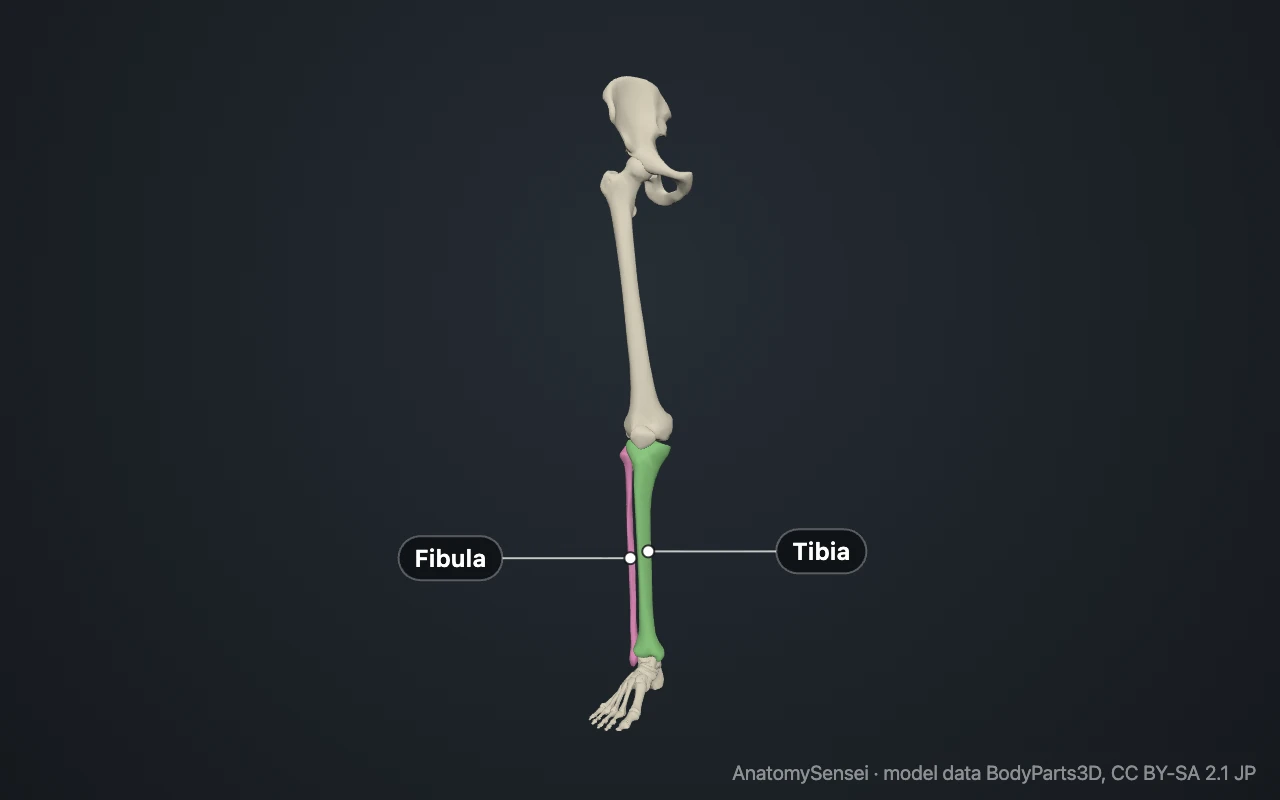
Both can be found on your own leg. The hard ridge down the front of the shin is the tibia. The bump on the inner side of the ankle is its lower end. The bump on the outer side of the ankle is the lower end of the fibula, and the small knob on the outer side just below the knee is its head.
How do the tibia and fibula differ?
The clearest difference is size. The tibia is thick, with a broad upper end that supports the femur. The fibula is thin along its whole length.
They also differ in what they carry. The tibia transmits nearly all of the body weight. The fibula carries only a small share and serves mainly for muscle attachment and ankle stability.
Finally, they differ at the knee. The tibia forms the knee joint with the femur. The fibula stops short of it and touches only the tibia.
How are the tibia and fibula joined?
The two bones are joined in three places. At the top, the head of the fibula meets the underside of the lateral condyle of the tibia. This small joint allows only slight gliding.
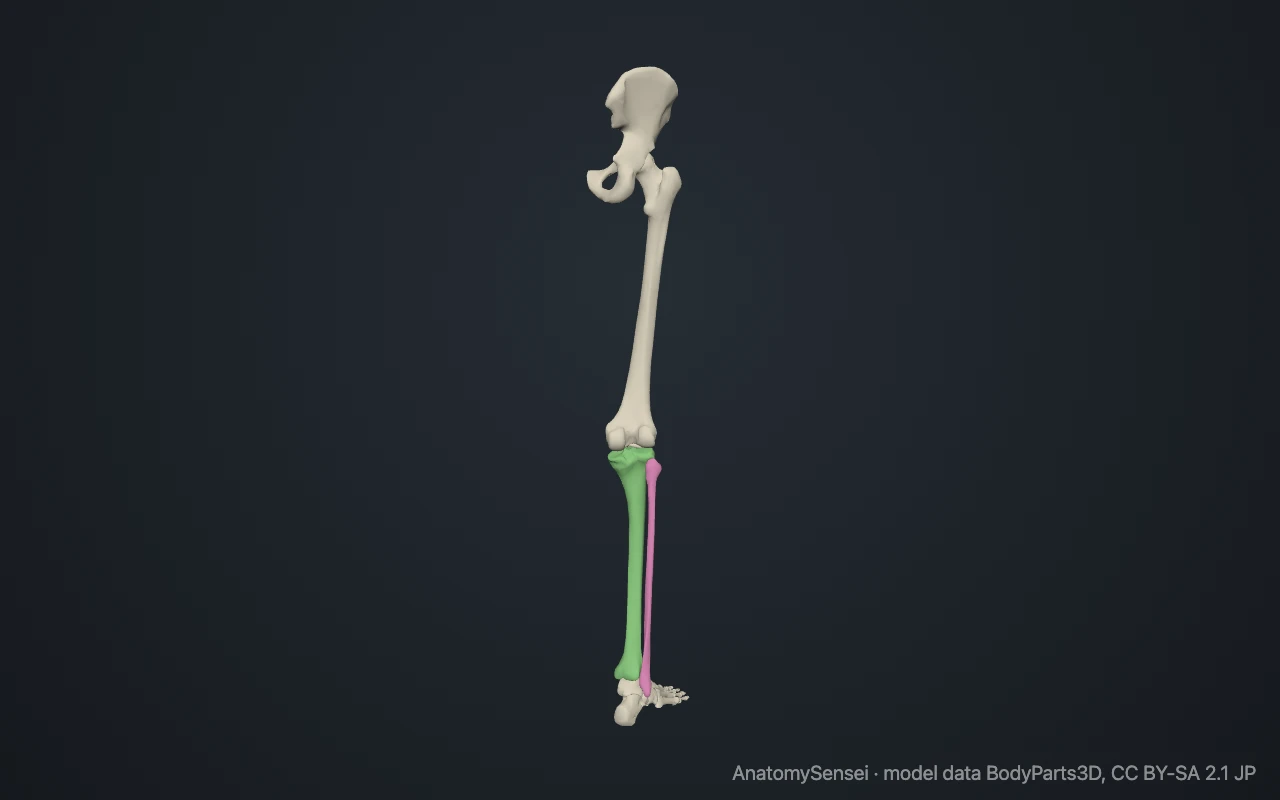
Between the shafts stretches the interosseous membrane, a strong sheet of fibrous tissue. It ties the bones together and gives extra surface for muscles. On the model the membrane is not shown, so a gap appears between the shafts.
At the bottom, the fibula fits into a notch on the tibia and is held there by strong ligaments. This fibrous joint is called the tibiofibular syndesmosis.
How do the tibia and fibula form the ankle?
Together the lower ends of the two bones form a three-sided socket, often called the ankle mortise. The lower surface of the tibia is its roof. The medial malleolus of the tibia is its inner wall, and the lateral malleolus of the fibula is its outer wall.
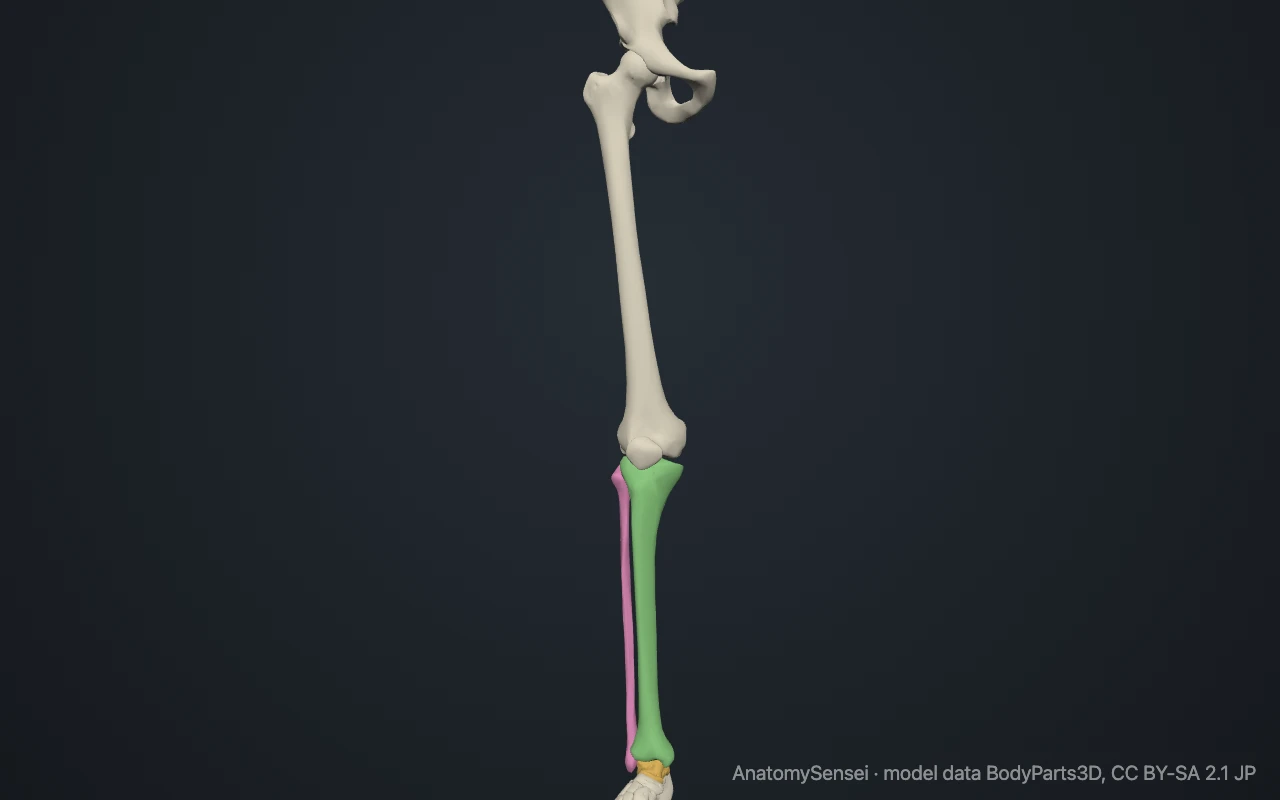
The upper part of the talus fits into this socket like a tenon in a carpenter’s joint. The fit lets the foot hinge up and down while limiting side-to-side tilt.
The two walls are not equal. The lateral malleolus reaches lower than the medial one. The ligaments of the syndesmosis keep the two bones from spreading apart under load.
What do the tibia and fibula do together?
As a pair they carry the body over the foot. The tibia acts as the pillar, and the fibula acts as a strut that completes the ankle.
They also provide the origin for most muscles that move the foot and toes. These muscles arise from both bones and from the membrane between them.
Common problems with the tibia and fibula
A strong blow or twist can break both bones at once in the shaft. At the ankle, a fracture may involve one malleolus or both.
An injury to the ligaments of the syndesmosis is often called a high ankle sprain. Stress fractures from repeated loading occur in both bones, more often in the tibia. This page describes anatomy only.
Common questions
Which is the inner bone, the tibia or the fibula?
The tibia is on the inner side of the leg. The fibula is on the outer side.
Which bone carries the weight?
The tibia. The fibula carries only a small share.
Do the tibia and fibula rotate around each other like the forearm bones?
No. They are bound tightly together and allow only very slight movement.
Are the ankle bones part of the tibia and fibula?
The two bumps at the ankle are. The inner one is the end of the tibia and the outer one is the end of the fibula.
Is this 3D model of the tibia and fibula free?
Yes. The interactive 3D model on this page is free to view and use for study, with no account or download needed. Its geometry comes from the open BodyParts3D data set (CC BY-SA).
About this free 3D model of the tibia and fibula
The interactive 3D model on this page is free to use in your browser, with no sign-up. It is built from scan-based anatomy data, so every bone is a separate, correctly placed shape you can turn and inspect from any side.