
Fibula
Fibula
The fibula is the thin bone on the outer side of the leg, beside the tibia. It carries little weight but anchors muscles and forms the outer side of the ankle.
Loading 3D model…
Free 3D model of the fibula. Right leg. Drag to rotate, zoom with + and − (or Ctrl + scroll), click a bone to highlight and name it.
Key points
- The fibula is the slender bone on the outer side of the leg.
- It is not part of the knee joint and carries only a small share of body weight.
- Its lower end is the lateral malleolus, the bump on the outer side of the ankle.
- It joins the tibia at both ends and the talus at the ankle.
What is the fibula?
The fibula is the smaller of the two leg bones. It is about as long as the tibia but far thinner. It is sometimes called the calf bone.
Its name is the Latin word for a brooch or clasp. Beside the tibia it looks like the pin of a clasp.
Where is the fibula?
It lies on the outer side of the leg, slightly behind the tibia. Most of its shaft is buried in muscle.
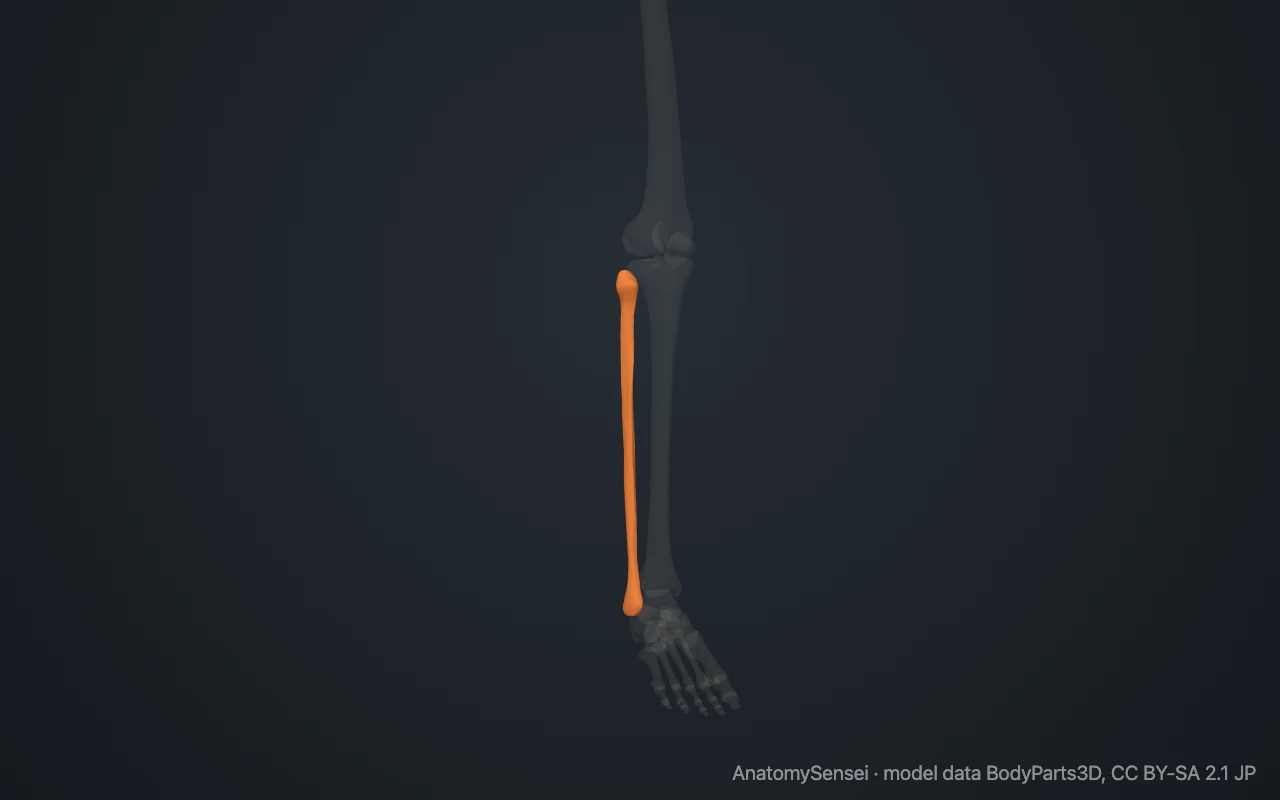
Its two ends can be felt. The lower end is the bump on the outer side of your ankle. The upper end, the head, is a small knob on the outer side of the leg just below the knee. It is easiest to find with the knee bent, by following the tight tendon at the outer back of the knee downward.
What are the parts of the fibula?
The upper end is the head, which has a small flat surface for the tibia. Just below it the bone narrows into the neck.
The shaft is long and thin, with ridges that mark where muscles and the interosseous membrane attach. The lower end widens into the lateral malleolus. Its inner face is smooth where it meets the talus.
The lateral malleolus reaches lower and lies further back than the medial malleolus of the tibia. This can be checked on the model from the front.
What does the fibula articulate with?
The fibula meets two bones. Its head joins the underside of the lateral condyle of the tibia. Its lower end fits into a notch on the tibia just above the ankle, where the two are bound tightly together.
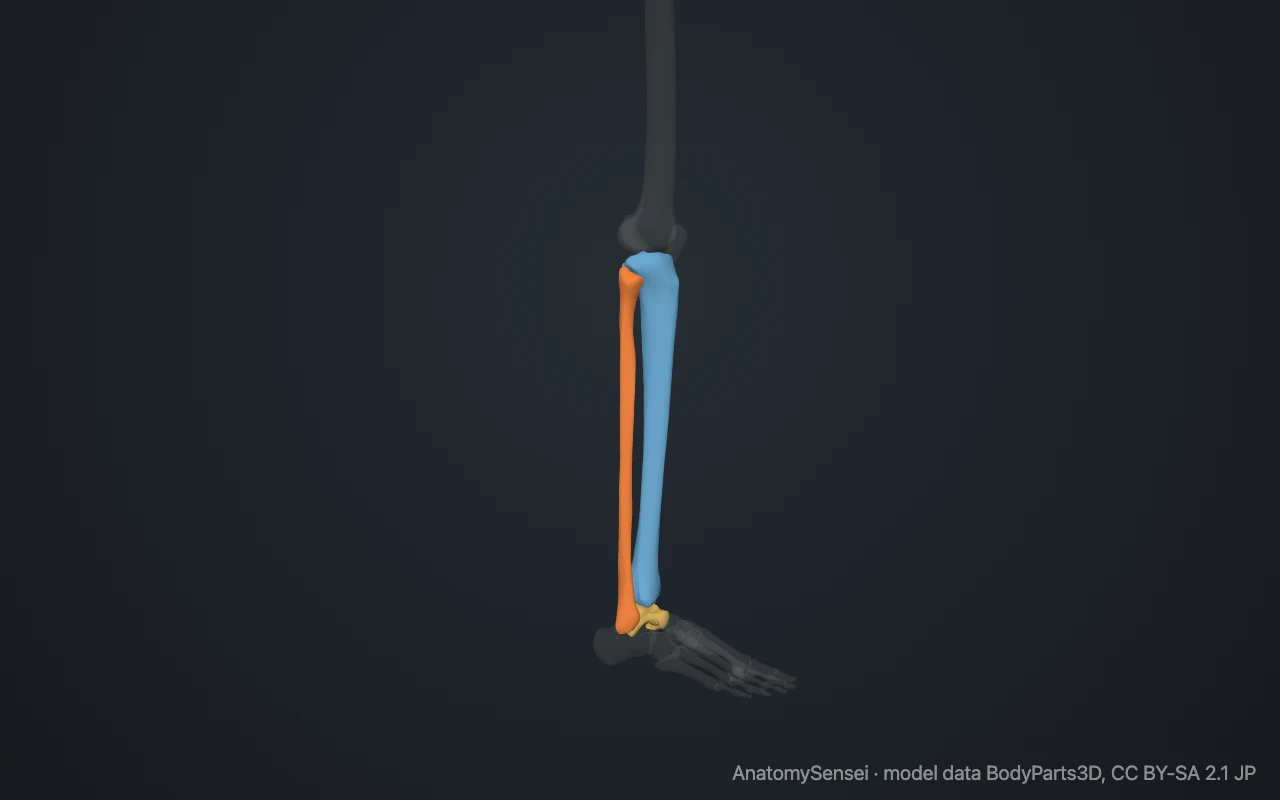
The inner face of the lateral malleolus meets the outer side of the talus, forming the outer wall of the ankle joint. The fibula does not reach the femur and is not part of the knee joint.
What attaches to the fibula?
The tendon of the biceps femoris, one of the hamstrings, attaches to the head. So does the lateral collateral ligament of the knee. The two fibularis muscles, also called the peroneal muscles, arise from the outer surface of the shaft, and part of the soleus arises from the back.
The interosseous membrane connects the shaft to the tibia. The ligaments on the outer side of the ankle run from the lateral malleolus to the talus and the calcaneus. A nerve, the common fibular nerve, winds around the neck of the bone close to the skin.
What does the fibula do?
The fibula carries only a small part of body weight. Its main roles are to give attachment to muscles and to hold the ankle steady.
The lateral malleolus is the outer wall of the ankle. It stops the talus from sliding outward. Because the shaft is not essential for bearing weight, surgeons can use part of it as a bone graft.
Common problems with the fibula
The most common injury is a fracture of the lateral malleolus, usually from a twisting injury of the ankle. Sprains of the outer ankle involve the ligaments attached to the same part of the bone.
A fracture at the neck can injure the common fibular nerve that passes around it. The shaft is also a site of stress fractures in runners. This page describes anatomy only.
Common questions
Is the fibula a weight-bearing bone?
Only slightly. The tibia carries nearly all of the weight in the leg.
Is the fibula part of the knee?
No. Its head lies below the knee joint and meets only the tibia.
Which bone forms the outer ankle bump?
The fibula. The bump is its lower end, the lateral malleolus.
Is the fibula the same as the calf bone?
Yes. Calf bone is an everyday name for the fibula.
Is the fibula on the same side as the little toe?
Yes. It is on the outer side of the leg, the side of the little toe.
Is this 3D model of the fibula free?
Yes. The interactive 3D model on this page is free to view and use for study, with no account or download needed. Its geometry comes from the open BodyParts3D data set (CC BY-SA).
About this free 3D model of the fibula
The interactive 3D model on this page is free to use in your browser, with no sign-up. It is built from scan-based anatomy data, so every bone is a separate, correctly placed shape you can turn and inspect from any side.