
Trapezoid bone
Os trapezoideum
The trapezoid is a small, wedge-shaped carpal bone in the distal row of the wrist. It sits between the trapezium and the capitate and supports the second metacarpal, the bone of the index finger.
Loading 3D model…
Free 3D model of the trapezoid bone. Right hand. Drag to rotate, zoom with + and − (or Ctrl + scroll), click a bone to highlight and name it.
Key points
- The trapezoid is the smallest bone in the distal row of the wrist.
- It is wedged between the trapezium and the capitate.
- It holds the base of the second metacarpal in a tight, nearly rigid joint.
- It is well protected and is the carpal bone least often fractured.
What is the trapezoid bone?
The trapezoid is one of the eight carpal bones. It is the second bone of the distal row, counting from the thumb side, and the smallest in that row. Older texts call it the lesser multangular bone.
It is a quiet bone. It is small, deeply set and tightly bound to its neighbours, and its main task is to give the index finger a solid base.
Where is the trapezoid bone?
It lies at the base of the index finger's metacarpal, with the trapezium on its thumb side, the capitate on its other side and the scaphoid behind it.
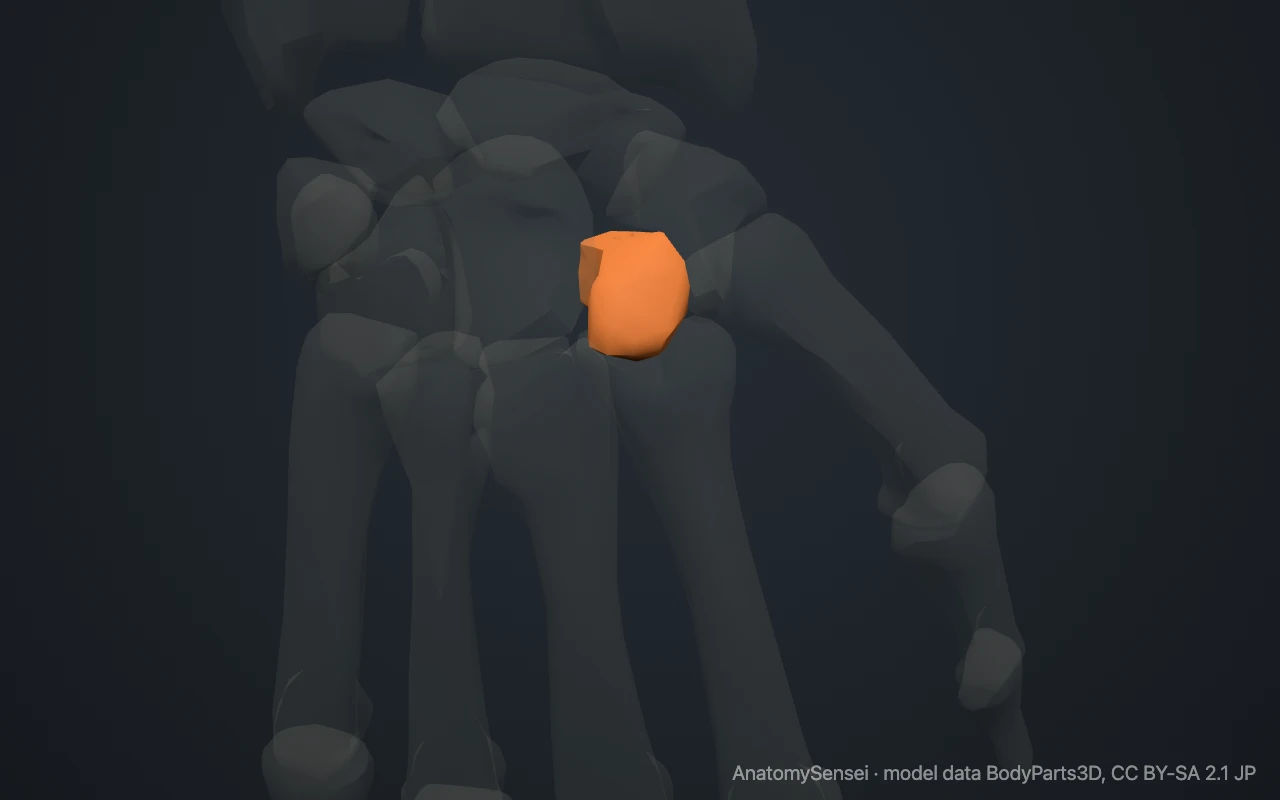
It is hard to feel as a separate bone. To find its position, trace the long bone of your index finger down the back of the hand to its base. The trapezoid is the bone just beyond that base, in a slight dip before the wrist.
What does the trapezoid look like?
The trapezoid is shaped like a wedge. Its back surface is about twice as wide as its palm surface, so it is easiest to see from the back of the hand. This is why the model on this page opens from the back.
Four of its six surfaces are smooth joint surfaces. The surface for the second metacarpal has a ridge down the middle, which fits into a notch in the base of that bone.
What does the trapezoid articulate with?
The trapezoid touches four bones. Towards the forearm it meets the scaphoid. On the thumb side it meets the trapezium, and on the other side the capitate.
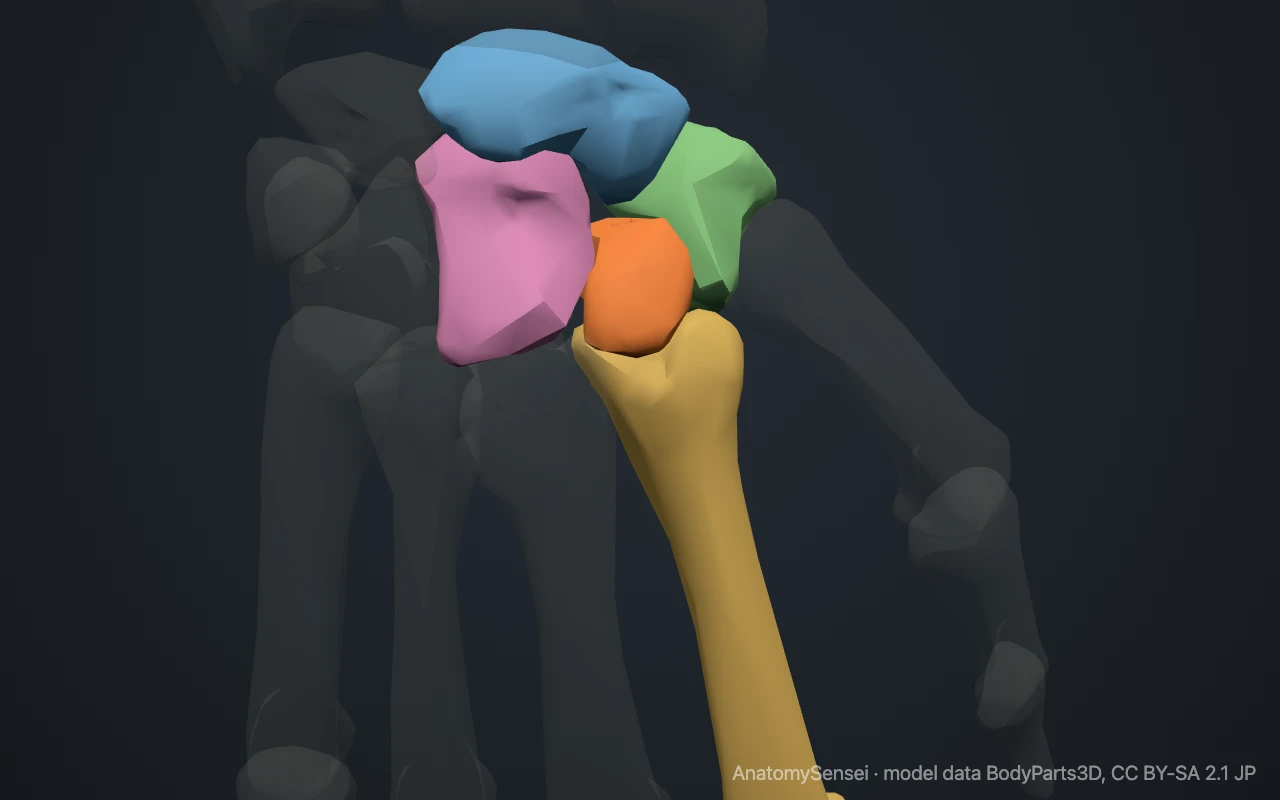
Towards the fingers it meets the base of the second metacarpal. The ridge-and-notch fit, together with strong ligaments, makes this one of the least mobile joints in the hand.
What attaches to the trapezoid?
Its rough palm and back surfaces give attachment to ligaments that bind it to the trapezium, the capitate, the scaphoid and the second metacarpal.
Few muscles reach it. Part of the deep head of flexor pollicis brevis, a small thumb muscle, may arise from its palm surface. The tendons that cross the wrist pass over it without attaching.
What does the trapezoid do?
It forms a fixed base for the index finger. The second and third metacarpals barely move on the carpus, and this stiff central pillar gives the more mobile thumb and outer fingers something to work against.
Its wedge shape also helps to build the arch across the wrist. With the narrow edge on the palm side, the row of bones curves forward at its ends and forms the hollow of the carpal tunnel.
Common problems with the trapezoid
The trapezoid is the carpal bone least often fractured. It is small, sheltered by its neighbours and held by strong ligaments. When it does break or shift, the cause is usually a strong force driven along the index finger metacarpal.
Arthritis can affect the joints between the scaphoid, trapezium and trapezoid, usually together with arthritis at the base of the thumb. This page describes anatomy only.
Common questions
Which finger sits on the trapezoid?
The index finger. The trapezoid supports the second metacarpal.
Is the trapezoid bigger than the trapezium?
No. The trapezoid is the smaller of the two, and the smallest bone in the distal row.
How many bones touch the trapezoid?
Four: the scaphoid, trapezium, capitate and second metacarpal.
Why is the trapezoid rarely broken?
It is small and wedged tightly between larger bones, which shield it.
Is this 3D model of the trapezoid bone free?
Yes. The interactive 3D model on this page is free to view and use for study, with no account or download needed. Its geometry comes from the open BodyParts3D data set (CC BY-SA).
About this free 3D model of the trapezoid bone
The interactive 3D model on this page is free to use in your browser, with no sign-up. It is built from scan-based anatomy data, so every bone is a separate, correctly placed shape you can turn and inspect from any side.