
Radius
Radius
The radius is the forearm bone on the thumb side. It is narrow at the elbow and wide at the wrist, where it forms the main joint with the hand.
Loading 3D model…
Free 3D model of the radius. Right arm. Drag to rotate, zoom with + and − (or Ctrl + scroll), click a bone to highlight and name it.
Key points
- The radius is the forearm bone on the same side as the thumb.
- Its small, disc-shaped head is at the elbow and its wide end is at the wrist.
- It rotates around the ulna to turn the palm up and down.
- It carries most of the load that passes from the hand to the forearm.
What is the radius?
The radius is one of the two long bones of the forearm. The other is the ulna. The radius lies on the lateral side, which is the thumb side when the palm faces forward.
Its name is the Latin word for the spoke of a wheel. The name suits it, because the bone turns around the ulna much as a spoke turns around a hub.
Where is the radius?
It runs from the outer side of the elbow to the thumb side of the wrist. In the model the right palm faces forward, so the radius is on the outer side of the forearm.
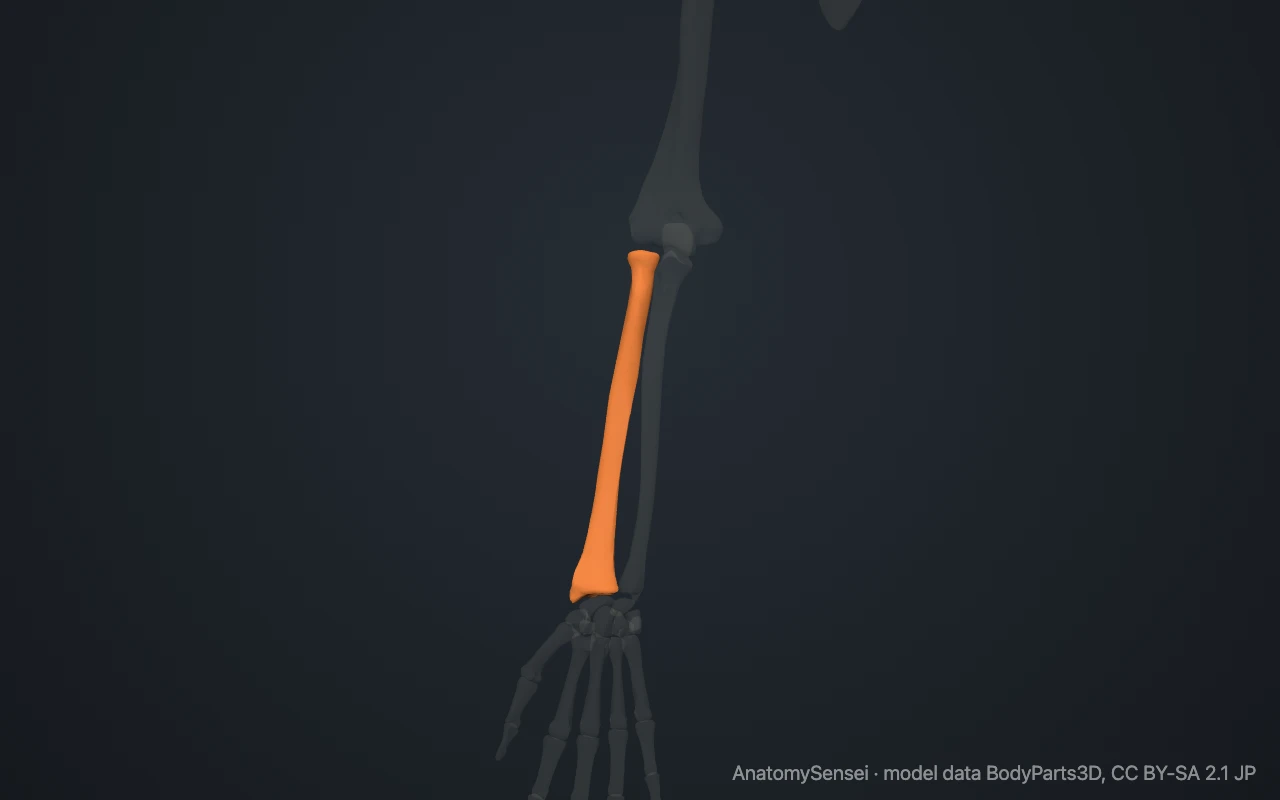
You can feel both ends. At the wrist, the firm bone just above the base of your thumb is the lower end of the radius. At the elbow, press into the dimple on the outer side and turn your palm up and down. The small disc that spins under your finger is the head of the radius.
What are the parts of the radius?
The upper end has a head shaped like a thick disc, with a shallow cup on top. Below it is a short neck, and below that a bump called the radial tuberosity.
The shaft curves gently outward and thickens as it descends. Its inner edge is sharp and faces the ulna.
The lower end is the widest part. Its outer side ends in a point, the styloid process, which can be felt at the base of the thumb. Its inner side has a small notch for the head of the ulna, and its underside is a smooth hollow for the wrist bones.
What does the radius articulate with?
At the elbow, the cup on the head meets the capitulum of the humerus. The rim of the head also turns in a notch on the side of the ulna.
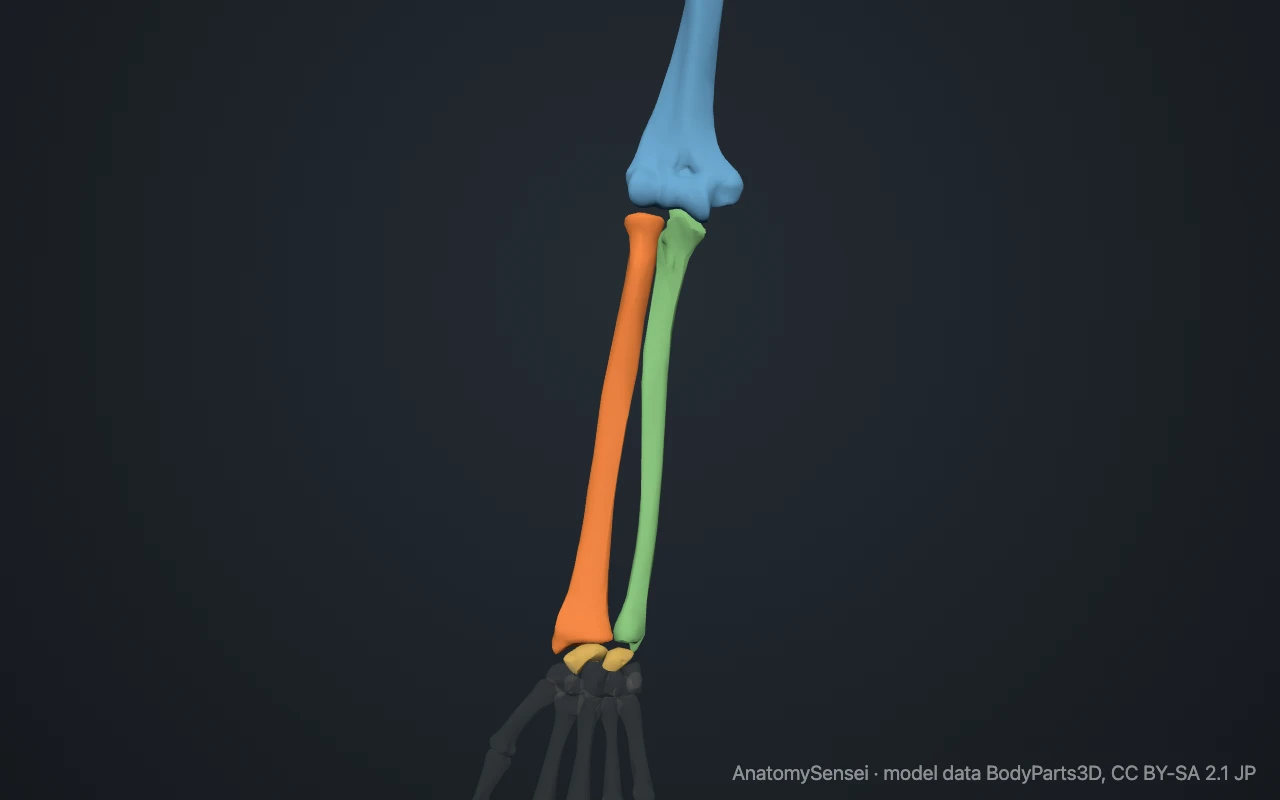
At the wrist, the lower end meets two carpal bones, the scaphoid and the lunate. This is the main part of the wrist joint. The lower end also meets the head of the ulna, so the radius touches the ulna at both ends.
What attaches to the radius?
The biceps tendon attaches to the radial tuberosity. When the biceps pulls, it bends the elbow and also turns the palm upward.
The supinator muscle wraps around the upper shaft, pronator teres attaches halfway down, and pronator quadratus crosses to the lower shaft. A sheet of fibrous tissue, the interosseous membrane, joins the sharp inner edge to the ulna along most of its length.
What does the radius do?
It has two main jobs. First, it carries the hand. Most of the force from the wrist passes into the wide lower end of the radius.
Second, it turns the hand. The radius pivots around the ulna and takes the hand with it, which turns the palm up or down without moving the elbow.
Common problems with the radius
A break of the lower end of the radius is among the most common fractures in adults. It typically follows a fall onto an outstretched hand. One well-known pattern is called a Colles fracture.
The same kind of fall can crack the head of the radius at the elbow. In young children, a sudden pull on the hand can make the head slip partly out of the ligament that holds it, an injury known as a pulled elbow. This page describes anatomy only.
Common questions
Is the radius on the thumb side or the little-finger side?
The thumb side. The ulna is on the little-finger side.
Is the radius bigger than the ulna?
The ulna is a little longer. The radius is wider at the wrist and the ulna is wider at the elbow.
Where is the pulse felt against the radius?
At the wrist, on the front of the lower end of the radius near the base of the thumb. The radial artery lies against the bone there.
Why is it called the radius?
From the Latin for the spoke of a wheel.
Is this 3D model of the radius free?
Yes. The interactive 3D model on this page is free to view and use for study, with no account or download needed. Its geometry comes from the open BodyParts3D data set (CC BY-SA).
About this free 3D model of the radius
The interactive 3D model on this page is free to use in your browser, with no sign-up. It is built from scan-based anatomy data, so every bone is a separate, correctly placed shape you can turn and inspect from any side.