
Radius and ulna (forearm bones)
Radius et ulna
The radius and the ulna are the two bones of the forearm. They lie side by side between the elbow and the wrist, and the radius can rotate around the ulna to turn the palm.
Loading 3D model…
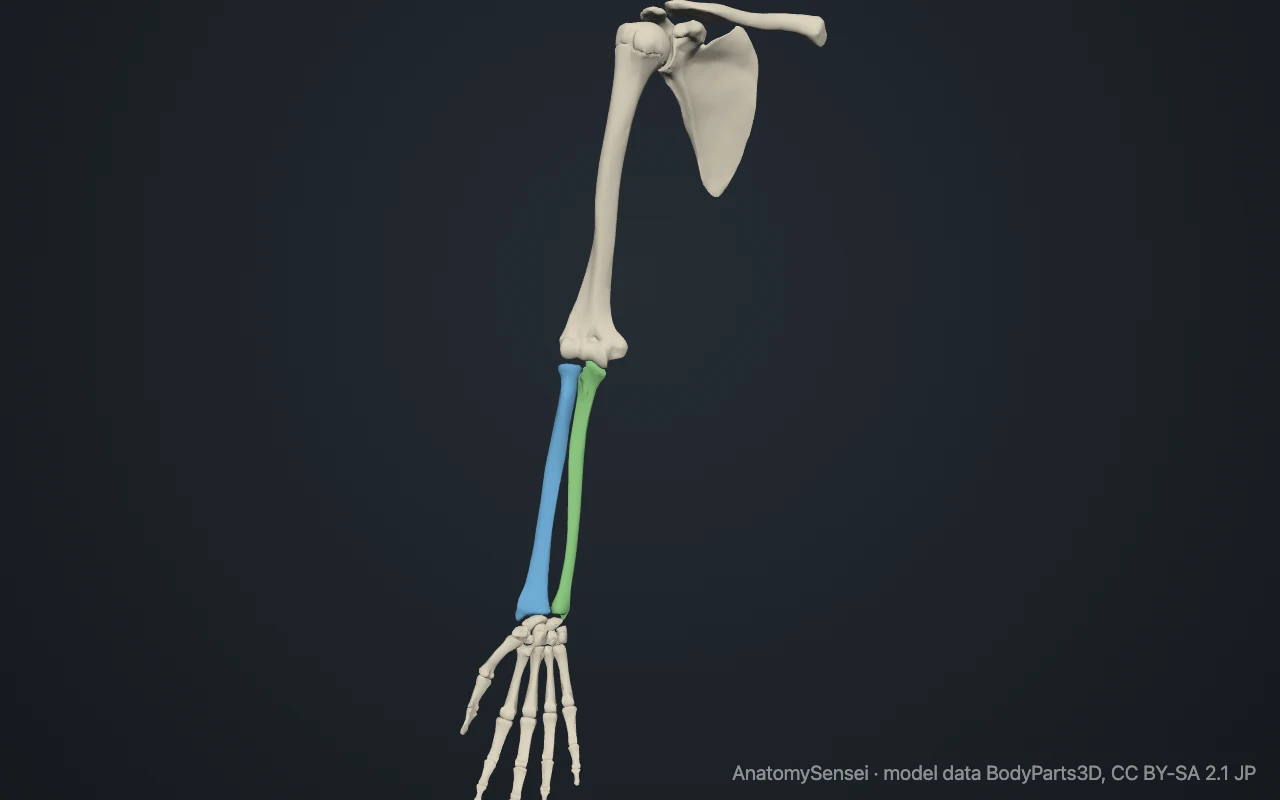
Free 3D model of the radius and ulna. Right arm. Drag to rotate, zoom with + and − (or Ctrl + scroll), click a bone to highlight and name it.
- Radius (thumb side)
- Ulna (little-finger side)
Key points
- The radius is on the thumb side and the ulna is on the little-finger side.
- The ulna forms the main joint at the elbow and the radius forms the main joint at the wrist.
- The two bones meet at both ends and are tied together by a membrane in between.
- Turning the palm down crosses the radius over the ulna, and turning it up uncrosses them.
What are the radius and ulna?
The radius and ulna are the two long bones of the forearm. They run side by side from the elbow to the wrist and are roughly the same length, with the ulna slightly longer.
Having two bones in place of one is what lets the forearm rotate. A single bone could bend at the elbow but could not turn the hand over.
Which side is the radius and which is the ulna?
The radius is on the thumb side and the ulna is on the little-finger side. A common way to remember it is that the radius is the bone at which the radial pulse is taken, at the base of the thumb.
You can check on your own arm. The point of your elbow belongs to the ulna. The broad, firm bone just above the base of your thumb belongs to the radius.
How do the radius and ulna differ?
The two bones are shaped like opposites. The ulna is large at the elbow and small at the wrist. Its hooked upper end grips the humerus, and it tapers to a small rounded head at the lower end.
The radius is small at the elbow and large at the wrist. Its upper end is a small disc and its lower end is broad. This also means the two bones have their heads at opposite ends.
Their roles differ in the same way. The ulna does most of the work at the elbow, and the radius does most of the work at the wrist.
How are the radius and ulna joined?
They meet at two radioulnar joints. At the upper one, near the elbow, the head of the radius turns in a notch on the side of the ulna, held there by a ring-shaped ligament. At the lower one, near the wrist, a notch on the radius swings around the head of the ulna.
Between the joints, the shafts are tied together by the interosseous membrane, a strong sheet of fibrous tissue. It keeps the bones together and passes force from one to the other. The model shows bones only, so the gap between the shafts appears empty.
How does the radius rotate around the ulna?
Turning the palm is called pronation and supination. In supination the palm faces forward or up, and the two bones lie parallel. This is the position the model shows.
In pronation the palm faces backward or down. The ulna stays still. The head of the radius spins on the spot at the elbow, while its lower end swings across the front of the ulna and carries the hand with it. The radius ends up lying across the ulna like one arm of an X.
The biceps and the supinator muscle turn the palm up. Pronator teres and pronator quadratus turn it down.
What do the radius and ulna articulate with?
Both bones meet the humerus at the elbow. The ulna fits the spool-shaped trochlea and the radius rests against the rounded capitulum.
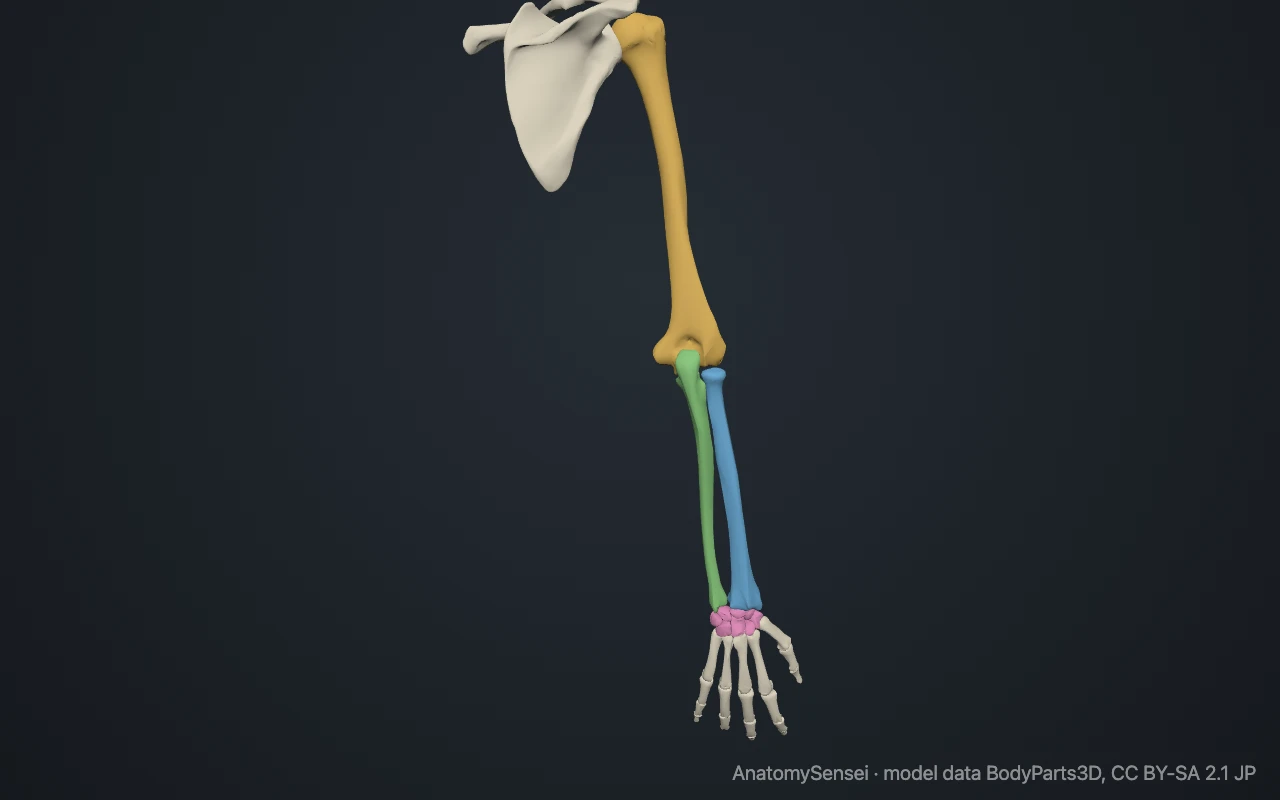
At the wrist, only the radius meets the carpal bones directly, at the scaphoid and the lunate. The head of the ulna is separated from them by a disc of cartilage.
What do the radius and ulna do together?
Together they give the hand a stable hinge and a rotating platform. The ulna provides the hinge at the elbow. The radius provides the platform that carries the hand and turns it.
Force from the hand enters the radius at the wrist. Part of it is passed across the interosseous membrane to the ulna and then on to the humerus.
Common problems with the radius and ulna
Because the two bones are linked at both ends, an injury to one often involves the other. Both bones can break together in the middle of the forearm, especially in children.
A break of the ulnar shaft with a dislocated radial head is called a Monteggia fracture. A break of the radial shaft with disruption of the lower radioulnar joint is called a Galeazzi fracture. This page describes anatomy only.
Common questions
Which forearm bone moves when the palm is turned over?
The radius. The ulna stays almost still and the radius rotates around it.
Do the radius and ulna cross?
Yes, when the palm faces down or backward. With the palm facing forward they lie parallel.
Which bone forms the elbow?
Mainly the ulna, which grips the humerus. The radius also takes part in the elbow joint.
Which bone forms the wrist?
Mainly the radius, which meets the scaphoid and the lunate.
Is this 3D model of the radius and ulna free?
Yes. The interactive 3D model on this page is free to view and use for study, with no account or download needed. Its geometry comes from the open BodyParts3D data set (CC BY-SA).
About this free 3D model of the radius and ulna
The interactive 3D model on this page is free to use in your browser, with no sign-up. It is built from scan-based anatomy data, so every bone is a separate, correctly placed shape you can turn and inspect from any side.