
Humerus (upper arm bone)
Humerus
The humerus is the bone of the upper arm. It is the longest bone of the upper limb and runs from the shoulder to the elbow.
Loading 3D model…
Free 3D model of the humerus. Right arm. Drag to rotate, zoom with + and − (or Ctrl + scroll), click a bone to highlight and name it.
Key points
- The humerus is the only bone of the upper arm.
- Its rounded head fits the glenoid cavity of the scapula to form the shoulder joint.
- At the elbow its trochlea meets the ulna and its capitulum meets the radius.
- The two bumps felt at the sides of the elbow are its medial and lateral epicondyles.
What is the humerus?
The humerus is the single bone of the upper arm. It is a typical long bone, with a rounded upper end, a long shaft and a wide, flattened lower end.
It is the longest and largest bone of the upper limb. It links the shoulder girdle above to the two bones of the forearm below.
Where is the humerus?
It runs from the shoulder to the elbow, deep to the biceps in front and the triceps behind. Most of the shaft is covered by muscle and is hard to feel.
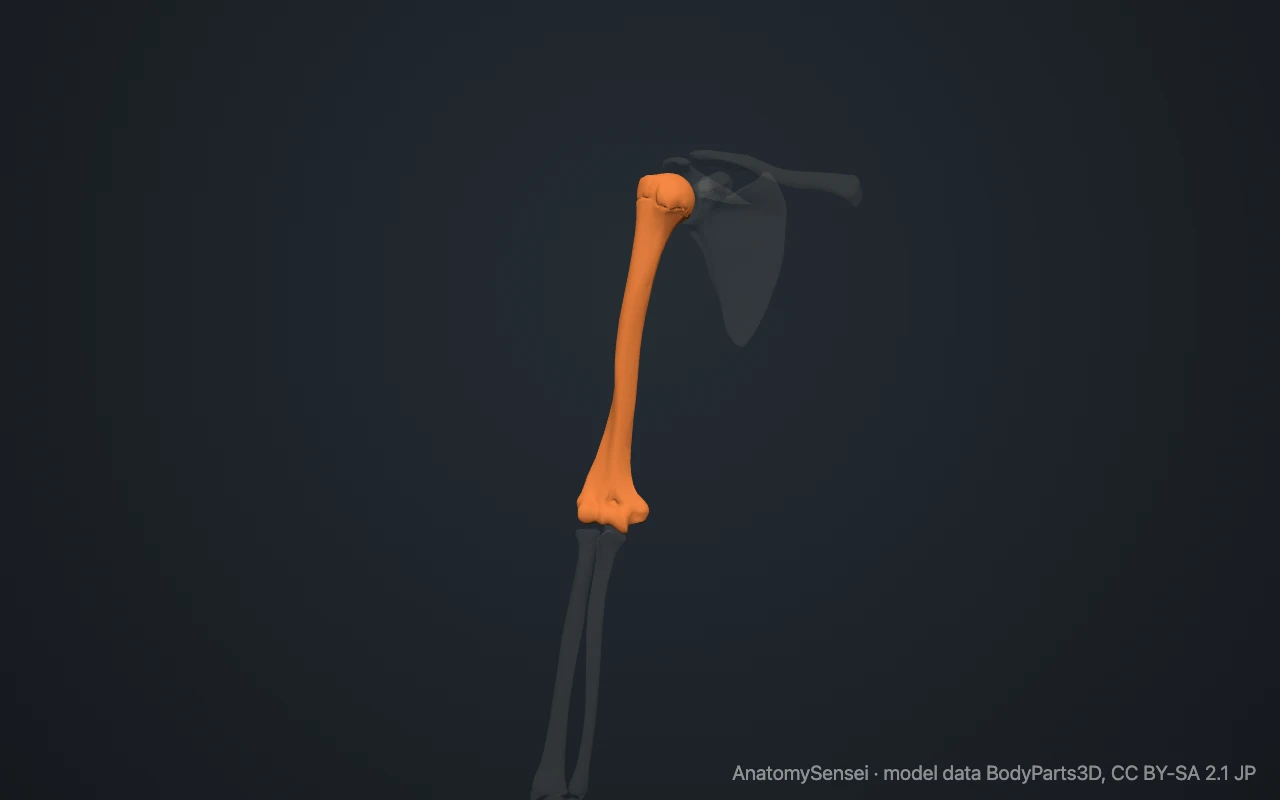
The lower end is easy to find. Bend your elbow and feel the two bony bumps on either side of it. The one on the inner side is the medial epicondyle and the one on the outer side is the lateral epicondyle.
What are the parts of the upper humerus?
The head is a smooth half-sphere that faces inward, upward and slightly backward. A shallow groove around its edge is called the anatomical neck.
Beside the head are two bumps. The greater tubercle is on the outer side and the lesser tubercle is on the front. A groove runs between them, and a tendon of the biceps lies in it.
Just below the tubercles the bone narrows to join the shaft. This narrow part is called the surgical neck, because it is a common site of fracture.
What are the parts of the shaft and lower humerus?
The shaft is round above and becomes flatter and wider below. Halfway down its outer side is a rough patch, the deltoid tuberosity, where the deltoid muscle attaches. A shallow spiral groove on the back of the shaft carries the radial nerve.
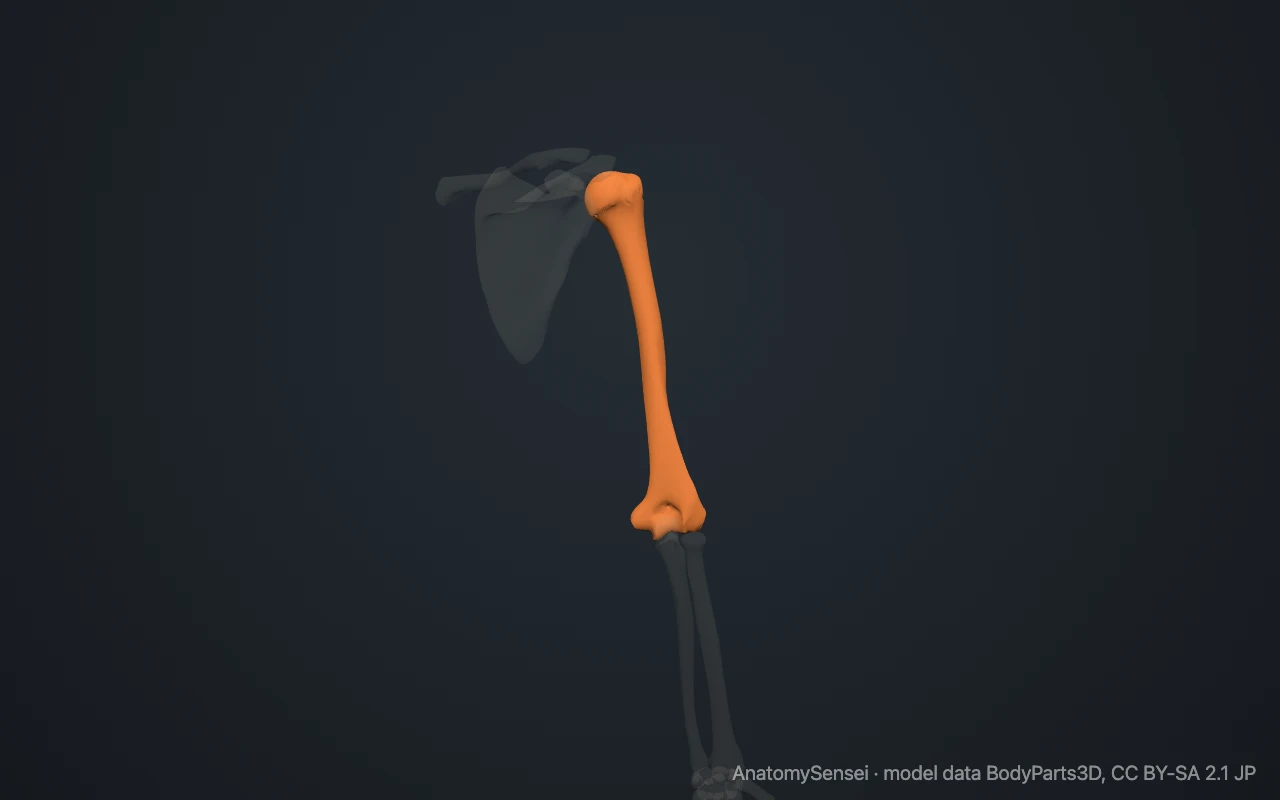
The lower end flares out into the medial and lateral epicondyles. Between them are two joint surfaces. The trochlea is shaped like a spool and lies on the inner side. The capitulum is a small rounded knob on the outer side.
Above these surfaces are hollows that make room for the forearm bones. The deepest is the olecranon fossa on the back, which receives the tip of the ulna when the elbow is straight.
What does the humerus articulate with?
At the top, the head meets the glenoid cavity of the scapula to form the shoulder joint, a ball and socket. The humerus does not touch the clavicle.
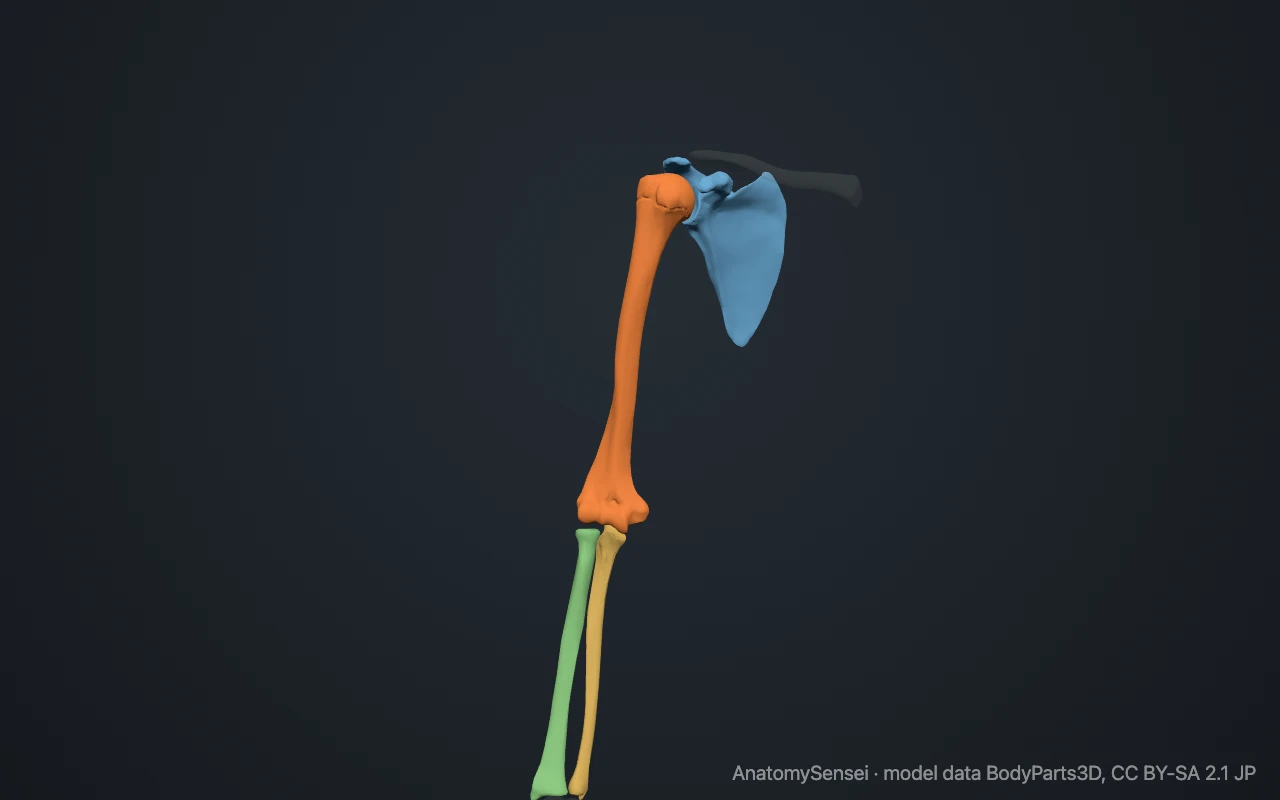
At the bottom it forms the elbow with both forearm bones. The trochlea fits the ulna, which makes the hinge. The capitulum meets the head of the radius, which can spin against it as the forearm turns.
What attaches to the humerus?
The tendons of the rotator cuff attach to the two tubercles. Three attach to the greater tubercle and one, subscapularis, to the lesser tubercle. Pectoralis major and latissimus dorsi attach along the groove between them.
The deltoid attaches to the deltoid tuberosity. The muscles that bend the wrist and fingers share a tendon on the medial epicondyle, and those that straighten them share one on the lateral epicondyle.
What does the humerus do?
It is the lever that positions the hand in space. Shoulder muscles move it in every direction, and the elbow below it lets the forearm bend and straighten.
It also provides a broad base of attachment for the muscles of the forearm, which begin at its epicondyles.
Common problems with the humerus
Fractures occur at three typical levels: the surgical neck near the shoulder, the middle of the shaft, and just above the epicondyles. Breaks above the epicondyles are seen mainly in children.
Three nerves lie against the bone and can be affected by injuries at these sites: the axillary nerve at the surgical neck, the radial nerve along the shaft and the ulnar nerve behind the medial epicondyle. Tennis elbow and golfer's elbow are painful conditions of the tendons at the lateral and medial epicondyles. This page describes anatomy only.
Common questions
Is the humerus the funny bone?
Not quite. The tingling comes from the ulnar nerve, which lies against the back of the medial epicondyle of the humerus.
Is the humerus in the arm or the leg?
The arm. The matching bone in the leg is the femur.
What is the difference between the anatomical neck and the surgical neck?
The anatomical neck is the groove around the edge of the head. The surgical neck is the narrowing below the tubercles, where fractures are common.
How many bones does the humerus touch?
Three: the scapula, the radius and the ulna.
Is this 3D model of the humerus free?
Yes. The interactive 3D model on this page is free to view and use for study, with no account or download needed. Its geometry comes from the open BodyParts3D data set (CC BY-SA).
About this free 3D model of the humerus
The interactive 3D model on this page is free to use in your browser, with no sign-up. It is built from scan-based anatomy data, so every bone is a separate, correctly placed shape you can turn and inspect from any side.