
Scapula (shoulder blade)
Scapula
The scapula is the shoulder blade. It is a flat, triangular bone on the back of the rib cage that carries the socket of the shoulder joint.
Loading 3D model…
Free 3D model of the scapula. Right arm. Drag to rotate, zoom with + and − (or Ctrl + scroll), click a bone to highlight and name it.
Key points
- The scapula is the shoulder blade, a flat triangular bone on the upper back.
- Its glenoid cavity is the socket for the head of the humerus.
- The acromion is the tip of the shoulder and joins the clavicle.
- It is held on the rib cage by muscles and has no bony joint with the ribs.
What is the scapula?
The scapula, or shoulder blade, is a thin, flat, triangular bone. With the clavicle it forms the shoulder girdle, which joins the arm to the trunk.
Much of the blade is thin enough to let light through. Its edges and its projections are thick and strong, because that is where muscles pull and where the joints lie.
Where is the scapula?
It lies on the back of the rib cage, to the side of the spine, and covers roughly the second to the seventh ribs. Its flat front surface faces the ribs and its back surface faces the skin.
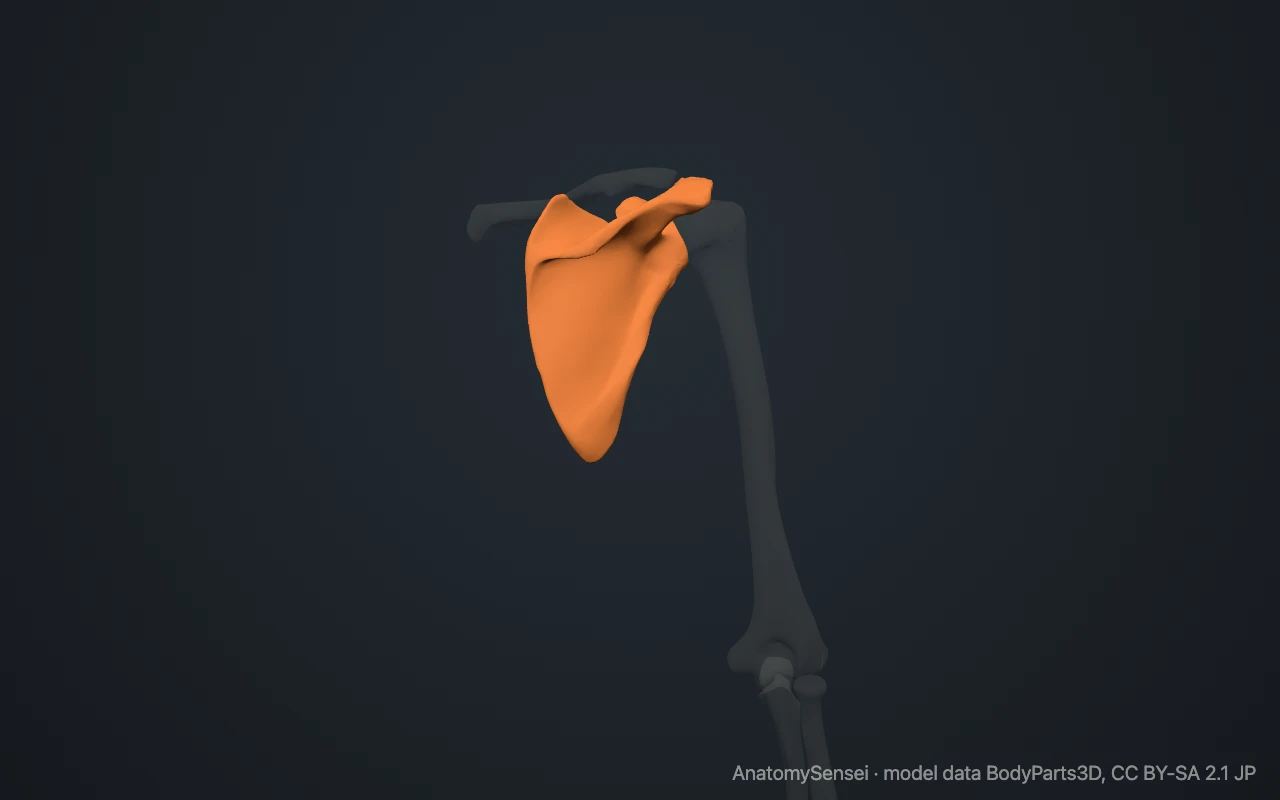
You can feel several parts of it. Reach across with the opposite hand and find the bony ridge that runs across the back of the shoulder. That is the spine of the scapula. Follow it outward and it ends in the flat tip of the shoulder, the acromion.
What are the parts of the scapula?
The blade has three borders, called superior, medial and lateral, and three corners, or angles. The back surface is crossed by the spine of the scapula, a ridge that divides it into a smaller hollow above and a larger one below.
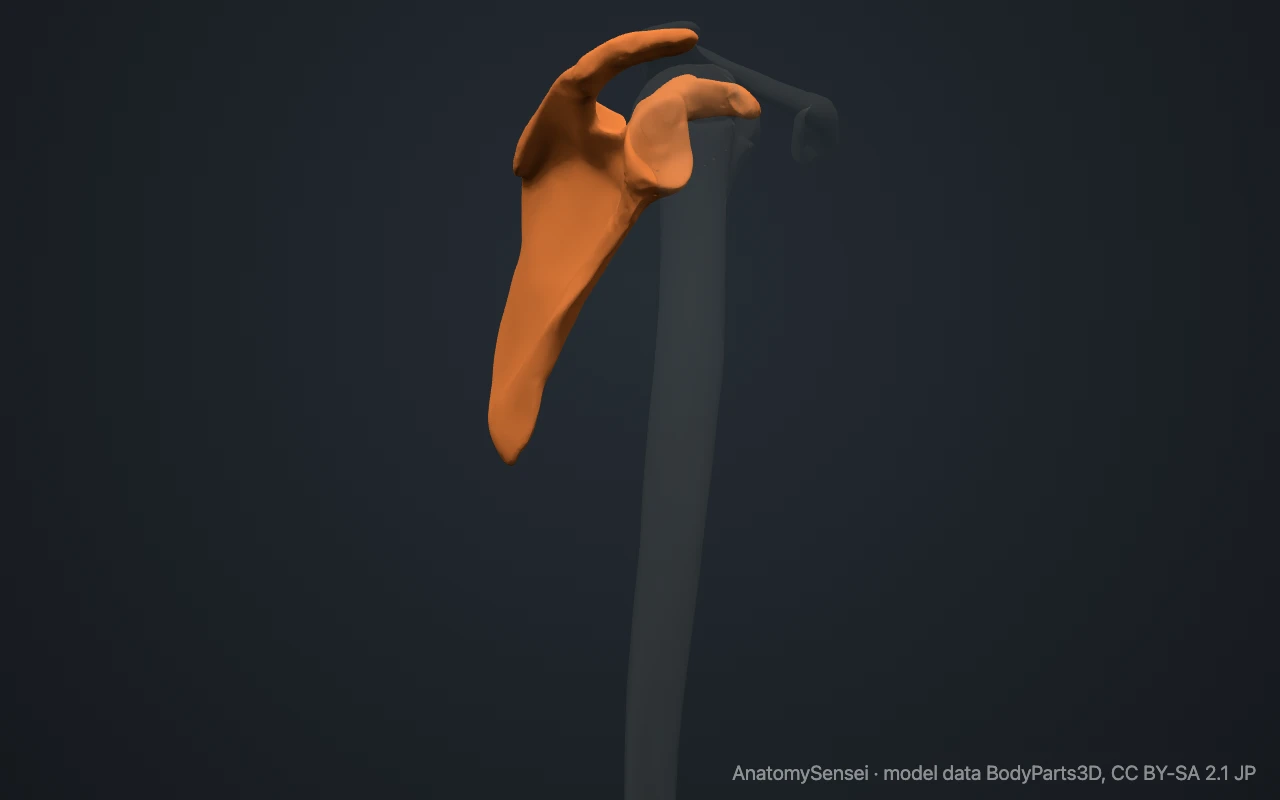
The spine ends in the acromion, a flat shelf that overhangs the shoulder joint. The coracoid process is a hook of bone that points forward from the top of the blade, shaped like a bent finger.
At the outer corner is the glenoid cavity, a shallow, pear-shaped socket that faces sideways. The front surface of the blade is slightly hollowed and is called the subscapular fossa.
What does the scapula articulate with?
It forms two joints. The glenoid cavity meets the head of the humerus at the shoulder joint, also called the glenohumeral joint. The acromion meets the outer end of the clavicle at the acromioclavicular joint.
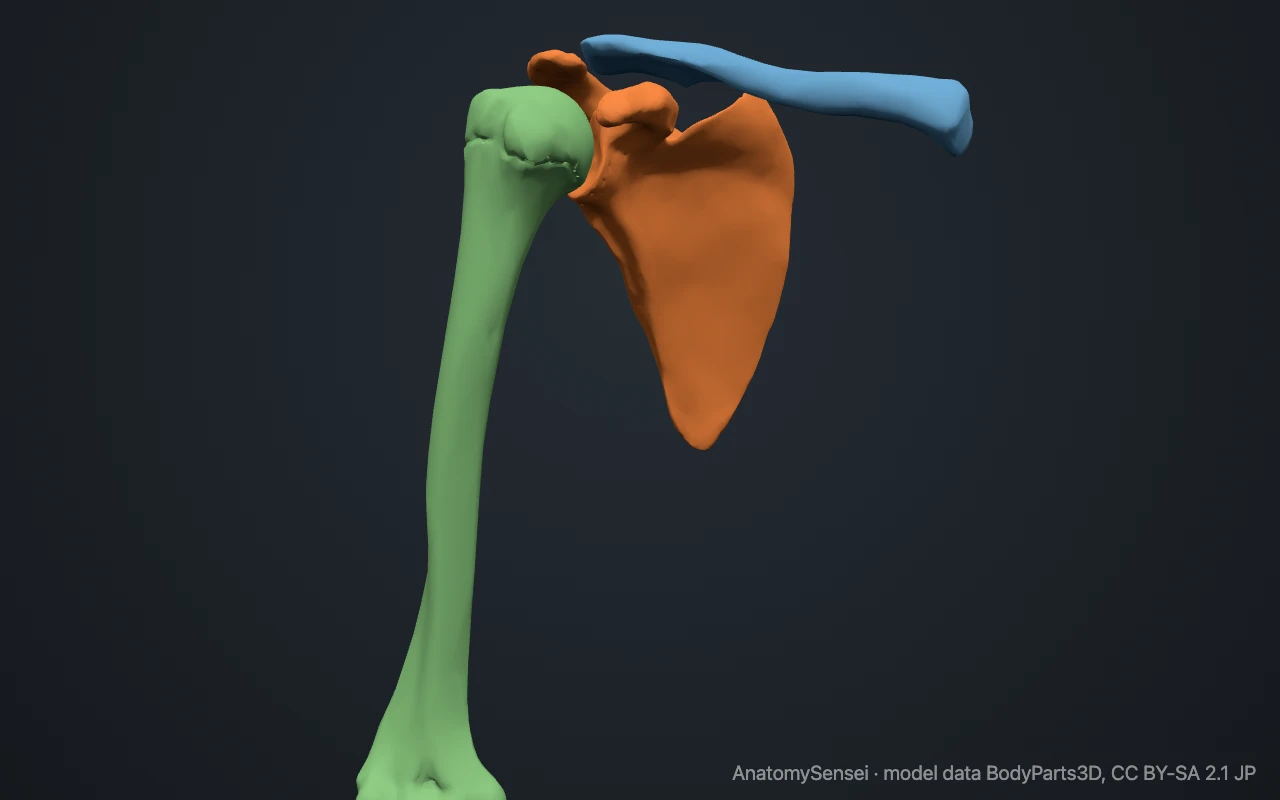
The scapula does not form a true joint with the ribs. It glides over the rib cage on a layer of muscle.
What attaches to the scapula?
Many muscles attach to it. The four rotator cuff muscles arise from the blade: supraspinatus above the spine, infraspinatus and teres minor below it, and subscapularis from the front surface. Their tendons hold the head of the humerus in the socket.
The trapezius and the deltoid attach to the spine and the acromion. Serratus anterior and the rhomboids attach along the medial border and hold the blade against the chest. The coracoid process anchors pectoralis minor, coracobrachialis and the short head of the biceps.
What does the scapula do?
It provides a movable base for the arm. The blade can slide up, down, forward and back on the rib cage, and it can rotate so that the socket points upward.
This rotation matters when the arm is raised. Lifting the arm overhead is a shared movement of the shoulder joint and the scapula, not of the shoulder joint alone.
Common problems with the scapula
The scapula is well padded by muscle, so fractures of the blade are uncommon and usually follow a high-energy injury.
A winged scapula is one whose medial border lifts away from the rib cage, often because serratus anterior is weak. The space under the acromion is also a site where rotator cuff tendons can be pinched, known as impingement. This page describes anatomy only.
Common questions
Is the scapula a flat bone?
Yes. It is one of the classic examples of a flat bone.
What is the acromion?
The flat outer end of the spine of the scapula. It forms the bony tip of the shoulder and joins the clavicle.
What is the glenoid cavity?
The shallow socket at the outer corner of the scapula that receives the head of the humerus.
Is the scapula attached to the ribs?
Not by a joint. It is held against the rib cage by muscles.
Is this 3D model of the scapula free?
Yes. The interactive 3D model on this page is free to view and use for study, with no account or download needed. Its geometry comes from the open BodyParts3D data set (CC BY-SA).
About this free 3D model of the scapula
The interactive 3D model on this page is free to use in your browser, with no sign-up. It is built from scan-based anatomy data, so every bone is a separate, correctly placed shape you can turn and inspect from any side.