
Ulna
Ulna
The ulna is the forearm bone on the little-finger side. Its hooked upper end grips the humerus to form the hinge of the elbow, and its tip is the point of the elbow.
Loading 3D model…
Free 3D model of the ulna. Right arm. Drag to rotate, zoom with + and − (or Ctrl + scroll), click a bone to highlight and name it.
Key points
- The ulna is the forearm bone on the same side as the little finger.
- It is wide at the elbow and narrow at the wrist, the opposite of the radius.
- The olecranon, its upper tip, is the bony point of the elbow.
- The head of the ulna is at the wrist end, not the elbow end.
What is the ulna?
The ulna is one of the two long bones of the forearm, alongside the radius. It lies on the medial side, which is the little-finger side when the palm faces forward.
It is the slightly longer of the two bones. It is the fixed bone of the forearm, the one that stays in place while the radius turns around it.
Where is the ulna?
It runs from the point of the elbow to the little-finger side of the wrist. Its back edge lies just under the skin for the whole length of the forearm.
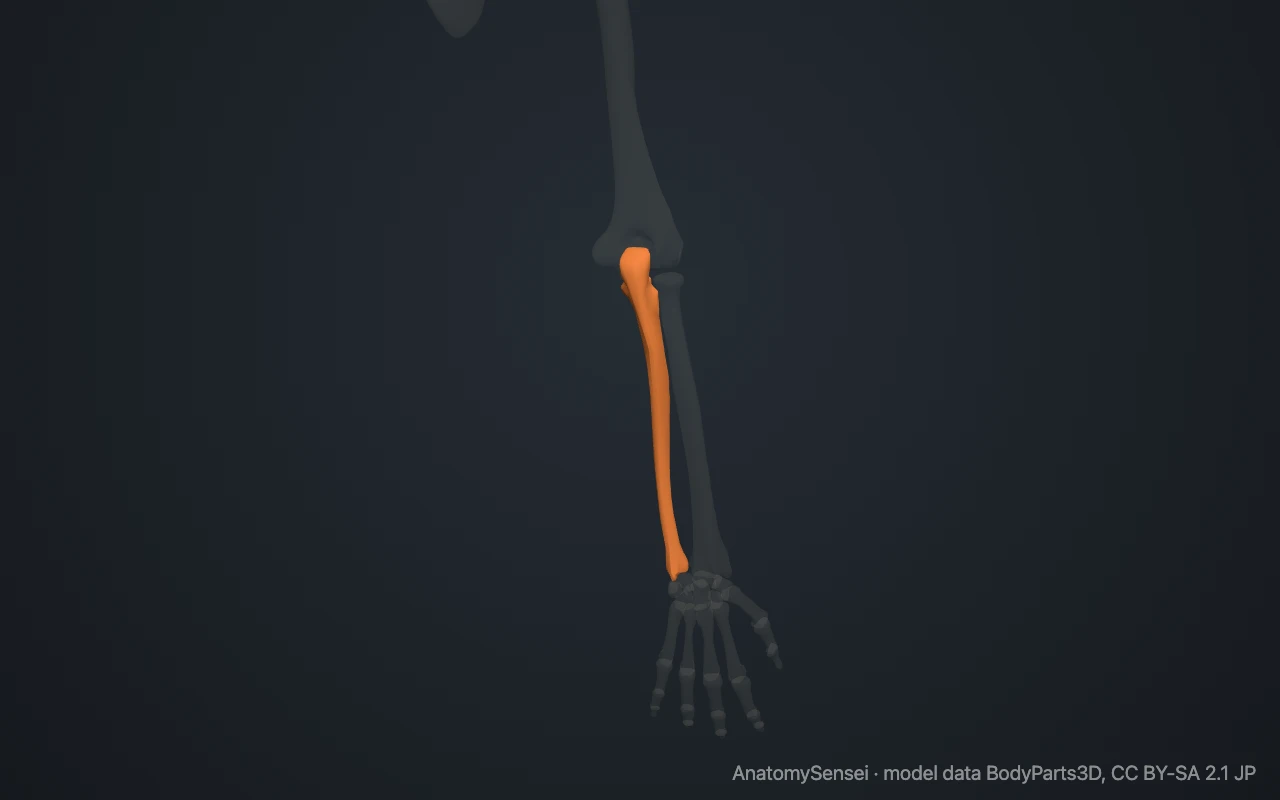
You can trace it easily. Start at the point of your elbow, which is the olecranon. Run a finger down the back of the forearm along the hard ridge to the wrist. The rounded bump on the back of the wrist on the little-finger side is the head of the ulna.
What are the parts of the ulna?
The upper end is shaped like the jaw of a spanner. The olecranon is the thick upper projection that forms the point of the elbow. The coronoid process is a smaller projection that points forward below it.
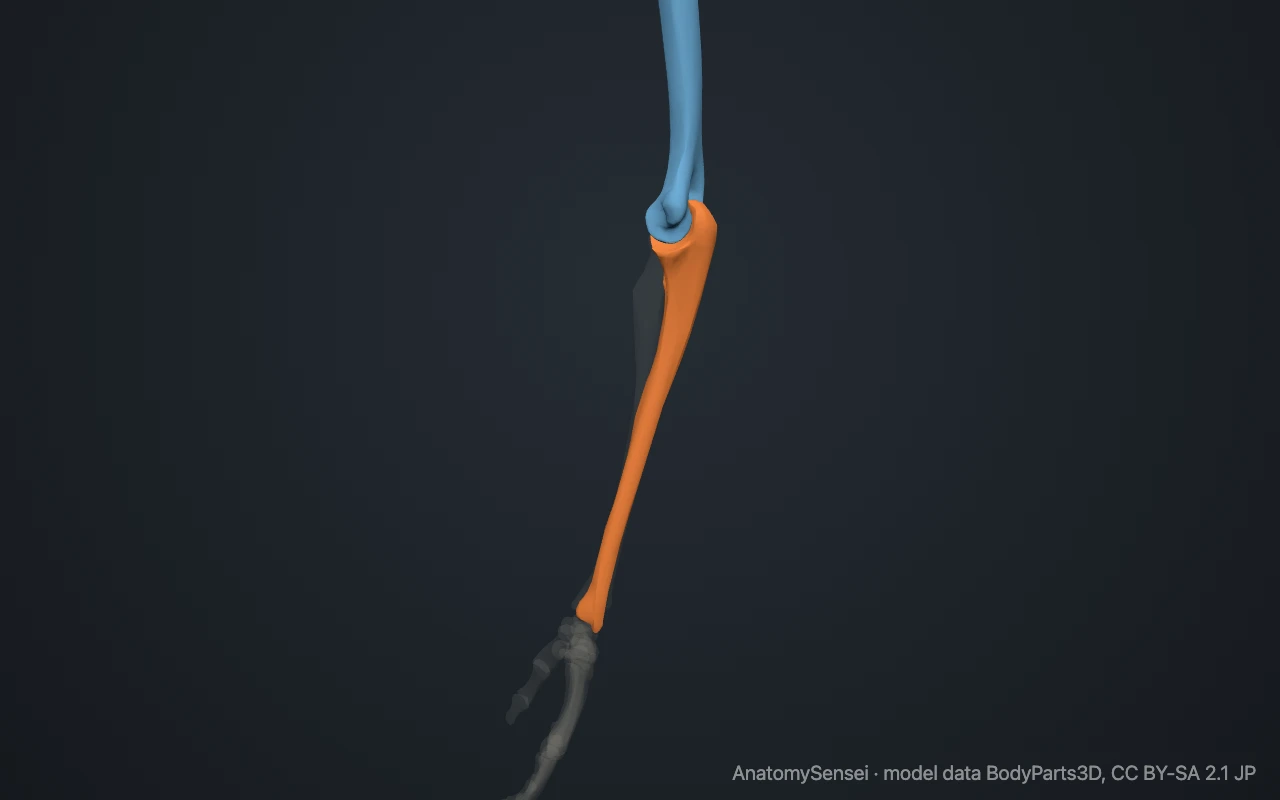
Between the two is a deep, C-shaped hollow called the trochlear notch. On the outer side of the coronoid process is a small radial notch, where the head of the radius turns.
The shaft tapers as it descends. The lower end is small and rounded and is called the head of the ulna. A short peg, the styloid process, projects from its back and inner side.
What does the ulna articulate with?
At the elbow, the trochlear notch wraps around the trochlea of the humerus. This is the hinge that lets the elbow bend and straighten.
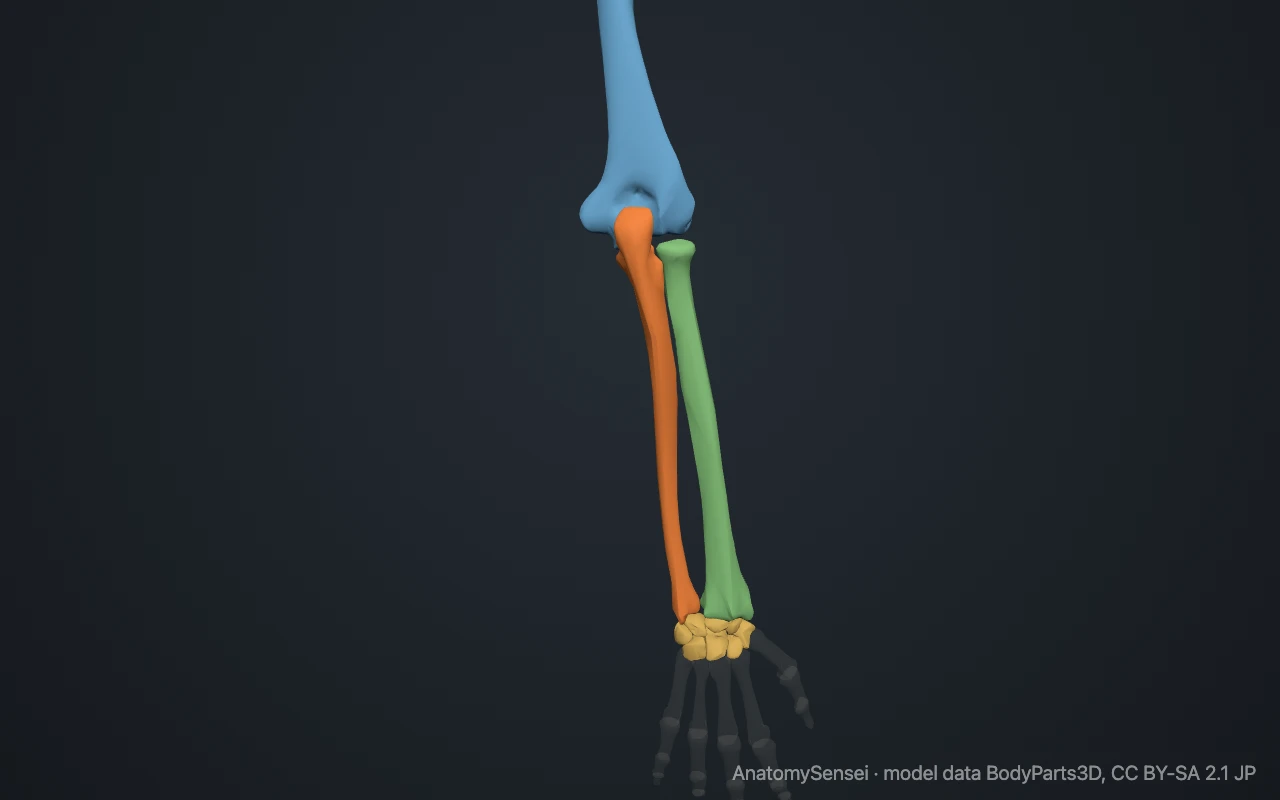
The ulna meets the radius at both ends, at the radial notch above and at its head below. It does not directly touch the carpal bones. A disc of cartilage, which the model does not show, lies between the head of the ulna and the wrist.
What attaches to the ulna?
The triceps attaches to the olecranon and straightens the elbow by pulling on it. The brachialis muscle attaches to the front of the coronoid process and bends the elbow.
Several muscles that move the wrist and fingers arise from the shaft. The interosseous membrane joins its outer edge to the radius.
What does the ulna do?
It is the stable bone of the forearm. Its tight fit on the humerus makes the elbow a firm hinge, and the olecranon works as a lever for the triceps.
It also serves as the axis for forearm rotation. The radius swings around the head of the ulna when the palm is turned over.
Common problems with the ulna
The olecranon lies directly under the skin, so a fall onto the point of the elbow can fracture it. The small fluid-filled sac over it can also swell, a condition called olecranon bursitis.
The shaft can be broken by a direct blow to the forearm. A break of the ulnar shaft together with a dislocated radial head is called a Monteggia fracture. This page describes anatomy only.
Common questions
Is the ulna on the pinky side?
Yes. The ulna is on the little-finger side of the forearm and the radius is on the thumb side.
What is the olecranon?
The upper end of the ulna. It forms the bony point of the elbow.
Is the ulna part of the wrist joint?
Not directly. A disc of cartilage separates the head of the ulna from the carpal bones.
Which is longer, the ulna or the radius?
The ulna, by a small margin.
Is this 3D model of the ulna free?
Yes. The interactive 3D model on this page is free to view and use for study, with no account or download needed. Its geometry comes from the open BodyParts3D data set (CC BY-SA).
About this free 3D model of the ulna
The interactive 3D model on this page is free to use in your browser, with no sign-up. It is built from scan-based anatomy data, so every bone is a separate, correctly placed shape you can turn and inspect from any side.