
Hamate bone
Os hamatum
The hamate is a wedge-shaped carpal bone on the little finger side of the distal row. It is recognised by the hook that projects from its palm surface and it supports the ring and little fingers.
Loading 3D model…
Free 3D model of the hamate bone. Right hand. Drag to rotate, zoom with + and − (or Ctrl + scroll), click a bone to highlight and name it.
Key points
- The hamate is the carpal bone on the little finger side of the distal row.
- A curved hook projects from its palm surface.
- It carries the fourth and fifth metacarpals, the bones of the ring and little fingers.
- The hook can break in sports played with a club, bat or racket.
What is the hamate bone?
The hamate is one of the eight carpal bones. Its name comes from the Latin hamus, a hook, after the curved process on its palm side. An older name is the unciform bone.
It is the last bone of the distal row on the little finger side. It is wedge-shaped, with the broad end facing the fingers and the narrow end pointing back towards the lunate.
Where is the hamate bone?
It lies on the little finger side of the wrist, beyond the triquetrum and beside the capitate. The ring and little finger metacarpals rest on it.
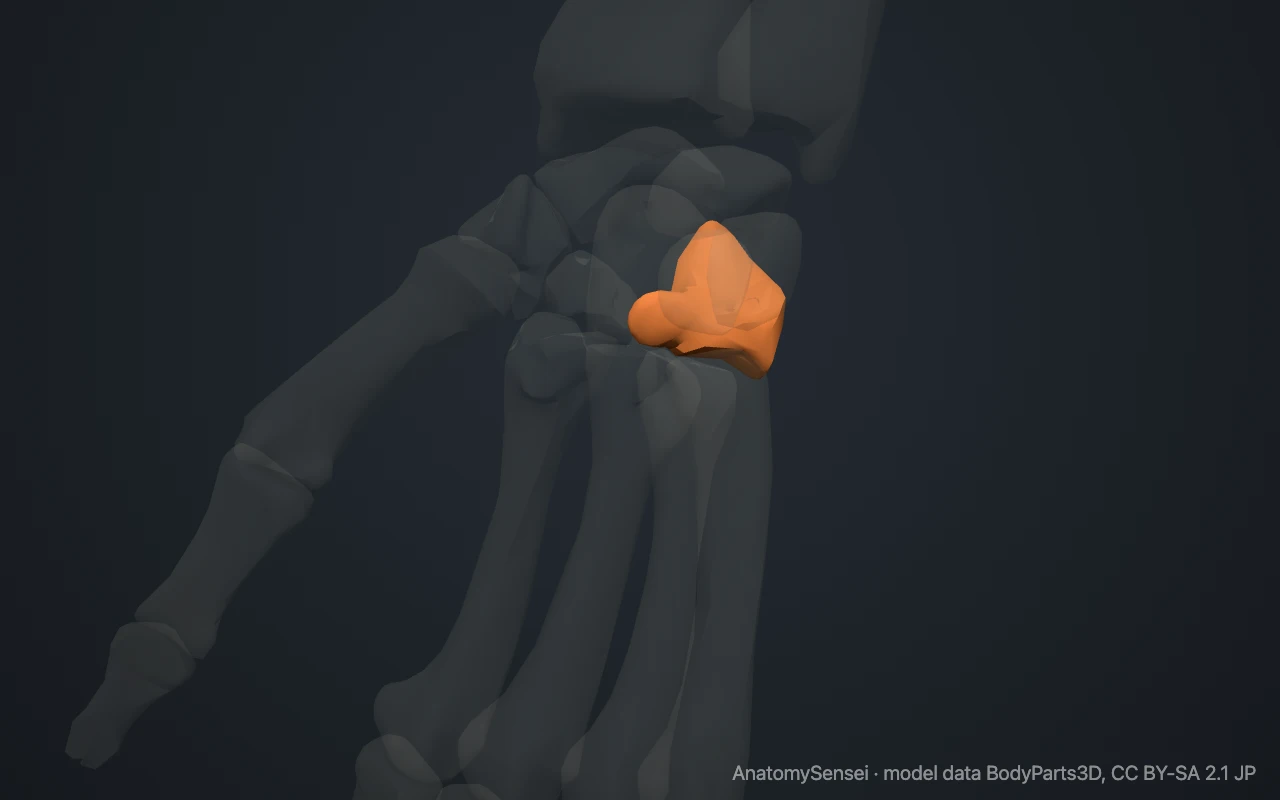
The hook can be felt through the palm. Find the pisiform, the hard knob at the base of your palm on the little finger side. From there, press firmly about two centimetres further into the palm, in the direction of the index finger. The deep, slightly tender point of bone is the hook of the hamate.
What is the hook of the hamate?
The hamate has two parts. The body is the wedge-shaped main mass that fits among the other carpals. The hook, or hamulus, is a flat, curved process that rises from the palm surface of the body.
The hook points towards the palm and curves slightly towards the thumb side. Its hollow side faces the carpal tunnel and forms part of the tunnel wall on the little finger side.
What does the hamate articulate with?
The hamate touches five bones. On its thumb side it lies flat against the capitate. On its other side a long, curved surface meets the triquetrum. Its narrow tip usually touches the lunate.
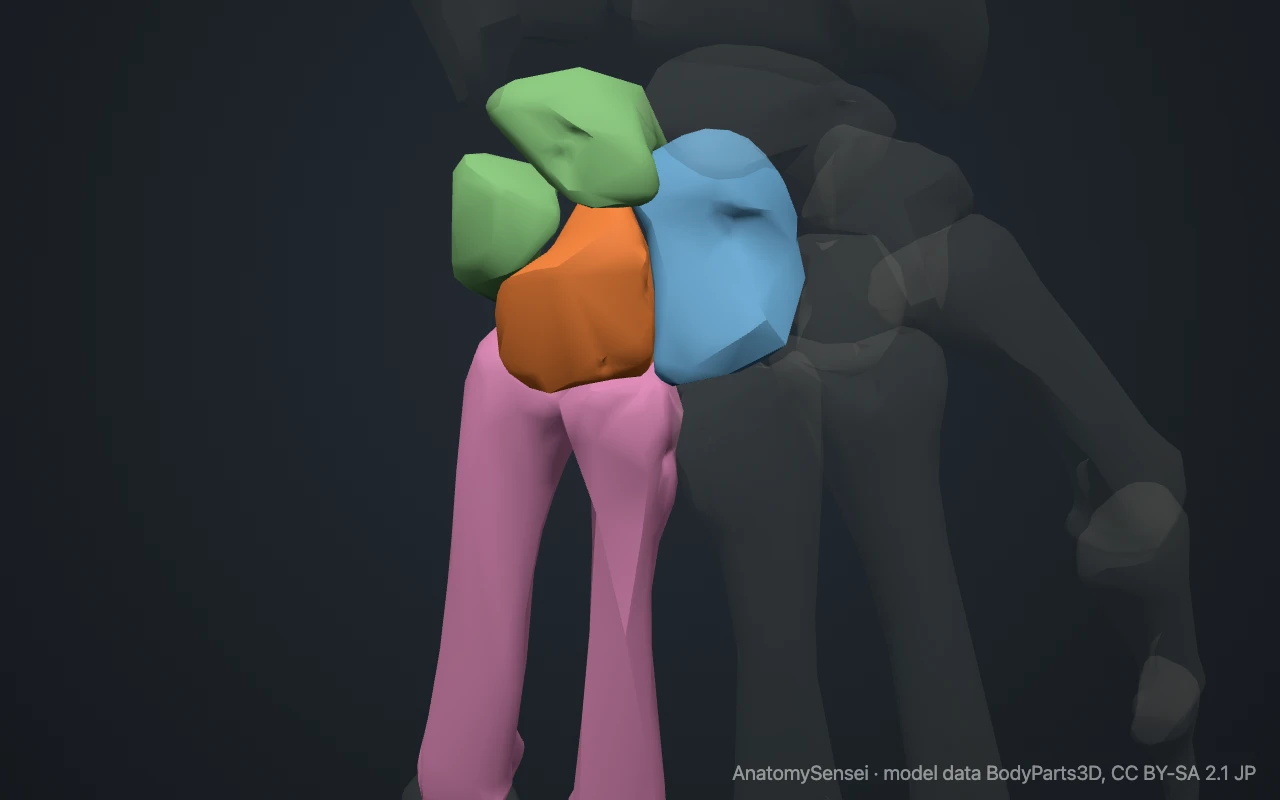
Its broad front surface has two facets, one for the fourth metacarpal and one for the fifth. These two joints move more than those of the index and middle fingers, which lets the palm cup around an object.
What attaches to the hamate?
The hook is a busy attachment point. The flexor retinaculum, the roof of the carpal tunnel, is fixed to it. A ligament from the pisiform also ends on it, carrying the pull of the flexor carpi ulnaris tendon.
Two small muscles of the little finger start from the hook: flexor digiti minimi brevis and opponens digiti minimi. The tendons that bend the ring and little fingers turn around the hook as they enter the palm.
What passes beside the hook of the hamate?
The ulnar nerve and ulnar artery pass between the pisiform and the hook of the hamate on their way into the hand. This short passage is the ulnar canal, or Guyon canal.
The deep branch of the ulnar nerve then curls around the hook to reach the small muscles of the hand. The model shows the hook and the pisiform, but not the nerve or the artery.
What does the hamate do?
The hamate supports the ring and little fingers and passes their load to the triquetrum and lunate. The mobility of its two metacarpal joints matters for a strong grip, because it lets those fingers close down firmly on a handle.
The hook works as a pulley for the finger tendons and as one of the four bony posts that hold up the roof of the carpal tunnel.
Common problems with the hamate
A fracture of the hook of the hamate is the best-known injury. It occurs in golf, baseball and racket sports, where the end of the handle presses against the hook during a swing. It is easily missed on ordinary X-rays.
Because the ulnar nerve runs beside the hook, a break or swelling here can cause numbness in the ring and little fingers. The body of the hamate can also break together with the bases of the fourth and fifth metacarpals after a punch. This page describes anatomy only.
Common questions
What does hamate mean?
Hooked. The name comes from the Latin hamus, a hook.
Which fingers sit on the hamate?
The ring and little fingers, through the fourth and fifth metacarpals.
Can you feel the hook of the hamate?
Yes, with firm pressure in the palm about two centimetres from the pisiform towards the index finger.
How many bones touch the hamate?
Five: the capitate, lunate, triquetrum and the fourth and fifth metacarpals.
Is this 3D model of the hamate bone free?
Yes. The interactive 3D model on this page is free to view and use for study, with no account or download needed. Its geometry comes from the open BodyParts3D data set (CC BY-SA).
About this free 3D model of the hamate bone
The interactive 3D model on this page is free to use in your browser, with no sign-up. It is built from scan-based anatomy data, so every bone is a separate, correctly placed shape you can turn and inspect from any side.