
Toe joints
Articulationes digitorum pedis
Each of the four smaller toes has three joints and the big toe has two. The joint at the base of a toe is a metatarsophalangeal joint; the joints within the toe are interphalangeal joints.
Loading 3D model…
Free 3D model of the toe joints. Right foot. Drag to rotate, zoom with + and − (or Ctrl + scroll), click a bone to highlight and name it.
- Proximal phalanges
- Middle phalanges
- Distal phalanges
Key points
- Each smaller toe has three joints; the big toe has two.
- The joint at the base of a toe is a metatarsophalangeal (MTP) joint.
- The joints within a toe are interphalangeal (IP) joints.
- Toe deformities are named by which joint stays bent.
What are the joints of the toes?
Each toe has a joint at its base and one or two more along its length. The base joint connects the toe to the foot. The others connect the small toe bones to one another.
The joints in each toe
The metatarsophalangeal (MTP) joint is at the base of every toe. Each of the four smaller toes then has a proximal interphalangeal (PIP) joint in the middle and a distal interphalangeal (DIP) joint near the tip.
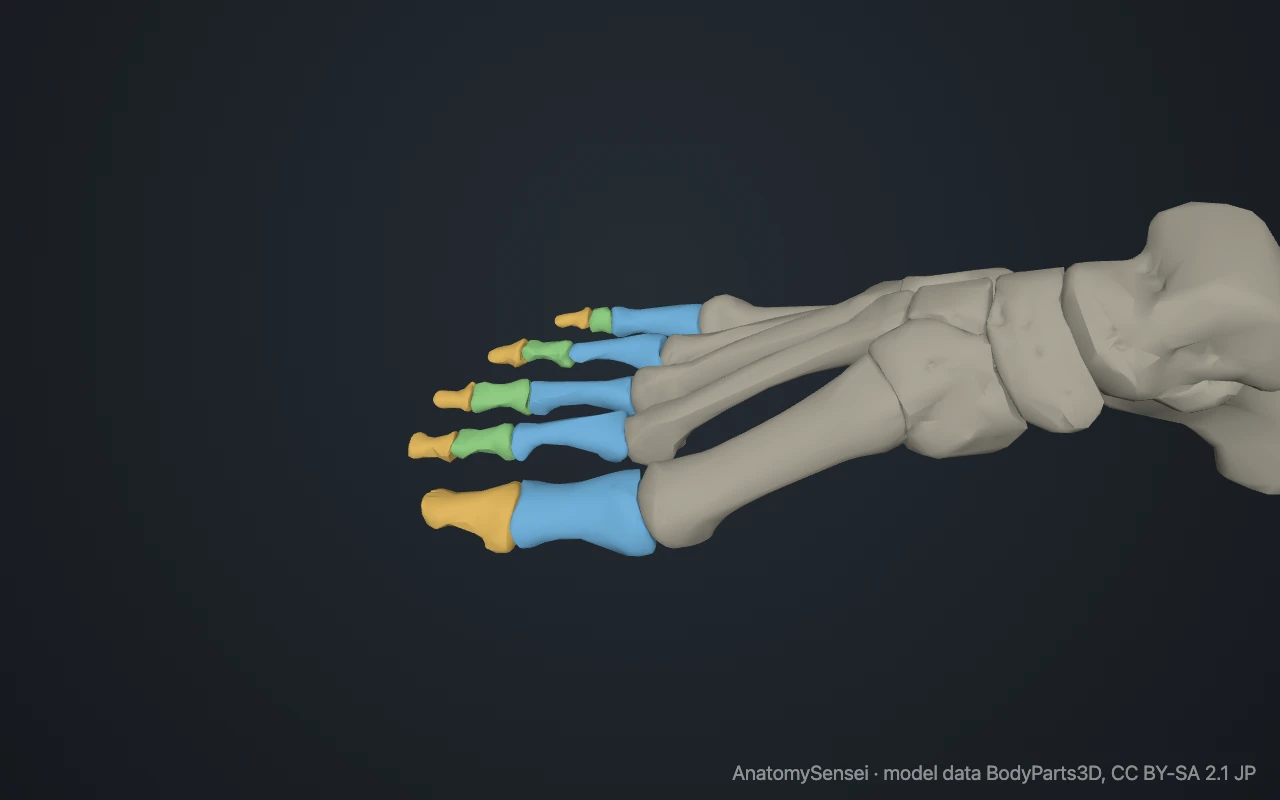
The big toe has only two bones, so it has a single interphalangeal (IP) joint.
How many toe joints are there?
Each foot has five MTP joints and nine interphalangeal joints: one in the big toe and two in each of the other four toes.
How do the toe joints move?
The interphalangeal joints are hinges. They only bend and straighten. The MTP joints at the base bend further and also let the toes spread slightly.
What holds the toe joints together?
Every toe joint has a capsule and a ligament on each side that stops it bending sideways. Underneath each one is a firm pad, the plantar plate, that stops the toe bending backward too far.
Tendons do the moving. Flexor tendons run under the toe and curl it. Extensor tendons run over the top and straighten it. When the pull of the two is out of balance for long enough, a joint can set in a bent position.
Hammer, mallet and claw toes
These are named by the joint that stays bent. A hammer toe is bent at the middle (PIP) joint. A mallet toe is bent at the joint near the tip (DIP). A claw toe is bent at both, with the base joint tilted up.
This page describes anatomy only.
Common questions
How many joints are in a toe?
Three in each smaller toe and two in the big toe, counting the joint at the base.
What is the IP joint of the big toe?
The interphalangeal joint: the single hinge between its two bones.
What is the PIP joint?
The proximal interphalangeal joint, the middle joint of a smaller toe.
What is the DIP joint?
The distal interphalangeal joint, the one nearest the tip of the toe.
Is this 3D model of the toe joints free?
Yes. The interactive 3D model on this page is free to view and use for study, with no account or download needed. Its geometry comes from the open BodyParts3D data set (CC BY-SA).
About this free 3D model of the toe joints
The interactive 3D model on this page is free to use in your browser, with no sign-up. It is built from scan-based anatomy data, so every bone is a separate, correctly placed shape you can turn and inspect from any side.