
Tarsometatarsal (Lisfranc) joints
Articulationes tarsometatarsales
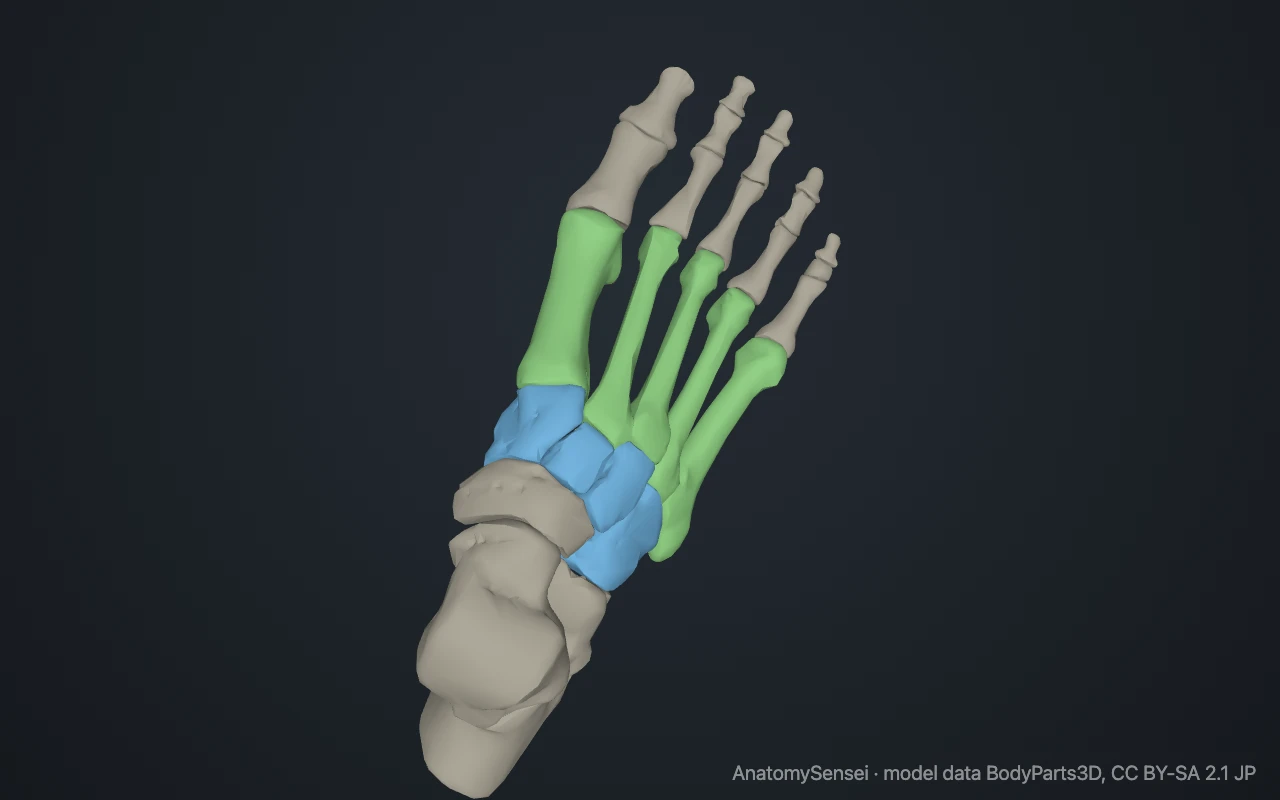
The tarsometatarsal joints are where the midfoot meets the forefoot. The three cuneiforms and the cuboid join the bases of the five metatarsals along a line also called the Lisfranc joint.
Loading 3D model…
Free 3D model of the tarsometatarsal joints. Right foot. Drag to rotate, zoom with + and − (or Ctrl + scroll), click a bone to highlight and name it.
- Cuneiforms and cuboid
- Metatarsals
Key points
- The tarsometatarsal joints connect the midfoot to the five metatarsals.
- Together they are called the Lisfranc joint.
- They move very little, which keeps the middle of the foot stiff.
- The second metatarsal is locked in place and acts as the keystone.
What are the tarsometatarsal joints?
The tarsometatarsal joints are the joints between the midfoot bones and the bases of the metatarsals. The name is often shortened to TMT joints. As a group they mark the line between midfoot and forefoot.
Which bones form the tarsometatarsal joints?
Four tarsal bones meet five metatarsals. The first three metatarsals each join one cuneiform. The fourth and fifth share the cuboid.
The three columns
The joints are grouped into three columns. The inner column is the first metatarsal and the medial cuneiform. The middle column is the second and third metatarsals with their cuneiforms. The outer column is the fourth and fifth metatarsals with the cuboid.
The middle column is the stiffest and the outer column the most mobile.
Why the second metatarsal matters
The base of the second metatarsal is set back into a slot between the medial and lateral cuneiforms. A strong ligament runs from the medial cuneiform to that base and holds the whole arrangement together.
How much do the tarsometatarsal joints move?
Very little. They are flat-surfaced joints that only glide a few millimetres. The second and third move least, which keeps the centre of the foot rigid.
The first allows a small amount of up-and-down movement, and the fourth and fifth allow the most. That lets the two edges of the forefoot adjust to the ground while the middle stays firm.
Common problems with the tarsometatarsal joints
A Lisfranc injury is damage to these joints or their ligaments, from a twist or a heavy load on a pointed foot. It is easy to miss on first assessment.
Arthritis here causes aching and a bony ridge on top of the midfoot. This page describes anatomy only.
Common questions
What is the TMT joint?
Short for tarsometatarsal joint: a joint between a tarsal bone and a metatarsal base.
Where is the Lisfranc joint?
Across the middle of the foot, where the arch meets the long bones of the forefoot.
How many tarsometatarsal joints are there?
Five, one for each metatarsal.
Why is it called Lisfranc?
After Jacques Lisfranc, a French surgeon of the Napoleonic era.
Is this 3D model of the tarsometatarsal joints free?
Yes. The interactive 3D model on this page is free to view and use for study, with no account or download needed. Its geometry comes from the open BodyParts3D data set (CC BY-SA).
About this free 3D model of the tarsometatarsal joints
The interactive 3D model on this page is free to use in your browser, with no sign-up. It is built from scan-based anatomy data, so every bone is a separate, correctly placed shape you can turn and inspect from any side.