
Transverse tarsal (Chopart) joint
Articulatio tarsi transversa
The transverse tarsal joint is the line across the foot that separates the hindfoot from the midfoot. It is made of two joints side by side: the talonavicular and the calcaneocuboid.
Loading 3D model…
Free 3D model of the transverse tarsal joint. Right foot. Drag to rotate, zoom with + and − (or Ctrl + scroll), click a bone to highlight and name it.
- Hindfoot: talus, calcaneus
- Midfoot: navicular, cuboid
Key points
- The transverse tarsal joint is the line between hindfoot and midfoot.
- It is two joints side by side: talonavicular and calcaneocuboid.
- It is also called the Chopart joint or midtarsal joint.
- It works with the subtalar joint to turn the sole in and out.
What is the transverse tarsal joint?
The transverse tarsal joint is the joint line that runs across the foot between the hindfoot and the midfoot. It is not one joint but two that act together.
Which bones form the transverse tarsal joint?
On the inner side, the head of the talus fits into the navicular. This is the talonavicular joint. On the outer side, the front of the calcaneus meets the cuboid. This is the calcaneocuboid joint.
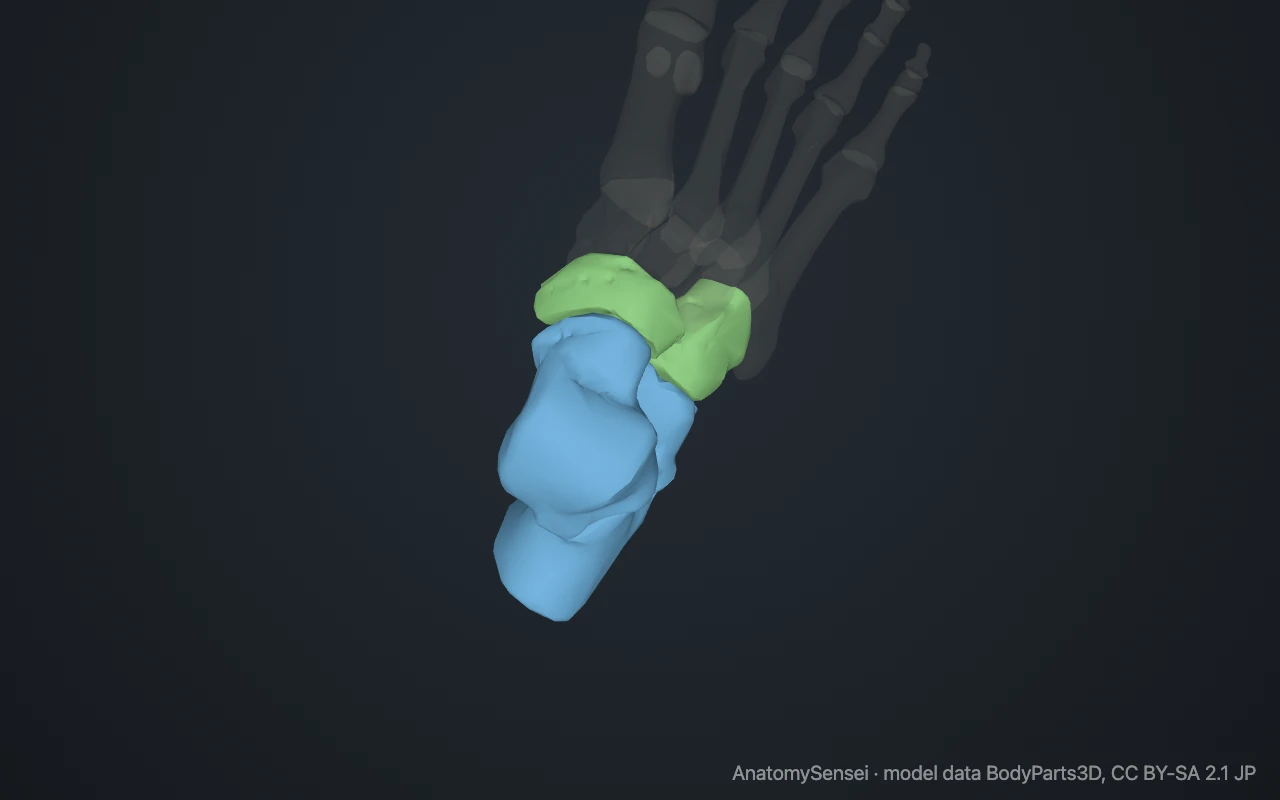
Seen from above, the two form a shallow S-shaped line.
How does the transverse tarsal joint move?
It lets the front of the foot twist relative to the heel. Together with the subtalar joint it produces inversion and eversion.
It also changes stiffness. When the heel tilts out, the two joints line up and the midfoot becomes supple to absorb landing. When the heel tilts in, they lock and the foot becomes a rigid lever for push-off.
What supports the transverse tarsal joint?
Underneath the head of the talus, the spring ligament runs from the heel bone to the navicular and holds the head up like a sling. If it stretches, the arch flattens.
A Y-shaped ligament on top links the calcaneus to both the navicular and the cuboid. Under the outer half, two strong plantar ligaments run from the heel bone to the cuboid and support the outer arch.
Why is it called the Chopart joint?
It is named after François Chopart, a French surgeon who described amputation through this line in the 18th century. It is also called the midtarsal joint.
Common problems with the transverse tarsal joint
Injuries here are uncommon and usually follow high-energy trauma. Arthritis of the talonavicular joint stiffens the whole hindfoot, because that joint is involved in almost every movement of the foot. This page describes anatomy only.
Common questions
What is the Chopart joint?
Another name for the transverse tarsal joint.
Which bones form the transverse tarsal joint?
The talus and calcaneus behind, the navicular and cuboid in front.
Is the midtarsal joint the same as the transverse tarsal joint?
Yes. They are two names for the same joint line.
What does the transverse tarsal joint separate?
The hindfoot from the midfoot.
Is this 3D model of the transverse tarsal joint free?
Yes. The interactive 3D model on this page is free to view and use for study, with no account or download needed. Its geometry comes from the open BodyParts3D data set (CC BY-SA).
About this free 3D model of the transverse tarsal joint
The interactive 3D model on this page is free to use in your browser, with no sign-up. It is built from scan-based anatomy data, so every bone is a separate, correctly placed shape you can turn and inspect from any side.