
Sternum (breastbone)
Sternum
The sternum, or breastbone, is the long flat bone in the middle of the front of the chest. It has three parts: the manubrium, the body and the xiphoid process.
Loading 3D model…
Free 3D model of the sternum. Whole rib cage. Drag to rotate, zoom with + and − (or Ctrl + scroll), click a bone to highlight and name it.
- Manubrium
- Body
- Xiphoid process
Key points
- The sternum is the breastbone, a flat bone in the midline of the chest.
- It has three parts: manubrium, body and xiphoid process.
- The sternal angle, where manubrium and body meet, marks the level of the second ribs.
- It joins the collarbones and the cartilages of the first seven pairs of ribs.
What is the sternum?
The sternum is a flat, dagger-shaped bone that forms the middle of the front wall of the chest. Its everyday name is the breastbone.
It closes the rib cage in front and lies directly over the heart. Like other flat bones it has a thin shell of dense bone around a spongy core filled with red bone marrow.
Where is the sternum?
It runs down the centre of the chest, from the base of the neck to the top of the abdomen. Almost all of its front surface lies just under the skin.
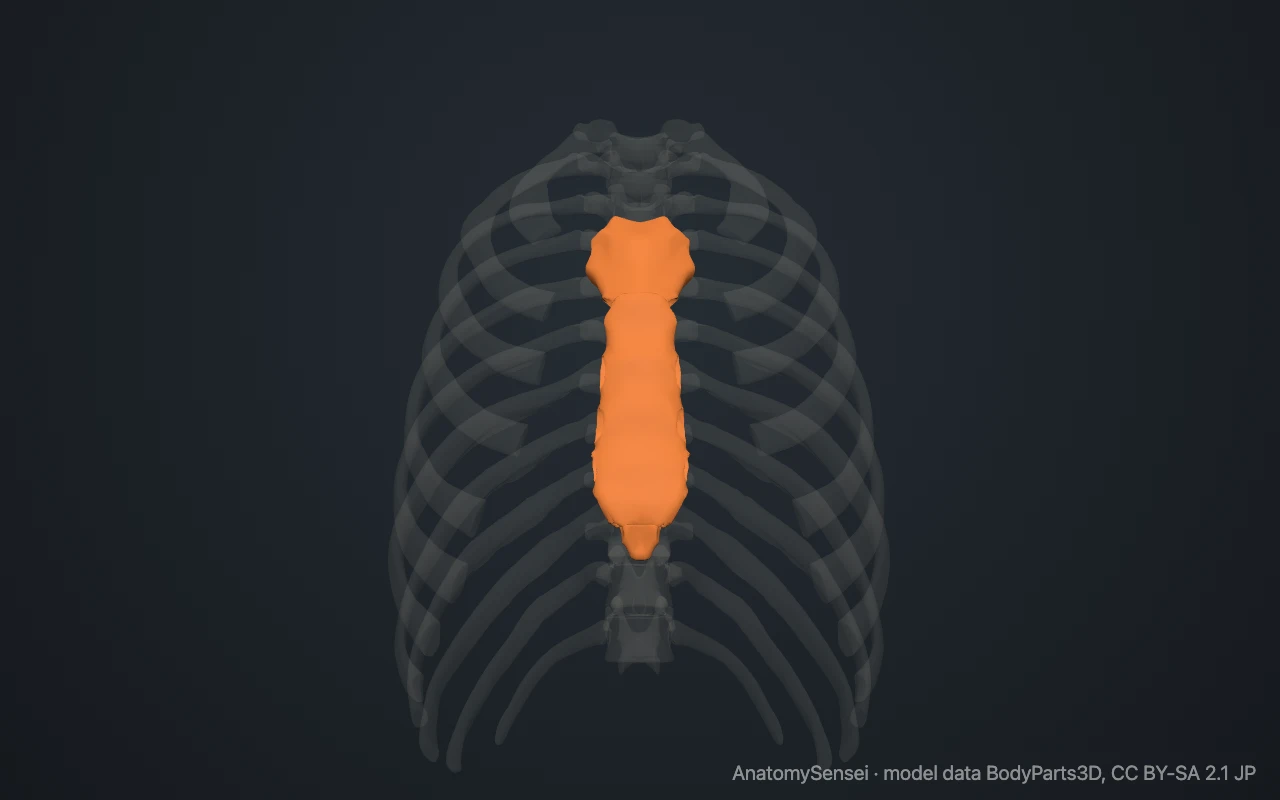
You can trace it on your own body. Put a finger in the soft dip between the inner ends of your collarbones. The bone below that dip is the sternum. Follow it down until it ends in the soft hollow at the top of the abdomen.
What are the three parts of the sternum?
The manubrium is the broad upper part. It is roughly four-sided, with a notch in its top edge, and it carries the joints for the collarbones and the first ribs.
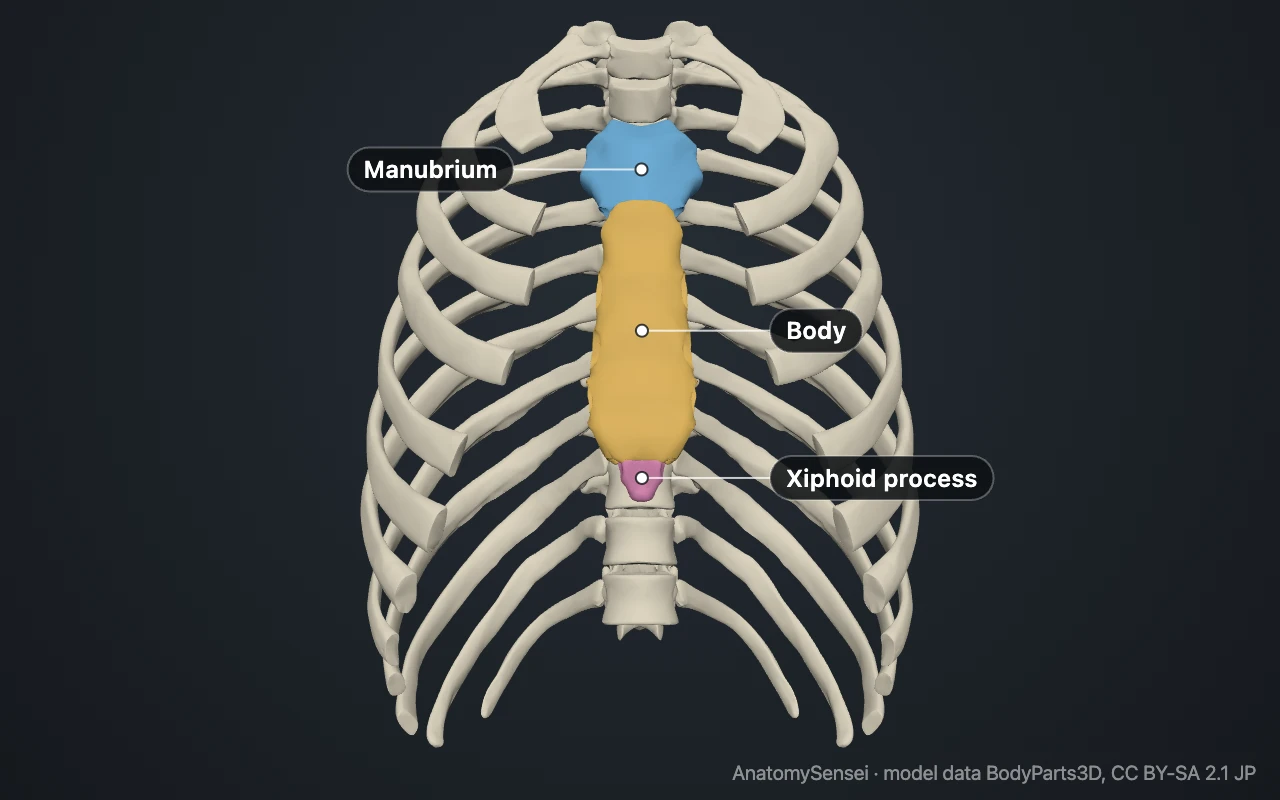
The body is the longest part. It forms in childhood from four segments that fuse together, and faint ridges across its front mark the old joins. Its edges are notched for the rib cartilages.
The xiphoid process is the small pointed tip at the lower end. It starts as cartilage and turns to bone in adult life.
What is the sternal angle?
The manubrium and the body do not lie in a straight line. They meet at a slight bend that can be felt as a ridge across the bone. This is the sternal angle, also called the angle of Louis.
It is one of the most useful landmarks on the chest. The second rib cartilage joins the sternum at this level, so it is the starting point for counting ribs. At the back, the same level corresponds to the disc between the fourth and fifth thoracic vertebrae.
What does the sternum articulate with?
On each side the manubrium meets the clavicle, or collarbone, at the sternoclavicular joint. This is the only bony joint between the arm and the trunk.
Along its edges the sternum receives the costal cartilages of ribs 1 to 7. The first joins the manubrium, the second joins at the sternal angle, and the third to seventh join the body.
The model shows bones only. The costal cartilages and the collarbones are not part of it, so the sternum appears to stand free with the ribs ending short of its edges.
What attaches to the sternum?
The large chest muscle, pectoralis major, arises from the front of the sternum on each side. The sternocleidomastoid muscle of the neck has one of its heads on the front of the manubrium.
Thin strap muscles of the neck attach to the back of the manubrium. At the lower end, the diaphragm and the rectus abdominis muscle attach to the xiphoid process.
What does the sternum do?
It shields the heart and the great vessels behind it. It also ties the two sides of the rib cage together and gives the collarbones a fixed point to brace the shoulders against.
In breathing, the sternum rises and moves forward as the ribs lift, which deepens the chest. Its marrow makes blood cells throughout life.
Common problems with the sternum
A sternal fracture usually results from a direct blow to the front of the chest, for example against a steering wheel or seat belt in a road accident. Breaks tend to occur in the body or near the sternal angle.
The sternum may also sit differently from usual. In pectus excavatum it is sunken, and in pectus carinatum it projects forward. This page describes anatomy only.
Common questions
Is the sternum one bone or three?
It is counted as one bone with three parts. The parts are separate in the young and joined by cartilage, and they may fuse later in life.
Which ribs attach to the sternum?
Ribs 1 to 7, the true ribs, each through its own costal cartilage. Ribs 8 to 10 reach it only indirectly.
Is the sternum a flat bone?
Yes. It is a classic flat bone, thin and broad, with marrow inside.
What is behind the sternum?
The heart in its sac and the large vessels above it, with the front edges of the lungs on each side.
Why is the sternal angle important?
It marks the second rib, so the ribs and the spaces between them can be counted from it.
Is this 3D model of the sternum free?
Yes. The interactive 3D model on this page is free to view and use for study, with no account or download needed. Its geometry comes from the open BodyParts3D data set (CC BY-SA).
About this free 3D model of the sternum
The interactive 3D model on this page is free to use in your browser, with no sign-up. It is built from scan-based anatomy data, so every bone is a separate, correctly placed shape you can turn and inspect from any side.