
Manubrium of the sternum
Manubrium sterni
The manubrium is the upper part of the sternum, or breastbone. It is the widest and thickest of the three parts and joins the collarbones and the first two pairs of ribs.
Loading 3D model…
Free 3D model of the manubrium of the sternum. Whole rib cage. Drag to rotate, zoom with + and − (or Ctrl + scroll), click a bone to highlight and name it.
Key points
- The manubrium is the top part of the breastbone.
- The dip in its upper edge is the jugular notch, felt between the collarbones.
- It joins the collarbones, the first rib cartilages and half of each second rib cartilage.
- It meets the body of the sternum at the sternal angle.
What is the manubrium?
The manubrium is the uppermost of the three parts of the sternum. Its name is Latin for a handle. Early anatomists compared the sternum to a sword, with the manubrium as the handle, the body as the blade and the xiphoid process as the point.
It is roughly four-sided, wider at the top than at the bottom. It is also the thickest and strongest part of the breastbone.
Where is the manubrium?
It sits at the base of the neck in the midline, between the inner ends of the two collarbones. It lies at about the level of the third and fourth thoracic vertebrae.
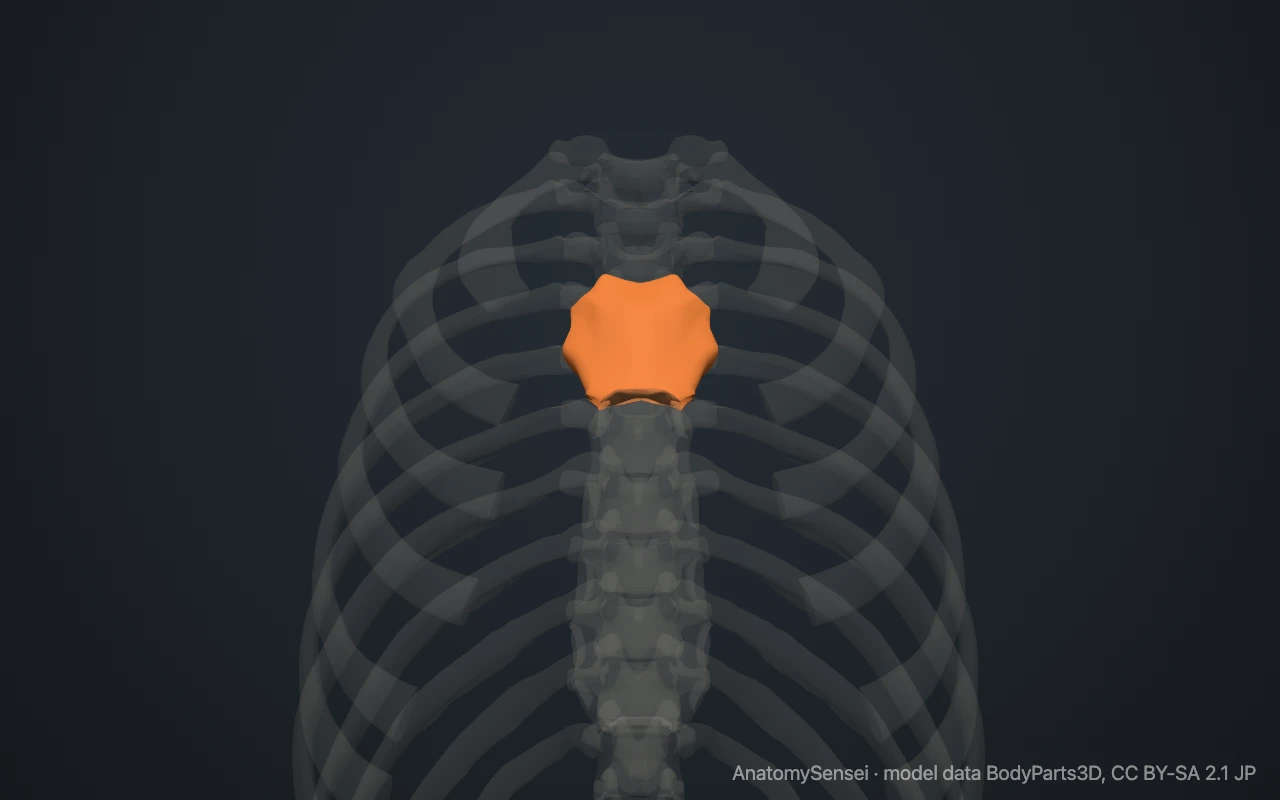
It is easy to find. Place a finger in the hollow at the bottom of the front of your neck. That hollow is the jugular notch, the top edge of the manubrium. Slide down about the width of three fingers to a low ridge across the bone. The ridge is the sternal angle, the lower end of the manubrium.
What are the landmarks of the manubrium?
The curved dip in the upper border is the jugular notch, also called the suprasternal notch. On each side of it is a clavicular notch, an oval hollow that faces upward and outward to receive the collarbone.
Just below each clavicular notch, the side border has a rough dent for the first costal cartilage. At the lower corner there is a small half-facet. It pairs with a matching half-facet on the body of the sternum to hold the second costal cartilage.
What does the manubrium articulate with?
It has joints with four structures on each side and one below. The sternoclavicular joint links it to the collarbone. This is the only place where the skeleton of the arm is jointed to the trunk.
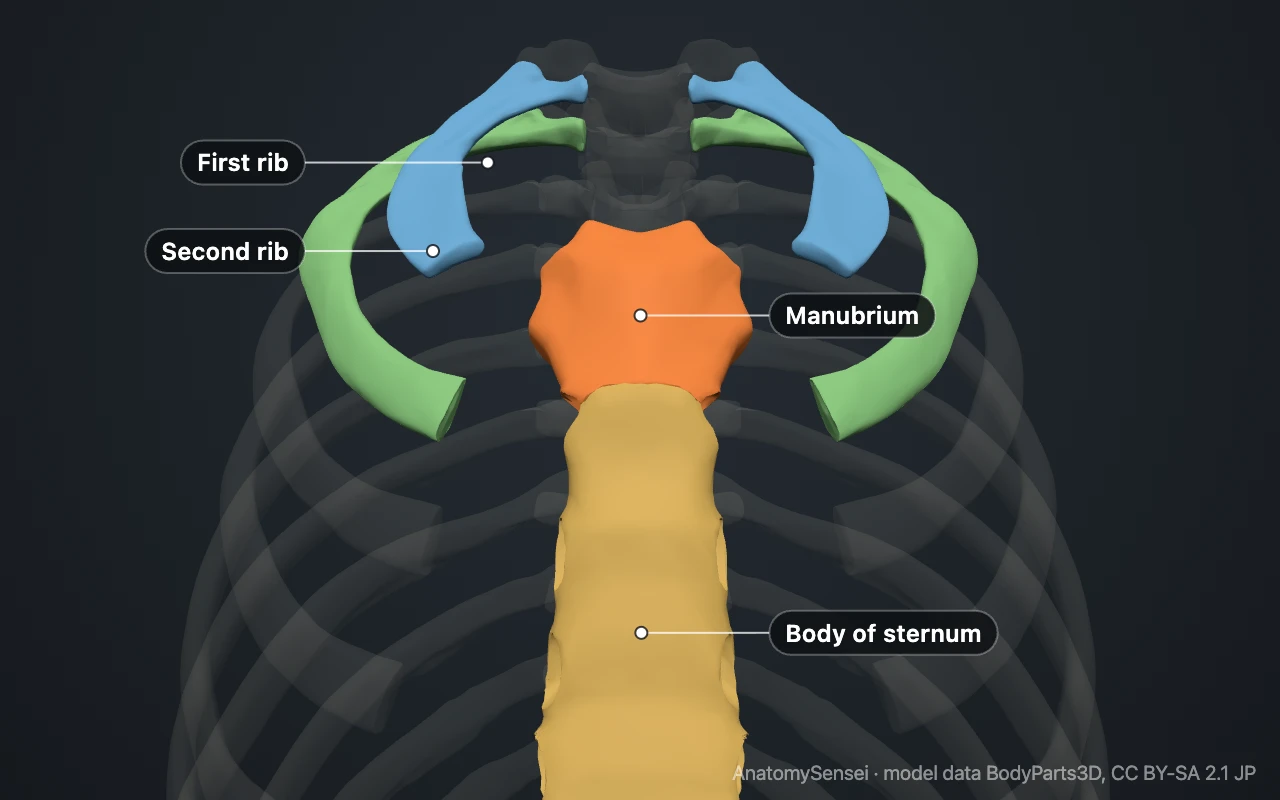
The first costal cartilage is fused to its side border in a stiff union. The second costal cartilage sits at the junction of the manubrium and the body, touching both.
Below, the manubrium meets the body of the sternum at the manubriosternal joint. The model has no cartilages and no collarbones, so the first and second ribs are shown ending short of the manubrium.
How does the manubrium form the sternal angle?
The manubrium slopes a little more steeply backward than the body. Where the two meet they form a shallow bend, the sternal angle, which shows as a ridge on the front of the chest.
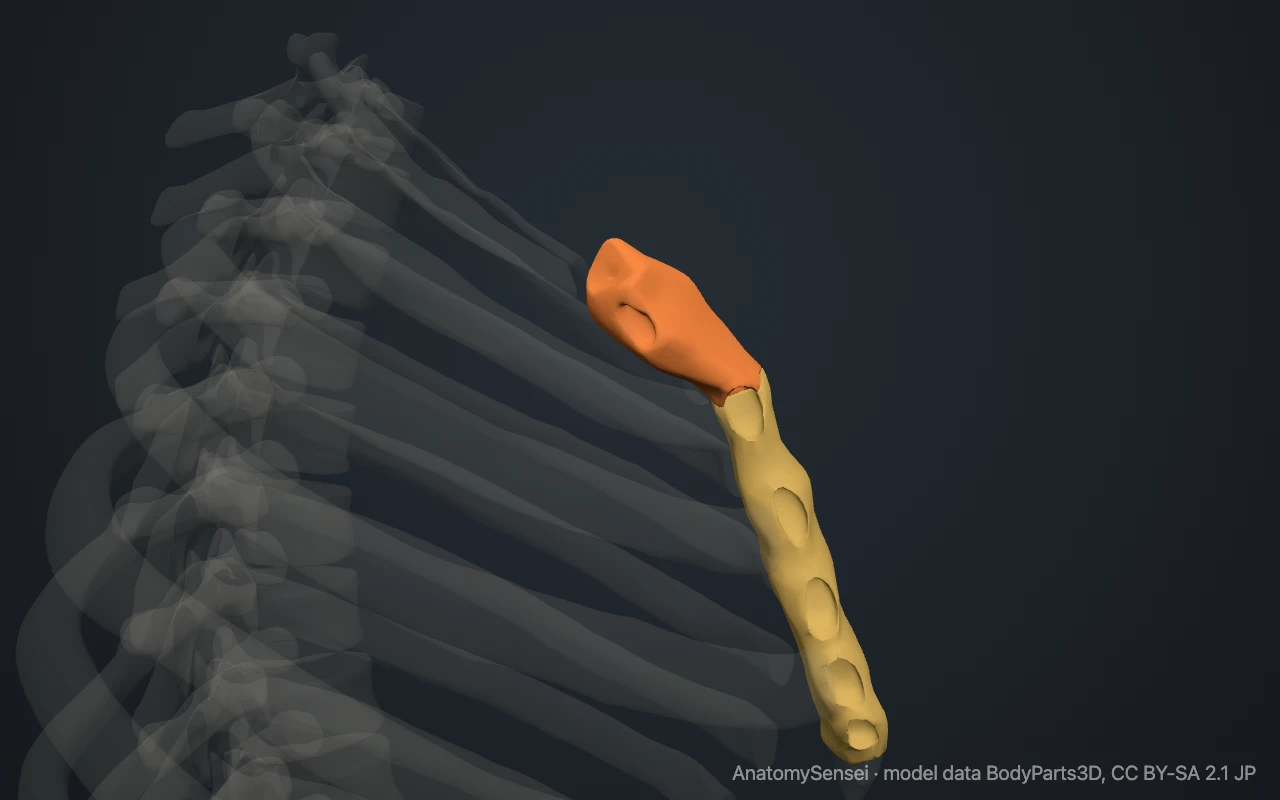
The joint here is made of fibrous cartilage and allows a slight hinge movement in breathing. In some older adults it turns to bone and the two parts become one.
What attaches to the manubrium?
On the front, the sternocleidomastoid muscle of the neck arises from the upper part by a rounded tendon. Part of pectoralis major, the large chest muscle, arises lower down on each side.
On the back, two thin strap muscles of the neck begin, the sternohyoid and the sternothyroid. They run upward to the hyoid bone and the voice box.
What does the manubrium do?
It is the anchor for the shoulder girdle. Forces from the arm travel along the collarbone to the manubrium and so to the rest of the rib cage.
With the first ribs and the first thoracic vertebra it forms the ring of the upper chest opening. It also protects the large vessels that lie behind it, including the arch of the aorta and the veins that drain the head and arms.
Common problems with the manubrium
The manubrium is thick and is fractured less often than the body of the sternum. A hard blow can instead displace the joint between the two at the sternal angle.
The sternoclavicular joint on its upper corner can be sprained or dislocated by a fall onto the shoulder, and it can be affected by arthritis. This page describes anatomy only.
Common questions
What is the notch at the top of the breastbone called?
The jugular notch, or suprasternal notch. It is the upper border of the manubrium.
Which ribs attach to the manubrium?
The first rib on each side, through its cartilage, and half of the second. The second rib cartilage is shared with the body of the sternum.
Is the manubrium a separate bone?
It is a part of the sternum. It is joined to the body by cartilage and may fuse with it in later life.
Does the manubrium fuse with the body of the sternum?
In most people the joint stays as cartilage. In some it turns to bone with age.
Is this 3D model of the manubrium of the sternum free?
Yes. The interactive 3D model on this page is free to view and use for study, with no account or download needed. Its geometry comes from the open BodyParts3D data set (CC BY-SA).
About this free 3D model of the manubrium of the sternum
The interactive 3D model on this page is free to use in your browser, with no sign-up. It is built from scan-based anatomy data, so every bone is a separate, correctly placed shape you can turn and inspect from any side.