
First rib
Costa prima
The first rib is the highest rib, lying at the root of the neck under the collarbone. It is the shortest, broadest and most sharply curved of all the ribs.
Loading 3D model…
Free 3D model of the first rib. Whole rib cage. Drag to rotate, zoom with + and − (or Ctrl + scroll), click a bone to highlight and name it.
Key points
- The first rib is the shortest, broadest and most curved rib.
- It is flat, with an upper and a lower surface instead of an outer and an inner one.
- The main vein, artery and nerves of the arm cross its upper surface.
- Its head joins only the first thoracic vertebra.
What is the first rib?
The first rib is the uppermost of the 12 ribs on each side. It forms a tight C-shaped curve from the spine to the top of the breastbone and is much shorter than the ribs below it.
It is a true rib, because its cartilage runs straight to the sternum. It is also an atypical rib, since its shape differs from the standard pattern in several ways.
Where is the first rib?
It lies at the root of the neck, behind and below the collarbone. From the first thoracic vertebra it slopes forward and downward to meet the manubrium, the top part of the sternum.
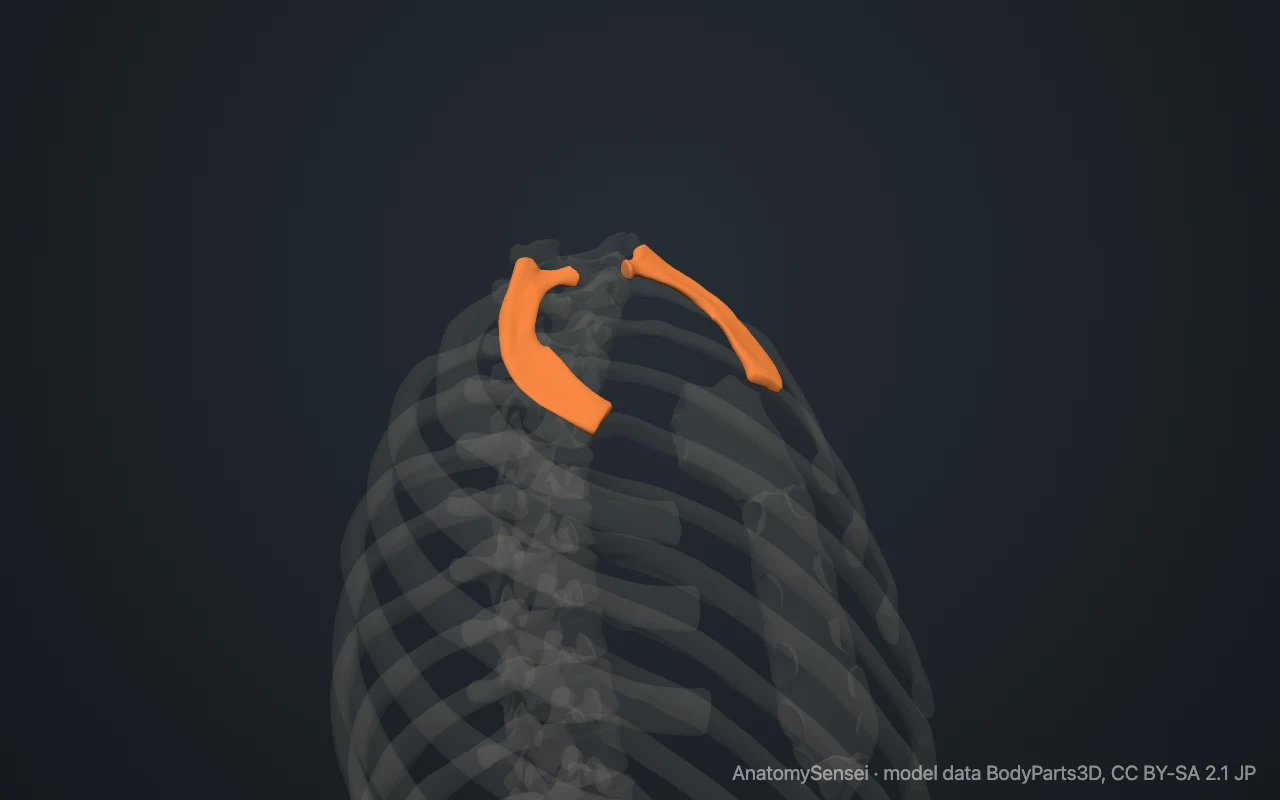
It is hard to feel on your own body. The collarbone covers its front half and thick muscles cover the rest. If you press down firmly into the hollow above the collarbone, close to the neck, the deep resistance under your fingers is the first rib.
How is the first rib different from other ribs?
Most ribs are flattened so that they face outward and inward. The first rib is flattened from top to bottom. It has a superior and an inferior surface, with an inner and an outer border.
Its head is small and round and has a single joint surface. It has a neck and a prominent tubercle, but its angle and its tubercle are at the same point. It has no costal groove on its underside.
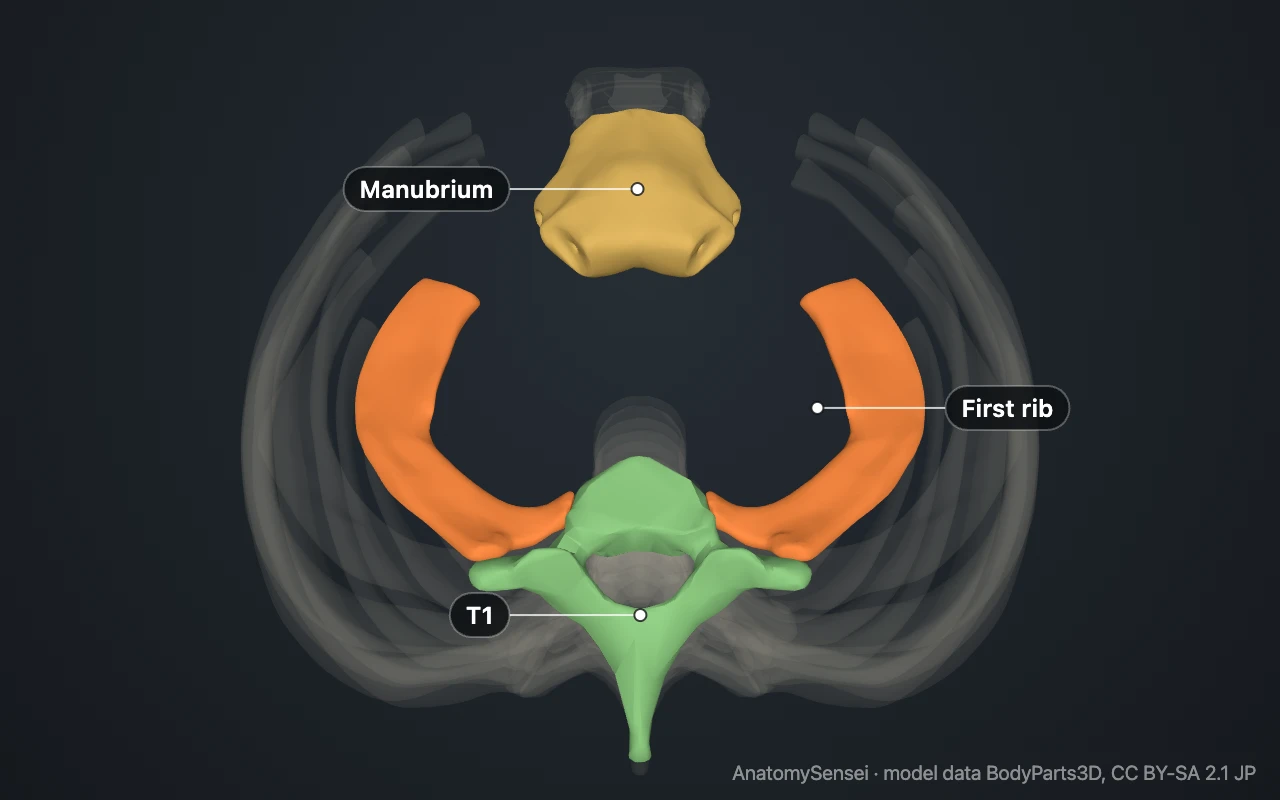
Seen from above, the two first ribs, the first thoracic vertebra and the manubrium form a ring. This ring is the upper opening of the chest.
What crosses the first rib?
The upper surface carries two shallow grooves separated by a small bump on the inner border, the scalene tubercle. The anterior scalene muscle attaches to this tubercle.
The subclavian vein crosses the rib in the groove in front of the tubercle. The subclavian artery and the lowest trunk of the brachial plexus, the bundle of nerves for the arm, cross in the groove behind it.
The collarbone lies just above. The vessels and nerves of the arm therefore pass through a narrow gap between the collarbone and the first rib on their way to the armpit.
What does the first rib articulate with?
At the back, the head of the first rib joins the body of the first thoracic vertebra only. Most other ribs also touch the vertebra above. Its tubercle rests against the transverse process of the same vertebra.
At the front, its short, thick costal cartilage joins the manubrium just below the joint for the collarbone. This joint is a rigid cartilage union with almost no movement. The model has no cartilage, so the first rib ends short of the manubrium there.
What attaches to the first rib?
Two neck muscles hold the rib from above. The anterior scalene attaches to the scalene tubercle, and the middle scalene attaches to the upper surface further back, behind the groove for the artery.
The small subclavius muscle arises from the front end of the rib and its cartilage, next to a strong ligament that ties the rib to the collarbone. The first slip of serratus anterior comes from the outer border, and the intercostal muscles of the first space attach along it.
What does the first rib do?
It forms the rim of the upper opening of the chest and a firm platform under the collarbone. The dome of the lung and its covering rise slightly above it into the root of the neck.
It moves less than the other ribs. In a deep breath the scalene muscles lift the first rib and the manubrium with it, which helps to raise the whole front of the rib cage.
Common problems with the first rib
The space between the first rib and the collarbone is tight. Pressure on the nerves or vessels there is called thoracic outlet syndrome. An extra cervical rib above the first rib is one of the things that can narrow the space.
The first rib is well shielded by the collarbone and the shoulder, so fractures are uncommon. When one does occur after an accident it points to a forceful injury. This page describes anatomy only.
Common questions
Is the first rib a true rib?
Yes. Its costal cartilage attaches directly to the manubrium of the sternum.
Can you feel your first rib?
Only with difficulty. It lies deep under the collarbone and the neck muscles, and can be pressed on in the hollow above the collarbone.
What is the scalene tubercle?
A small bump on the inner border of the first rib where the anterior scalene muscle attaches. It separates the grooves for the subclavian vein and artery.
Which vertebra does the first rib join?
The first thoracic vertebra, T1. Its head has one joint surface and does not reach the vertebra above.
Is this 3D model of the first rib free?
Yes. The interactive 3D model on this page is free to view and use for study, with no account or download needed. Its geometry comes from the open BodyParts3D data set (CC BY-SA).
About this free 3D model of the first rib
The interactive 3D model on this page is free to use in your browser, with no sign-up. It is built from scan-based anatomy data, so every bone is a separate, correctly placed shape you can turn and inspect from any side.