
Floating ribs (ribs 11 and 12)
Costae fluctuantes
The floating ribs are the eleventh and twelfth pairs of ribs. They join the spine at the back, but their front ends are free and do not connect to the sternum or to the ribs above.
Loading 3D model…
Free 3D model of the floating ribs. Whole rib cage. Drag to rotate, zoom with + and − (or Ctrl + scroll), click a bone to highlight and name it.
Key points
- The floating ribs are ribs 11 and 12, two on each side.
- They are attached to the spine but to nothing at the front.
- They are short and have no tubercle.
- They lie over the kidneys at the back of the abdomen.
What are the floating ribs?
The floating ribs are the last two pairs of ribs, the eleventh and the twelfth. The name describes their front ends, which are not tied to the sternum or to the costal margin.
They do not truly float. Each one is firmly jointed to the spine and is held in place by the muscles of the back and the abdominal wall.
Where are the floating ribs?
They are at the bottom of the rib cage, at the back and sides. From the lowest two thoracic vertebrae they slope downward and outward into the back wall of the abdomen. They do not come round to the front of the body.
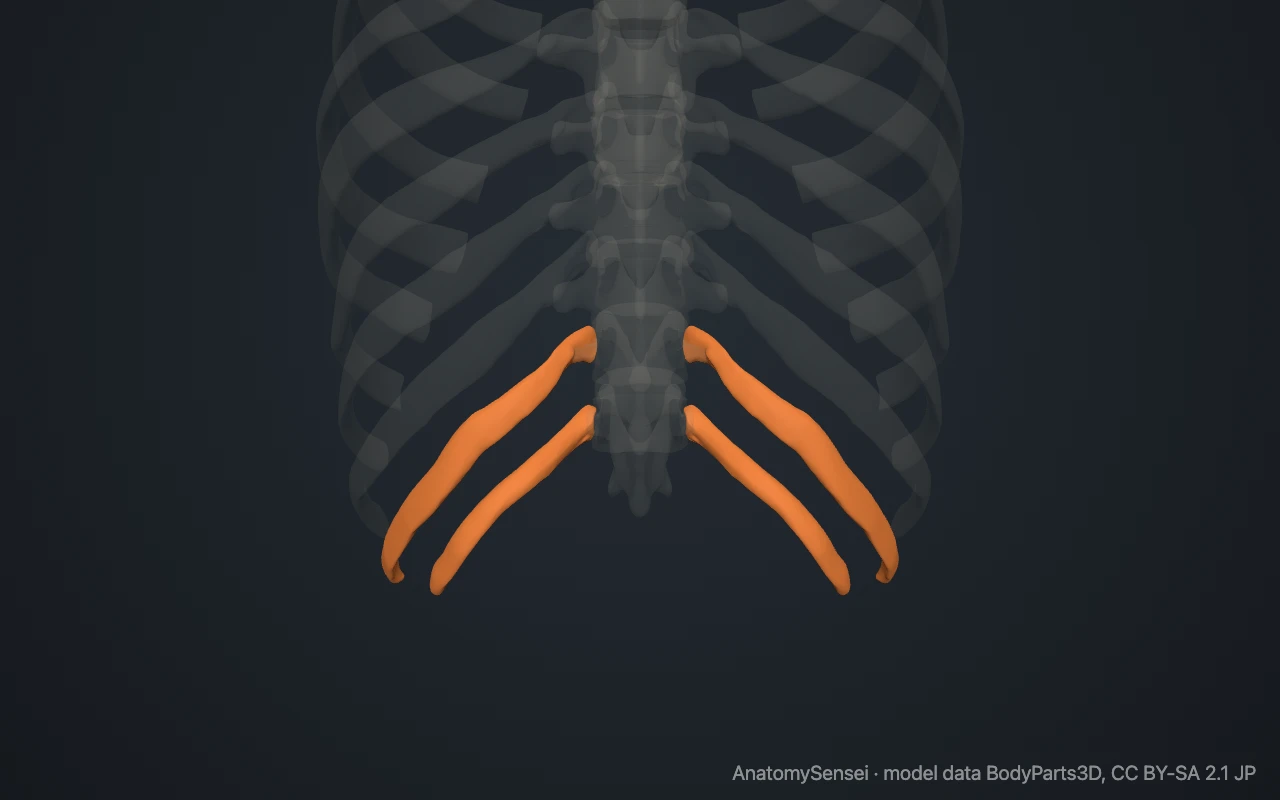
You can feel the eleventh rib on your own body. Follow the lower edge of your rib cage round to your side, at about the level of the elbow when your arm hangs down. The free tip there is usually the eleventh rib. The twelfth is shorter, lies further back under thick muscle and is harder to find.
How do the eleventh and twelfth ribs differ?
The eleventh rib is the longer of the two. It has a slight angle and a shallow costal groove on its lower edge.
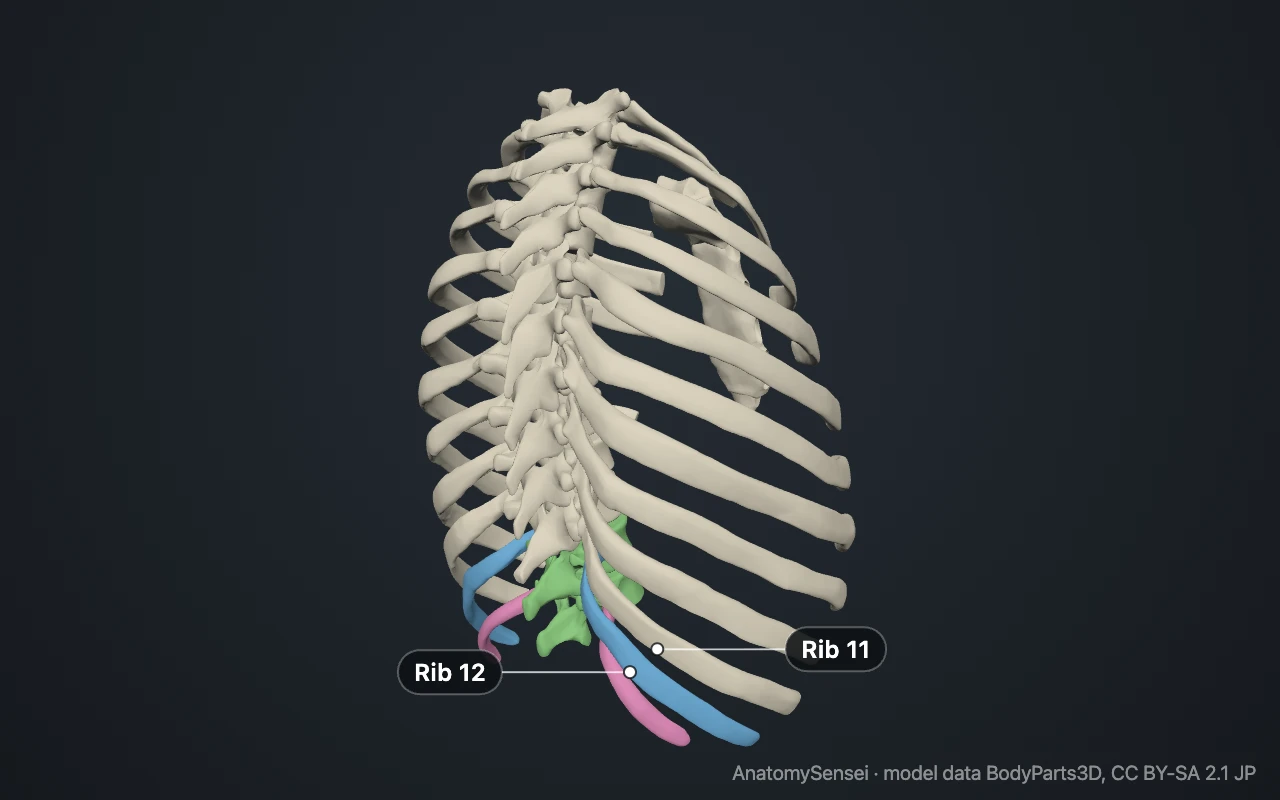
The twelfth rib is usually shorter and has neither an angle nor a groove. Its length varies a great deal from person to person. In some people it is only a few centimetres long, and occasionally it is missing.
How are floating ribs different from other ribs?
Both are short and simple. The head has a single large joint surface instead of two. There is no tubercle and little or no neck.
The front end tapers to a point capped with a small piece of cartilage. In a typical rib that end holds a long cartilage leading toward the sternum.
What do the floating ribs articulate with?
Each floating rib has one joint only. The head of the eleventh rib meets the body of the eleventh thoracic vertebra, and the head of the twelfth rib meets the twelfth.
They do not touch the vertebra above, and they have no joint with the transverse process. This single joint gives them more freedom of movement than the ribs higher up.
What attaches to the floating ribs?
The diaphragm takes part of its origin from the inner surfaces of the lowest ribs, including these two. The quadratus lumborum, a deep muscle of the lower back, attaches to the lower border of the twelfth rib.
The broad muscles of the abdominal wall and the back also attach here, among them the external and internal obliques and latissimus dorsi. The intercostal muscles of the eleventh space run between the two ribs.
What do the floating ribs do?
They guard the back of the upper abdomen. The kidneys lie in front of them, and the twelfth rib crosses the back of each kidney. The spleen on the left and the liver on the right are also partly covered by the lower ribs.
In breathing, the quadratus lumborum holds the twelfth rib steady. This gives the diaphragm a fixed base to pull against as it contracts.
What does the 3D model show?
The model shows the whole rib cage as bone only. It has no costal cartilages, so every rib ends before the sternum. For ribs 1 to 10 a bar of cartilage is missing from the picture.
For the floating ribs the picture is close to real life. Apart from a small cartilage tip, they do end freely.
Common problems with the floating ribs
Their free ends make them flexible, so they break less easily than the middle ribs. A fracture of a floating rib usually follows a direct blow to the back or flank. Because of what lies beneath, such an injury may be checked for damage to a kidney, the spleen or the liver.
The twelfth rib is a surgical and imaging landmark for the kidney, and its variable length is a known source of miscounting ribs on X-rays. This page describes anatomy only.
Common questions
How many floating ribs do humans have?
Four, two on each side. They are the eleventh and twelfth pairs.
Are floating ribs attached to anything?
Yes. Each is jointed to a thoracic vertebra at the back and is held by muscles. Only the front end is free.
Are floating ribs false ribs?
In many textbooks, yes. Ribs 8 to 12 are all called false because none reaches the sternum directly, and 11 and 12 are the floating subgroup.
Do women have more floating ribs than men?
No. Men and women normally have the same number of ribs, including two floating pairs.
Is this 3D model of the floating ribs free?
Yes. The interactive 3D model on this page is free to view and use for study, with no account or download needed. Its geometry comes from the open BodyParts3D data set (CC BY-SA).
About this free 3D model of the floating ribs
The interactive 3D model on this page is free to use in your browser, with no sign-up. It is built from scan-based anatomy data, so every bone is a separate, correctly placed shape you can turn and inspect from any side.