
Thoracic vertebrae
Vertebrae thoracicae
The thoracic vertebrae are the twelve bones of the upper and middle back, numbered T1 to T12. Each one carries a pair of ribs, so together they form the back of the rib cage.
Loading 3D model…
Free 3D model of the thoracic vertebrae. Whole spine. Drag to rotate, zoom with + and − (or Ctrl + scroll), click a bone to highlight and name it.
Key points
- There are twelve thoracic vertebrae, T1 to T12, between the neck and the lower back.
- They are the only vertebrae with joint surfaces for the ribs.
- Their long spinous processes slope downward and overlap like roof tiles.
- The thoracic spine is the least mobile region because the rib cage holds it steady.
What are the thoracic vertebrae?
The thoracic vertebrae are the twelve vertebrae of the chest region. They form the middle and longest section of the movable spine, between the cervical vertebrae of the neck and the lumbar vertebrae of the lower back.
Each thoracic vertebra is joined to a pair of ribs. That link is what defines the region. The model on this page shows the vertebrae without the ribs, which have their own model in the thorax section.
Where are the thoracic vertebrae?
They run from the base of the neck to the bottom of the rib cage. T1 lies just below the bump of C7, and T12 lies at the level of the lowest ribs. Seen from the side, the region curves gently backward. This curve is the thoracic kyphosis.
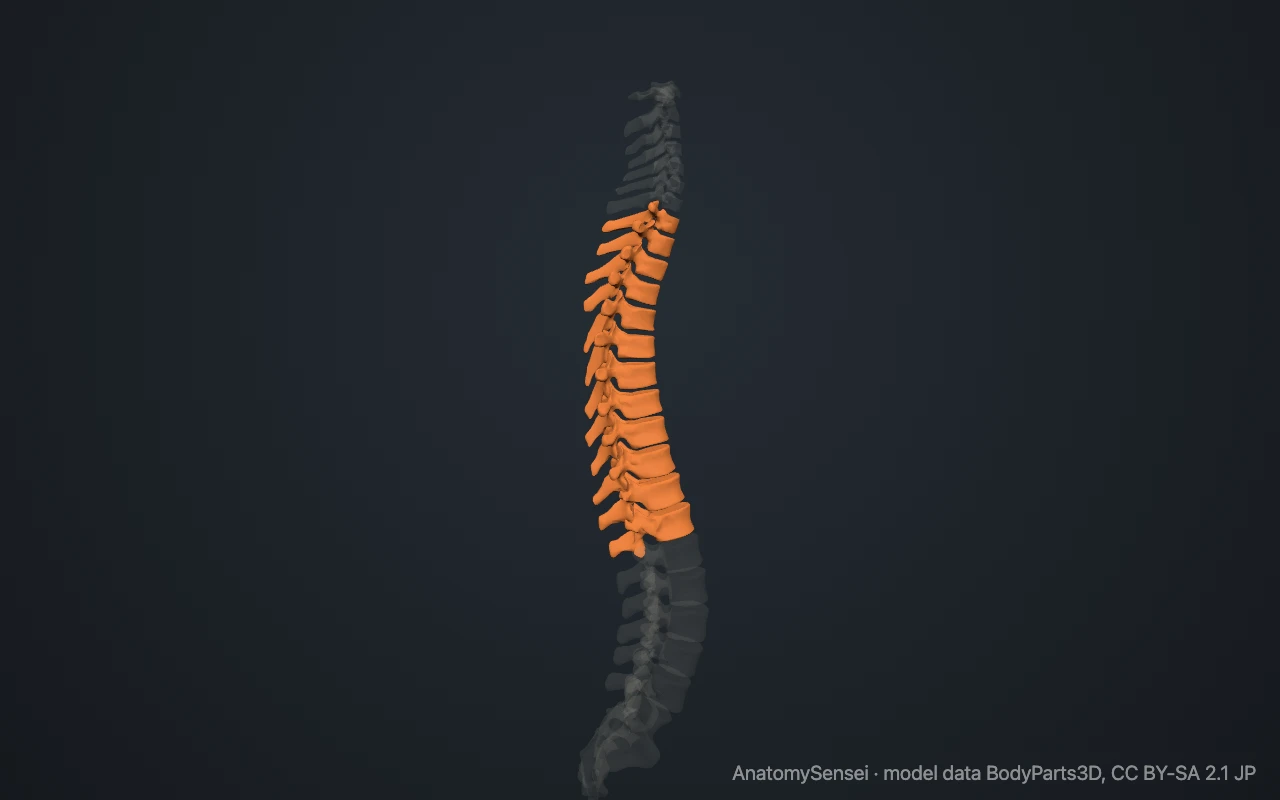
You can feel their spinous processes as the row of bumps down the middle of your upper back, clearest when you bend forward. Each tip lies lower than the body of its own vertebra, because the processes slope downward.
What makes a thoracic vertebra different?
The identifying feature is the set of costal facets, small smooth surfaces where the ribs attach. A typical thoracic vertebra has them on the sides of its body and on the front of each transverse process.
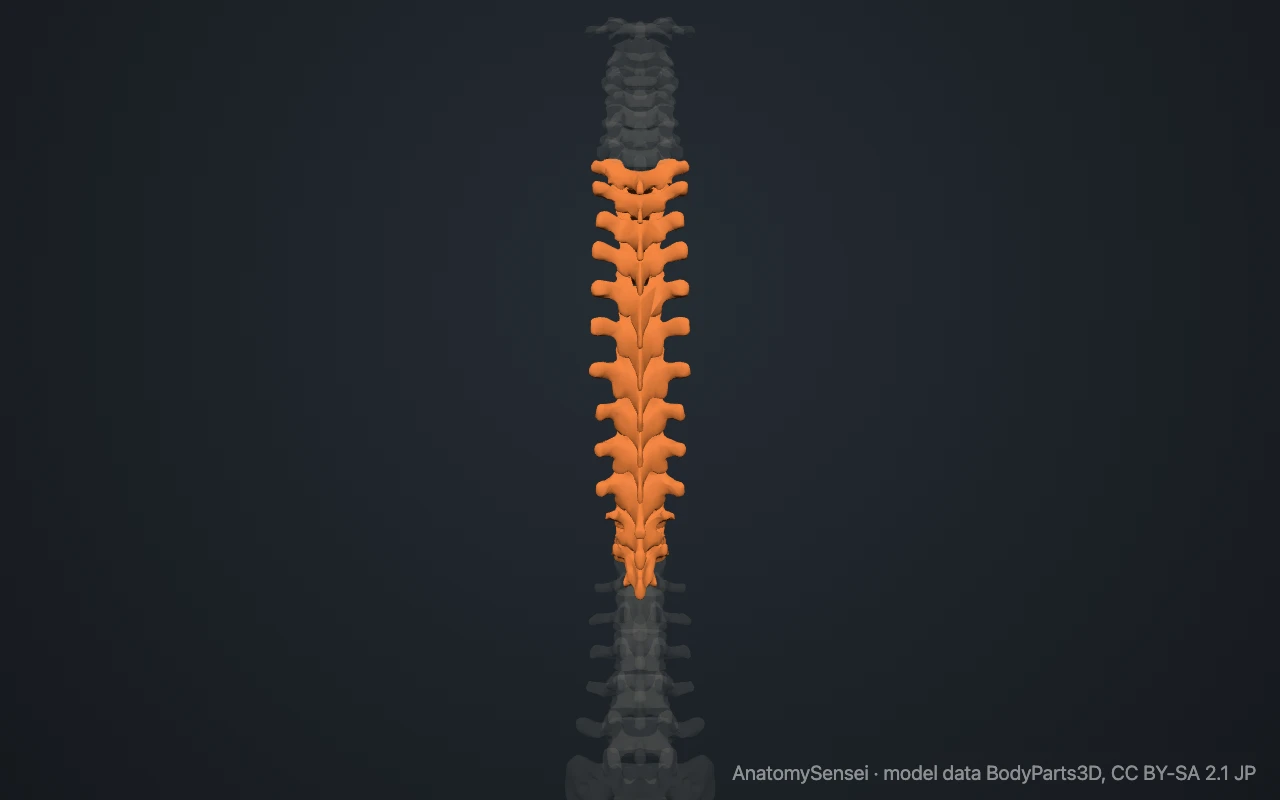
The body is roughly heart-shaped when seen from above, and grows larger from T1 down to T12 as the load increases. The vertebral foramen is small and round.
The spinous processes are long and point downward, each overlapping the one below. The facet joints lie almost in the plane of the back, which permits rotation but limits bending forward and backward.
How do the ribs attach to the thoracic vertebrae?
A typical rib meets the spine at two points. Its head sits in the gap between two vertebral bodies, touching a half-facet on each, called a demifacet, and the disc between them. Its tubercle, a little further out, rests on the transverse process of the lower of those two vertebrae.
So the head of the fifth rib, for example, meets the bodies of T4 and T5, and its tubercle meets the transverse process of T5. The twelve pairs of ribs are numbered to match the vertebra they belong to.
Which thoracic vertebrae are different from the rest?
The vertebrae at each end of the region blend into their neighbours. T1 looks partly cervical. It has a whole facet on each side for the first rib and a long, nearly horizontal spinous process that can be as prominent as that of C7.
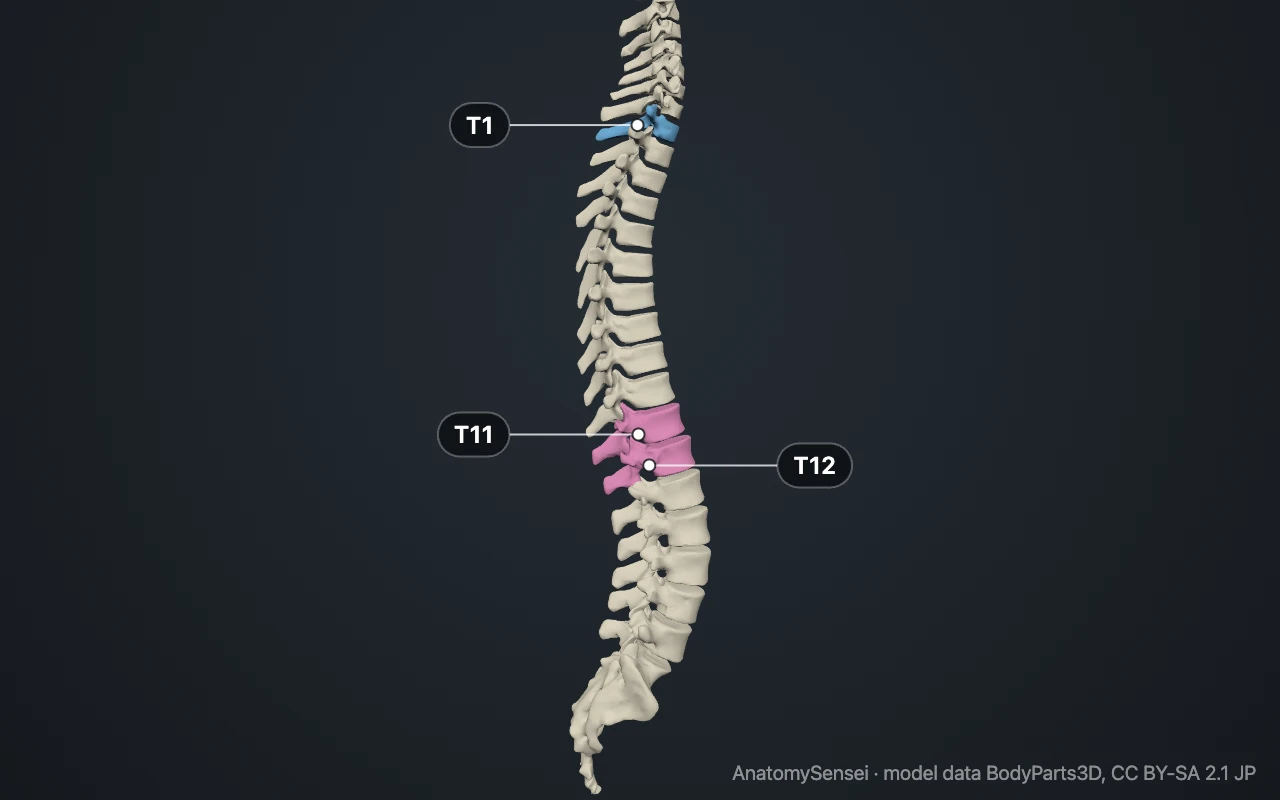
At the lower end, the ribs attach more simply. The bodies of the last few thoracic vertebrae each carry a single whole facet for their own rib. T11 and T12 have no facets on their transverse processes, because the eleventh and twelfth ribs, the floating ribs, do not rest on them.
T12 is the transition to the lumbar spine. Its upper joints face like thoracic ones and its lower joints like lumbar ones, and its spinous process is short and squared.
What do the thoracic vertebrae do?
With the ribs and the sternum, they form the rib cage that protects the heart and lungs. The rib joints also move slightly with every breath.
They carry the weight of the head, neck and arms down to the lumbar spine and protect the spinal cord. The ribs and the overlapping spinous processes make this the stiffest region of the spine, with rotation its freest movement.
What attaches to the thoracic vertebrae?
Apart from the ribs, the thoracic vertebrae anchor large muscles of the back and shoulder. The trapezius and the rhomboids arise from the spinous processes and run to the shoulder blade. The long erector spinae muscles lie in the grooves on each side of the spinous processes.
Common problems with the thoracic vertebrae
Bodies weakened by osteoporosis can collapse at the front, a compression fracture, most often in the middle of the thoracic spine and at the junction with the lumbar spine. Several such fractures increase the backward curve of the upper back.
Scoliosis, a sideways curve with rotation, often involves the thoracic region. Scheuermann disease is a condition of adolescence in which several thoracic bodies grow wedge-shaped. Disc herniation is uncommon here compared with the neck and lower back. This page describes anatomy only.
Common questions
How many thoracic vertebrae are there?
Twelve, numbered T1 to T12, one for each pair of ribs.
Which vertebrae do the ribs attach to?
Only the thoracic vertebrae. Each of the twelve carries one pair of ribs.
Why does the thoracic spine move less than the neck?
The ribs and sternum brace it, the discs are thin and the long spinous processes overlap. Together these limit bending.
What is the thoracolumbar junction?
The meeting point of T12 and L1, where the stiff thoracic spine joins the more mobile lumbar spine. It is a common site of fractures.
Is this 3D model of the thoracic vertebrae free?
Yes. The interactive 3D model on this page is free to view and use for study, with no account or download needed. Its geometry comes from the open BodyParts3D data set (CC BY-SA).
About this free 3D model of the thoracic vertebrae
The interactive 3D model on this page is free to use in your browser, with no sign-up. It is built from scan-based anatomy data, so every bone is a separate, correctly placed shape you can turn and inspect from any side.