
Cervical vertebrae
Vertebrae cervicales
The cervical vertebrae are the seven bones of the neck, numbered C1 to C7. They are the smallest and most mobile vertebrae, and they carry the head on top of the spine.
Loading 3D model…
Free 3D model of the cervical vertebrae. Whole spine. Drag to rotate, zoom with + and − (or Ctrl + scroll), click a bone to highlight and name it.
Key points
- There are seven cervical vertebrae, C1 to C7, between the skull and the first thoracic vertebra.
- Every cervical vertebra has a hole in each transverse process, found in no other region.
- C1 (atlas) and C2 (axis) are specialised for nodding and turning the head.
- C7 has a long spinous process that forms the bump at the base of the neck.
What are the cervical vertebrae?
The cervical vertebrae are the seven vertebrae of the neck. They form the top region of the spine, above the thoracic vertebrae. Almost all mammals have seven, whatever the length of the neck.
They are the smallest of the movable vertebrae because they carry the least weight, only that of the head. In exchange they allow more movement than any other region of the spine.
Where are the cervical vertebrae?
They run from the base of the skull to the top of the chest. C1 sits directly under the occipital bone of the skull, and C7 rests on the first thoracic vertebra, T1. Together they form a gentle forward curve called the cervical lordosis.
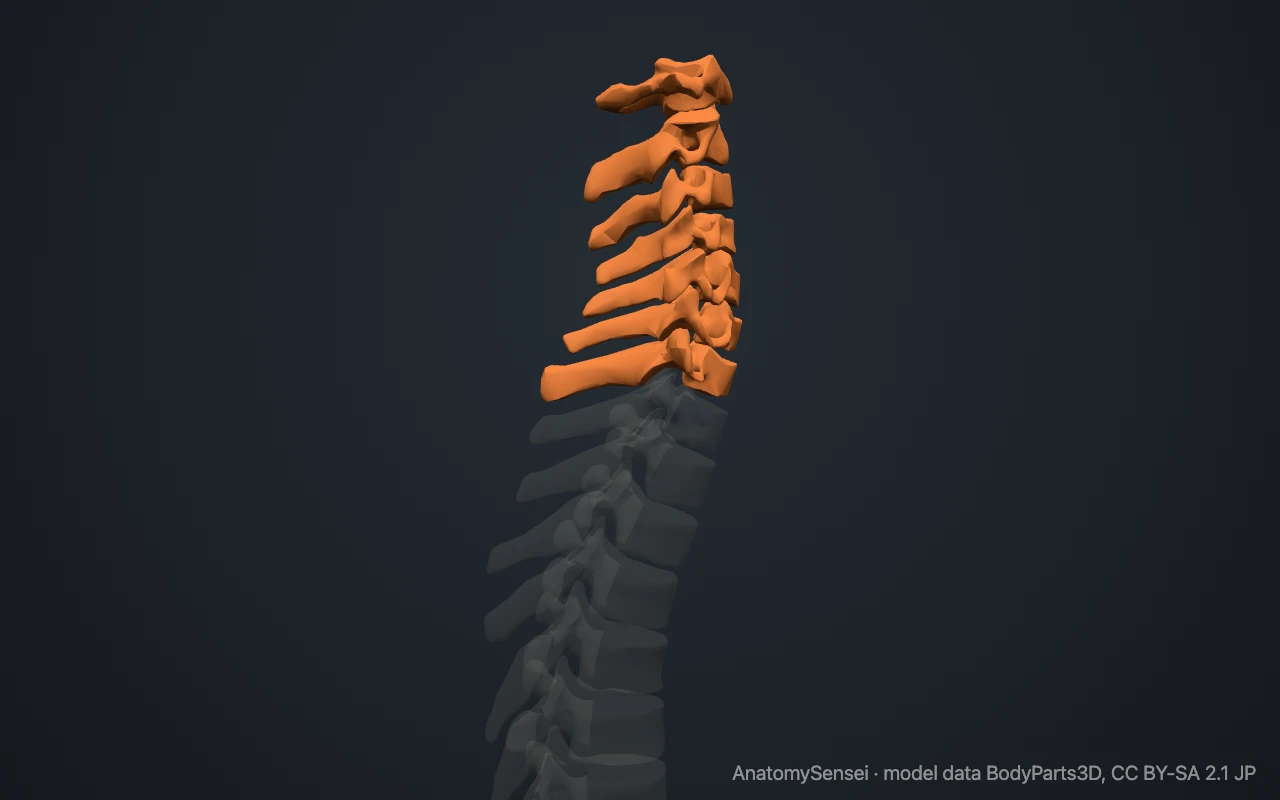
You can feel some of them on your own neck. Run a finger down the midline at the back. The first firm point below the skull is the spinous process of C2. Lower down, where the neck meets the shoulders, the most obvious bump is usually C7.
What makes a cervical vertebra different?
The feature that identifies a cervical vertebra is the transverse foramen, a hole in each transverse process. The vertebral artery, which supplies the back of the brain, climbs through these holes, usually from C6 upward.
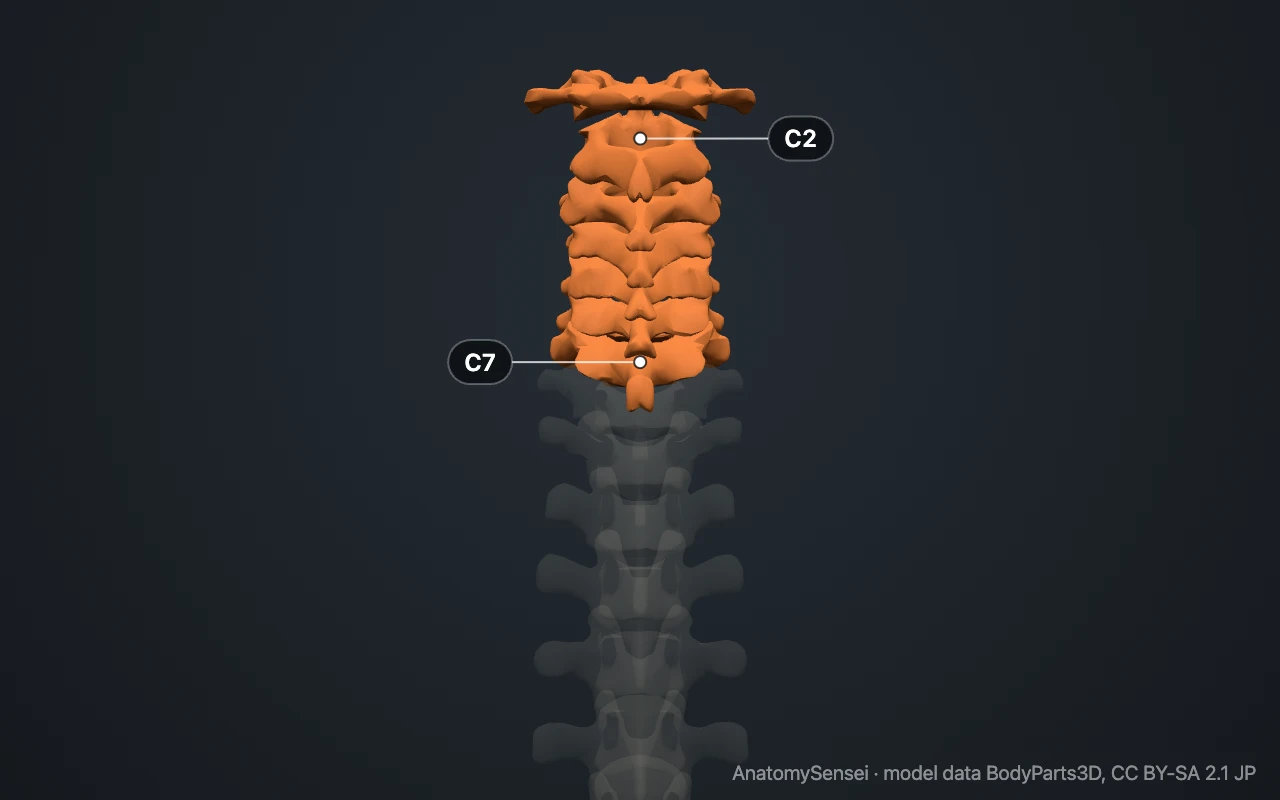
The typical cervical vertebrae, C3 to C6, share other traits. The body is small and wider from side to side than from front to back. Its upper surface has a raised lip on each side, the uncinate process. The vertebral foramen is large and triangular, because the spinal cord is thick in the neck.
The spinous processes of C2 to C6 are short and usually bifid, meaning split into two at the tip. The facet joints slope like roof tiles, which lets the neck bend and turn freely.
Which cervical vertebrae are different from the rest?
Three of the seven are called atypical. The atlas (C1) is a ring of bone with no body and no spinous process. It holds up the skull and allows the nodding movement of the head.
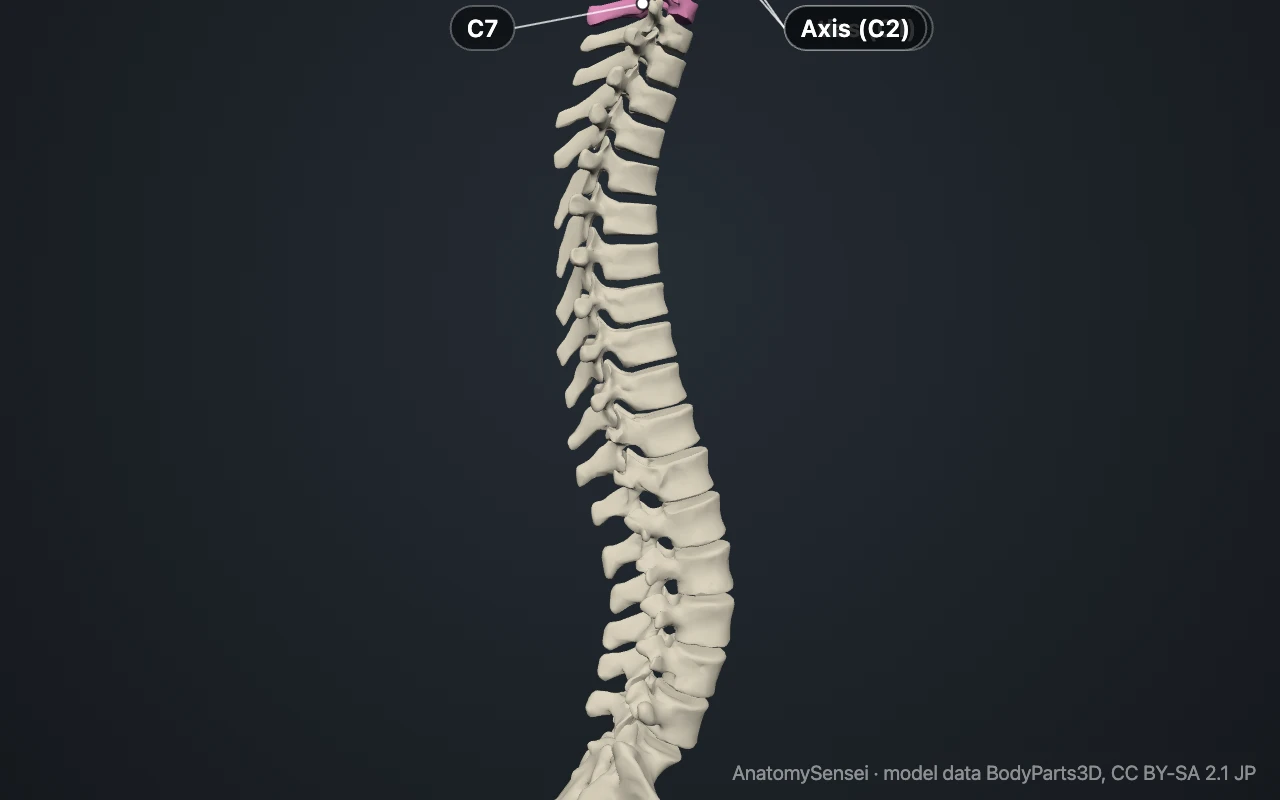
The axis (C2) has a peg of bone, the dens, that projects upward into the ring of the atlas. The atlas and the skull turn around this peg when the head rotates.
C7 is a transition to the thoracic spine. Its spinous process is long and is not split, and it is easy to feel under the skin, which gives the bone its other name, the vertebra prominens.
What do the cervical vertebrae articulate with?
At the top, the atlas meets the occipital bone of the skull at the atlanto-occipital joints. At the bottom, C7 meets T1. In between, each vertebra joins the next through a disc in front and two facet joints behind.
The exception is the joint between the atlas and the axis, which has no disc. The first disc of the spine lies between C2 and C3.
What attaches to the cervical vertebrae?
A strong sheet of ligament, the nuchal ligament, runs in the midline from the back of the skull to the spinous process of C7 and attaches to the cervical spinous processes on the way.
The transverse processes anchor the scalene muscles, which run down to the first two ribs, and the levator scapulae, which runs to the shoulder blade. Deep muscles of the neck attach along the front and back of the column.
What do the cervical vertebrae do?
They support and move the head. Nodding happens mainly between the skull and the atlas, and a large part of turning the head happens between the atlas and the axis. The lower cervical joints add bending forward, backward and to the side.
They also protect the upper spinal cord and the vertebral arteries. Eight pairs of cervical nerves leave this region, one more than the number of vertebrae, because the first pair exits above the atlas.
Common problems with the cervical vertebrae
Wear of the discs and joints of the neck with age is called cervical spondylosis, and is most common at the lower levels such as C5 to C6. A bulging disc or bony spur can press on a nerve root, a condition called cervical radiculopathy.
A sudden back-and-forth movement of the neck can strain its soft tissues, an injury known as whiplash. Fractures and dislocations of the cervical vertebrae are serious because the spinal cord lies so close. This page describes anatomy only.
Common questions
How many cervical vertebrae are there?
Seven, numbered C1 to C7 from the top down.
Why are there eight cervical nerves but seven cervical vertebrae?
The first cervical nerve leaves above the atlas, between it and the skull. The eighth leaves below C7.
Which cervical vertebra sticks out at the back of the neck?
Usually C7, the vertebra prominens. In some people the spinous process of T1 just below it is as prominent or more so.
Do the cervical vertebrae have ribs?
Not normally. A small number of people have an extra rib attached to C7, called a cervical rib.
Is this 3D model of the cervical vertebrae free?
Yes. The interactive 3D model on this page is free to view and use for study, with no account or download needed. Its geometry comes from the open BodyParts3D data set (CC BY-SA).
About this free 3D model of the cervical vertebrae
The interactive 3D model on this page is free to use in your browser, with no sign-up. It is built from scan-based anatomy data, so every bone is a separate, correctly placed shape you can turn and inspect from any side.