
Axis (C2)
Axis
The axis is the second cervical vertebra, C2. It has a tooth-like peg called the dens that points upward into the atlas and forms the pivot on which the head turns.
Loading 3D model…
Free 3D model of the axis. Whole spine. Drag to rotate, zoom with + and − (or Ctrl + scroll), click a bone to highlight and name it.
Key points
- The axis is C2, the second vertebra, directly below the atlas.
- Its dens is a peg of bone that projects up into the ring of the atlas.
- The atlas and skull rotate around the dens when the head turns.
- Its large split spinous process is the first one that can be felt below the skull.
What is the axis?
The axis is the second vertebra of the neck, also written C2. Its name describes its job. It provides the axis, or pivot, around which the head rotates.
It is the strongest of the cervical vertebrae. From below it looks like an ordinary neck vertebra, but its upper half is unique because of a single feature, the dens.
Where is the axis?
It lies high in the neck, between the atlas above and C3 below. In front of it is the back of the throat.
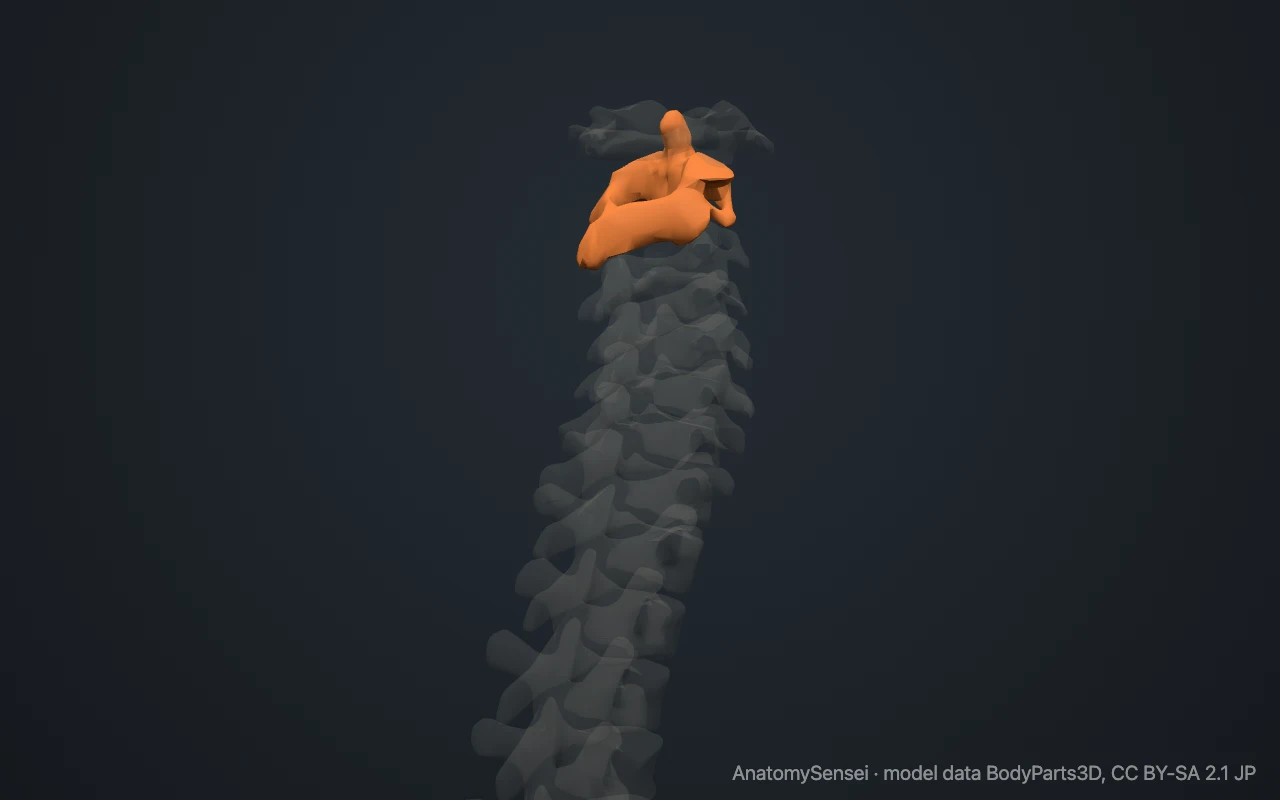
You can feel it. Place a finger in the midline hollow at the back of your neck, just under the skull, and press gently while sliding downward. The first firm bump you meet is the spinous process of the axis. The atlas above it has no spinous process, so nothing is felt there.
What is the dens?
The dens is a strong peg of bone that stands up from the body of the axis. The word is Latin for tooth. It is also called the odontoid process, which means the same in Greek.
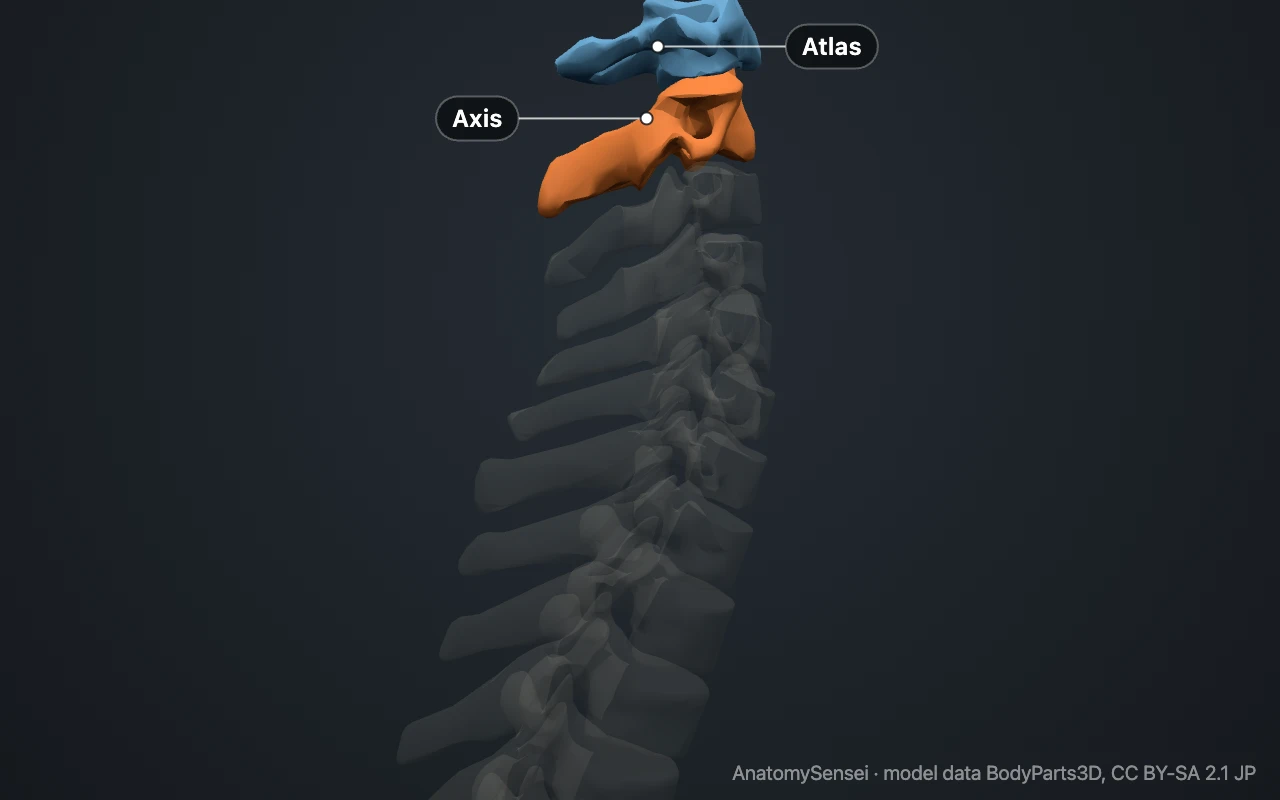
The dens fits into the front part of the ring of the atlas. A smooth facet on its front touches the back of the anterior arch of the atlas, and the transverse ligament of the atlas passes behind it to hold it in place.
In development, the dens forms from what would have been the body of the atlas. In the model the atlas partly hides the dens, so the see-through setting helps to show the peg inside the ring.
What are the other parts of the axis?
Beside the dens, on top of the body, are two large, gently rounded superior articular facets. They carry the lateral masses of the atlas and, through them, the weight of the head.
The spinous process is large and bifid, meaning split in two at its tip. It is the biggest in the upper neck and gives attachment to several muscles. The laminae that support it are thick.
The transverse processes are small, and each contains a transverse foramen for the vertebral artery. The lower surface of the axis has ordinary facets and a disc surface for C3.
What does the axis articulate with?
Above, it meets the atlas at the three atlantoaxial joints: one in the midline around the dens and one on each side between the facets. No disc lies between the two bones.
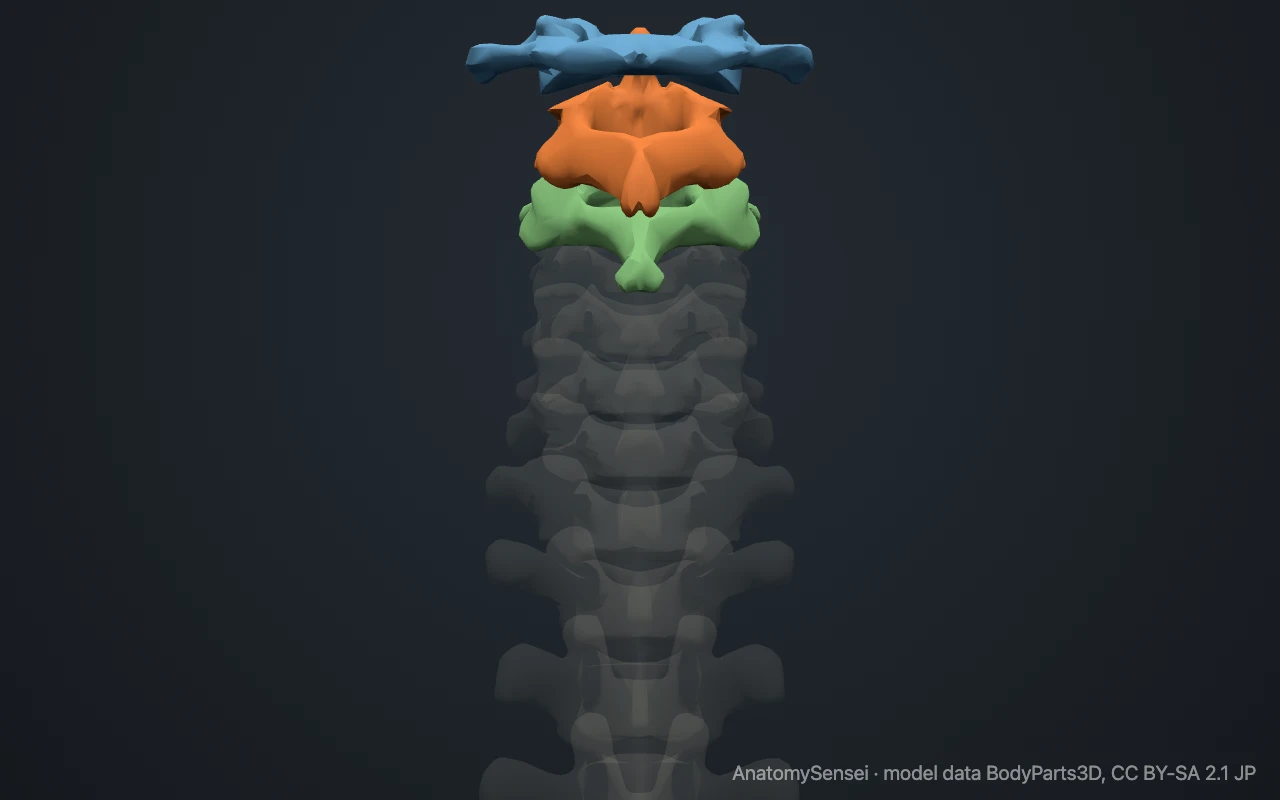
Below, it meets C3 in the usual way, through an intervertebral disc and a pair of facet joints. This is the first disc of the spine.
What attaches to the axis?
Strong ligaments tie the dens to the skull. The two alar ligaments run from the sides of the dens to the occipital bone and check how far the head can turn. A slender apical ligament runs from its tip to the front edge of the opening in the skull.
The spinous process anchors small deep muscles that pass up to the atlas and the skull and help to turn and extend the head. The nuchal ligament also attaches to it.
What does the axis do?
The axis lets the head turn from side to side. The atlas, carrying the skull, spins around the dens like a ring around a post. A large part of all the rotation of the neck happens at this one level.
The axis also passes the weight of the head from the atlas down to the rest of the cervical spine.
Common problems with the axis
The dens can break, usually at or near its base. These odontoid fractures follow falls in older adults and high-energy accidents in younger people.
A fracture through the arch on both sides, between the upper and lower facets, is called a hangman's fracture. Today it is seen mainly after road accidents in which the head is thrown backward. Injuries at this level matter because the upper spinal cord lies just behind the dens. This page describes anatomy only.
Common questions
What is the difference between the atlas and the axis?
The atlas is C1, a ring that carries the skull. The axis is C2, with a peg that the atlas turns around.
Why is C2 called the axis?
Because it forms the pivot on which the atlas and the head rotate.
Is the dens part of the atlas or the axis?
It is part of the axis, although it sits inside the ring of the atlas.
Can you feel the axis?
Yes. Its spinous process is the first bony bump in the midline below the back of the skull.
Is this 3D model of the axis free?
Yes. The interactive 3D model on this page is free to view and use for study, with no account or download needed. Its geometry comes from the open BodyParts3D data set (CC BY-SA).
About this free 3D model of the axis
The interactive 3D model on this page is free to use in your browser, with no sign-up. It is built from scan-based anatomy data, so every bone is a separate, correctly placed shape you can turn and inspect from any side.