
Seventh cervical vertebra (C7)
Vertebra cervicalis VII
The seventh cervical vertebra, C7, is the lowest bone of the neck. Its long spinous process makes the bump felt at the base of the neck, which is why it is called the vertebra prominens.
Loading 3D model…
Free 3D model of the seventh cervical vertebra. Whole spine. Drag to rotate, zoom with + and − (or Ctrl + scroll), click a bone to highlight and name it.
Key points
- C7 is the last cervical vertebra, where the neck meets the upper back.
- Its spinous process is long, nearly horizontal and not split at the tip.
- The bump it makes is used to count the vertebrae above and below.
- It is a transitional bone with both cervical and thoracic features.
What is the C7 vertebra?
C7 is the seventh and lowest cervical vertebra. It lies at the junction between the mobile neck and the stiffer thoracic spine, and its shape is a blend of the two regions.
Its Latin name, vertebra prominens, means the prominent vertebra. The name refers to its spinous process, which stands out further than those of the neck vertebrae above it.
Where is the C7 vertebra?
It sits at the base of the neck, between C6 above and the first thoracic vertebra, T1, below. It is roughly level with the tops of the shoulders.
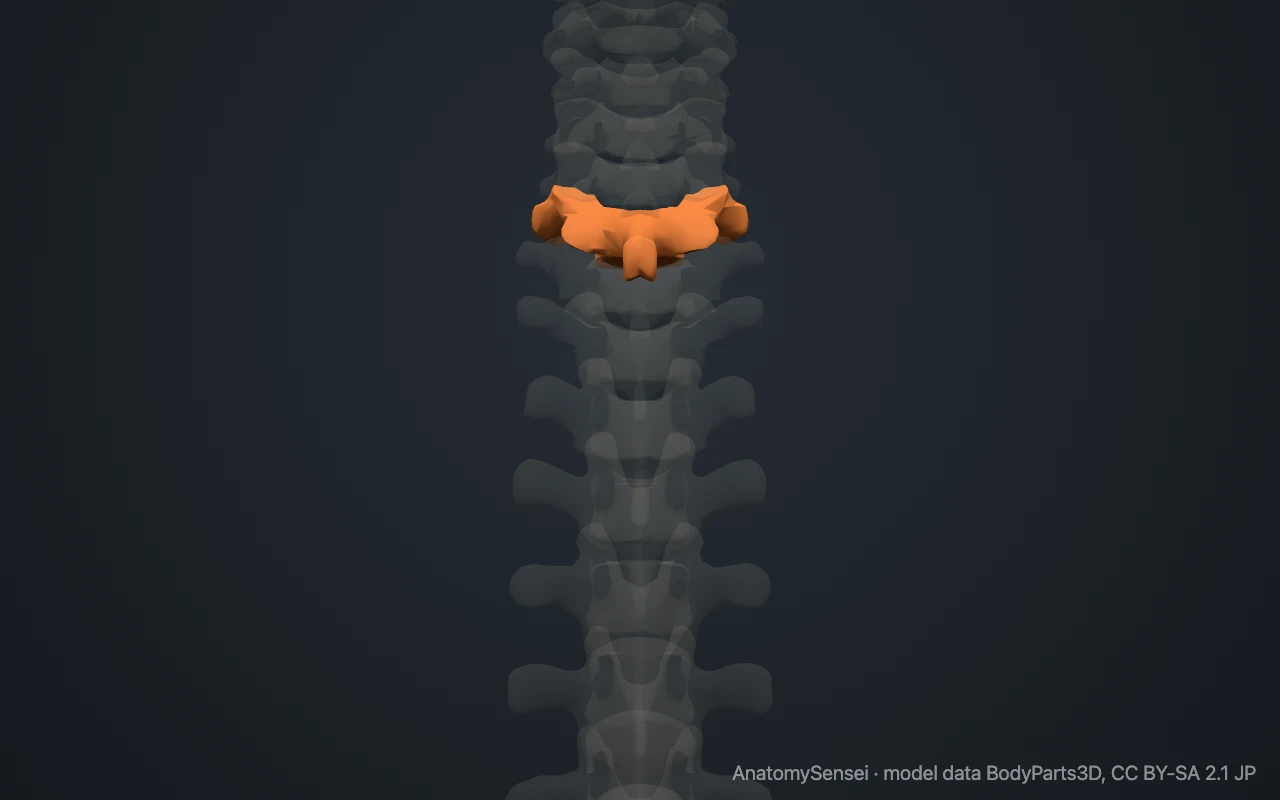
You can find it on yourself. Bend your head forward and run a finger down the midline at the back of your neck. The spinous processes above are short and lie deep. The first large, obvious bump is usually C7. In some people T1, just below, sticks out as much or more.
What makes C7 different from the other cervical vertebrae?
The main difference is the spinous process. In C3 to C6 it is short and split into two at the tip. In C7 it is long, thick, almost horizontal and ends in a single rounded knob, like that of a thoracic vertebra.
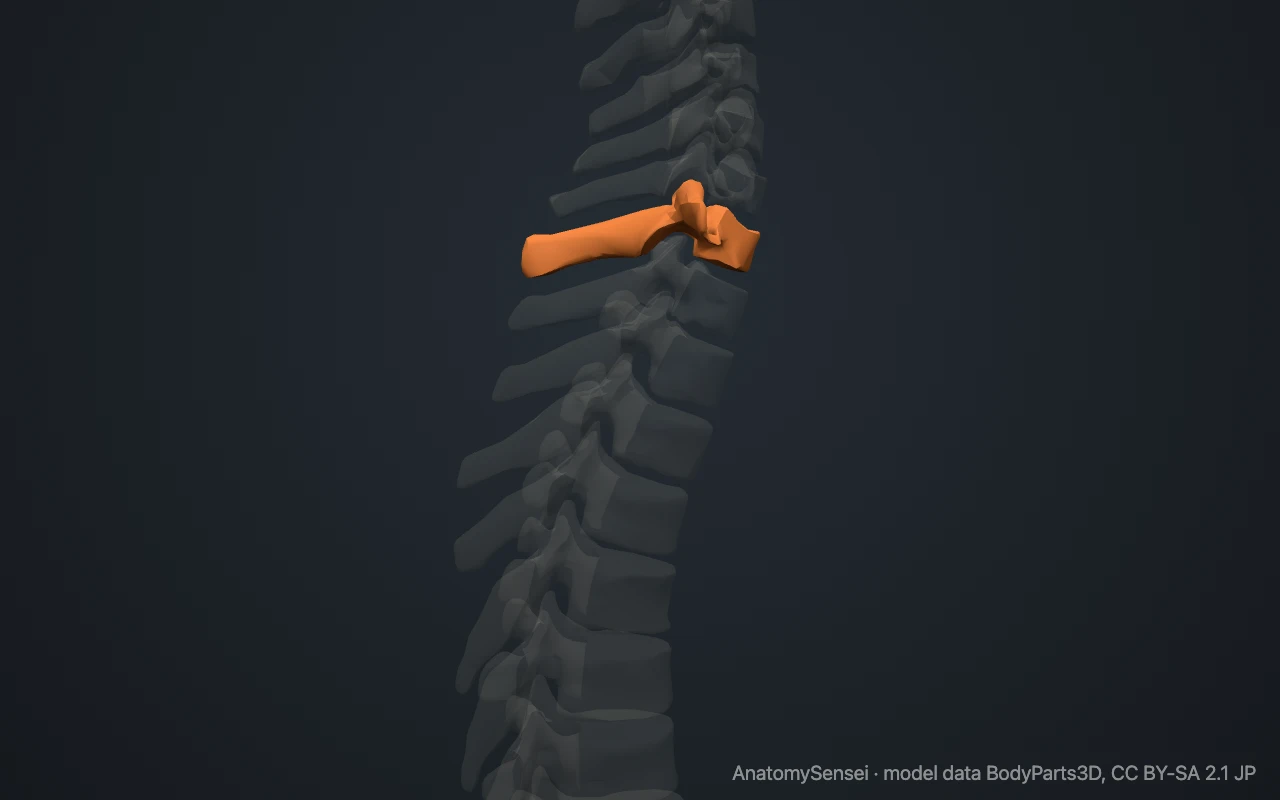
The body is larger than those above. The transverse processes are large, and each still has a transverse foramen, the hole that marks a cervical vertebra. In C7 the hole is small. The vertebral artery usually does not pass through it and instead enters the column at C6. Small veins use it.
C7 normally has no joint surfaces for ribs, which separates it from T1.
What does C7 articulate with?
It joins C6 above and T1 below. At each level there is an intervertebral disc between the bodies and a pair of facet joints between the arches.
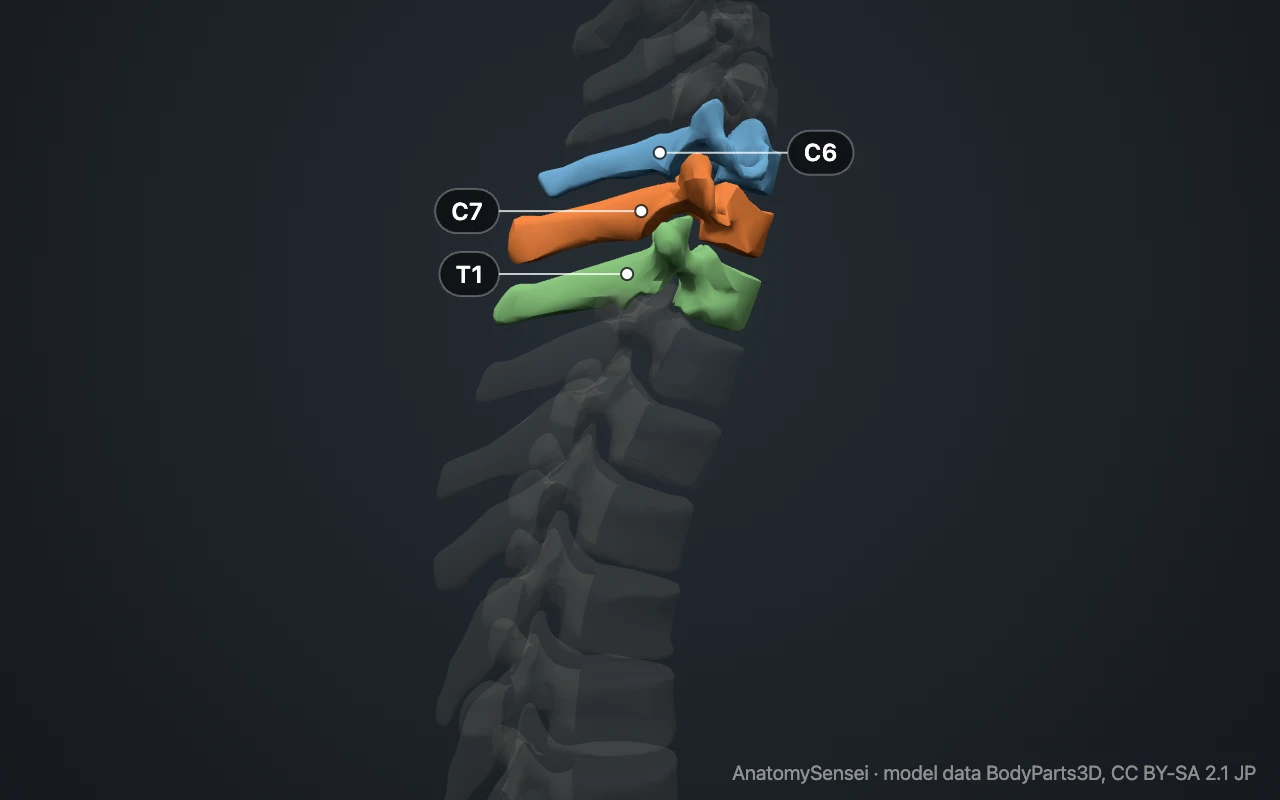
The joint with T1 is called the cervicothoracic junction. Here the forward curve of the neck changes into the backward curve of the upper back, and a flexible region meets a rigid one.
What attaches to C7?
The nuchal ligament, the strong midline band at the back of the neck, ends below on the spinous process of C7. From there it continues down the back as the supraspinous ligament.
The same spinous process gives origin to part of the trapezius and to other muscles of the upper back and neck, including the rhomboid minor and splenius capitis. The transverse processes anchor some of the scalene muscles.
What does C7 do?
Like its neighbours, C7 supports the head and neck and protects the spinal cord. Its long spinous process gives extra leverage to the muscles and ligaments that hold the head upright.
It is also a practical landmark. Clinicians find the bump of C7 first and count up or down from it to identify other vertebrae. The nerve that leaves between C7 and T1 is the eighth cervical nerve, the last of the cervical set.
Common problems with C7
Some people have a cervical rib, an extra rib attached to the transverse process of C7. It is often small and unnoticed, but it can crowd the nerves and vessels passing to the arm, one cause of thoracic outlet syndrome.
The tip of the spinous process can break off under sudden muscle pull or a direct blow, an injury known as a clay-shoveler's fracture. Disc wear and herniation are also common at the levels just above and below C7. This page describes anatomy only.
Common questions
Why is C7 called the vertebra prominens?
Because its long spinous process is the most prominent in the neck and is easy to see and feel under the skin.
Is the bump at the base of the neck always C7?
Usually, but not always. In some people the spinous process of T1 is as prominent or more so.
Is C7 a cervical or a thoracic vertebra?
It is cervical. It has transverse foramina and normally no ribs, though its spinous process resembles a thoracic one.
Which nerve exits below C7?
The eighth cervical nerve (C8), which leaves between C7 and T1.
Is this 3D model of the seventh cervical vertebra free?
Yes. The interactive 3D model on this page is free to view and use for study, with no account or download needed. Its geometry comes from the open BodyParts3D data set (CC BY-SA).
About this free 3D model of the seventh cervical vertebra
The interactive 3D model on this page is free to use in your browser, with no sign-up. It is built from scan-based anatomy data, so every bone is a separate, correctly placed shape you can turn and inspect from any side.