
Ribs
Costae
The ribs are 24 curved, flat bones arranged in 12 pairs. They run from the spine around the sides of the chest and form most of the rib cage.
Loading 3D model…
Free 3D model of the ribs. Whole rib cage. Drag to rotate, zoom with + and − (or Ctrl + scroll), click a bone to highlight and name it.
- True ribs (1 to 7)
- False ribs (8 to 10)
- Floating ribs (11 and 12)
Key points
- There are 12 ribs on each side, 24 in total.
- Ribs 1 to 7 are true ribs, 8 to 10 are false ribs and 11 and 12 are floating ribs.
- A typical rib has a head, a neck, a tubercle, an angle and a shaft.
- All ribs join the thoracic vertebrae at the back.
What are the ribs?
The ribs are long, curved, flat bones that form the side walls of the chest. Each one starts at the spine, sweeps outward and backward, then curves around to the front, sloping downward as it goes.
They are light and springy. A rib is flattened so that it has an outer and an inner surface, and it contains red bone marrow. Together with the sternum and the thoracic vertebrae, the ribs make up the rib cage.
How many ribs do humans have?
Most people have 24 ribs, 12 on each side. They are numbered from the top down, and each pair is attached to the thoracic vertebra of the same number.
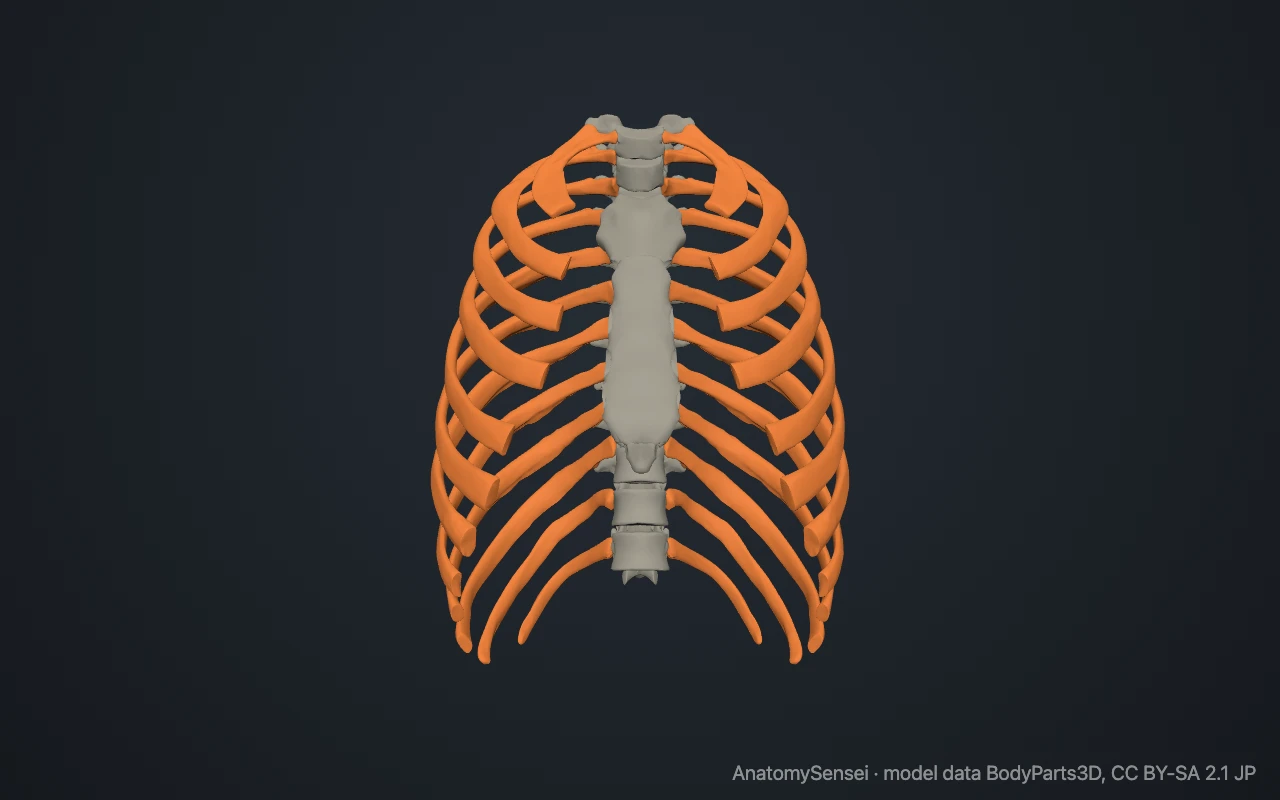
The ribs grow longer from the first to the seventh and then shorter again down to the twelfth. A small number of people have an extra rib, most often a cervical rib above the first, or are missing the twelfth pair.
What are true, false and floating ribs?
The ribs are sorted by how their front ends attach. True ribs, 1 to 7, each have their own costal cartilage that connects directly to the sternum.
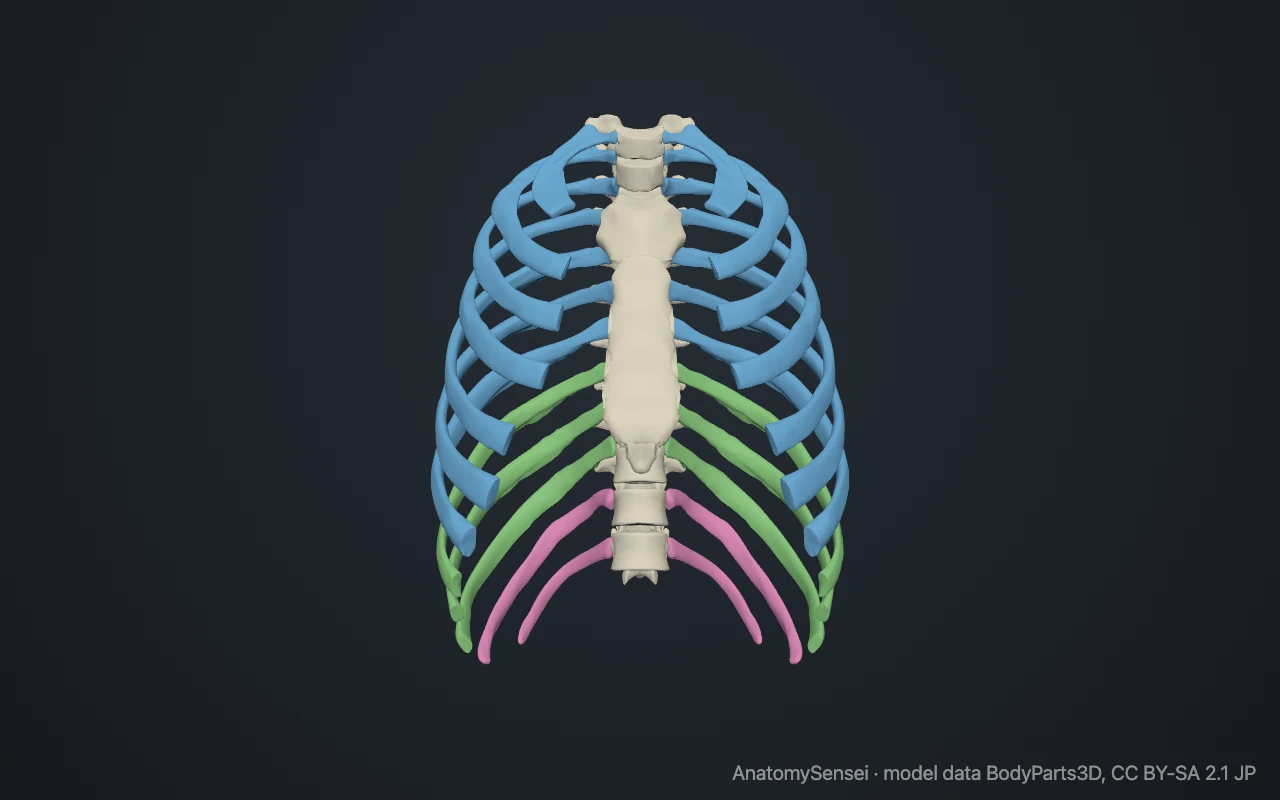
False ribs, 8 to 10, do not reach the sternum on their own. The cartilage of each one joins the cartilage of the rib above, and together these form the costal margin, the lower edge of the chest.
Floating ribs, 11 and 12, have no attachment at the front at all. Their short tips lie free in the muscles of the abdominal wall. Some textbooks count the floating ribs as a kind of false rib, which gives five false pairs.
What are the parts of a typical rib?
Ribs 3 to 9 share the same design and are called typical ribs. At the rear end is the head, a small wedge with two joint surfaces separated by a ridge. Next comes the short neck.
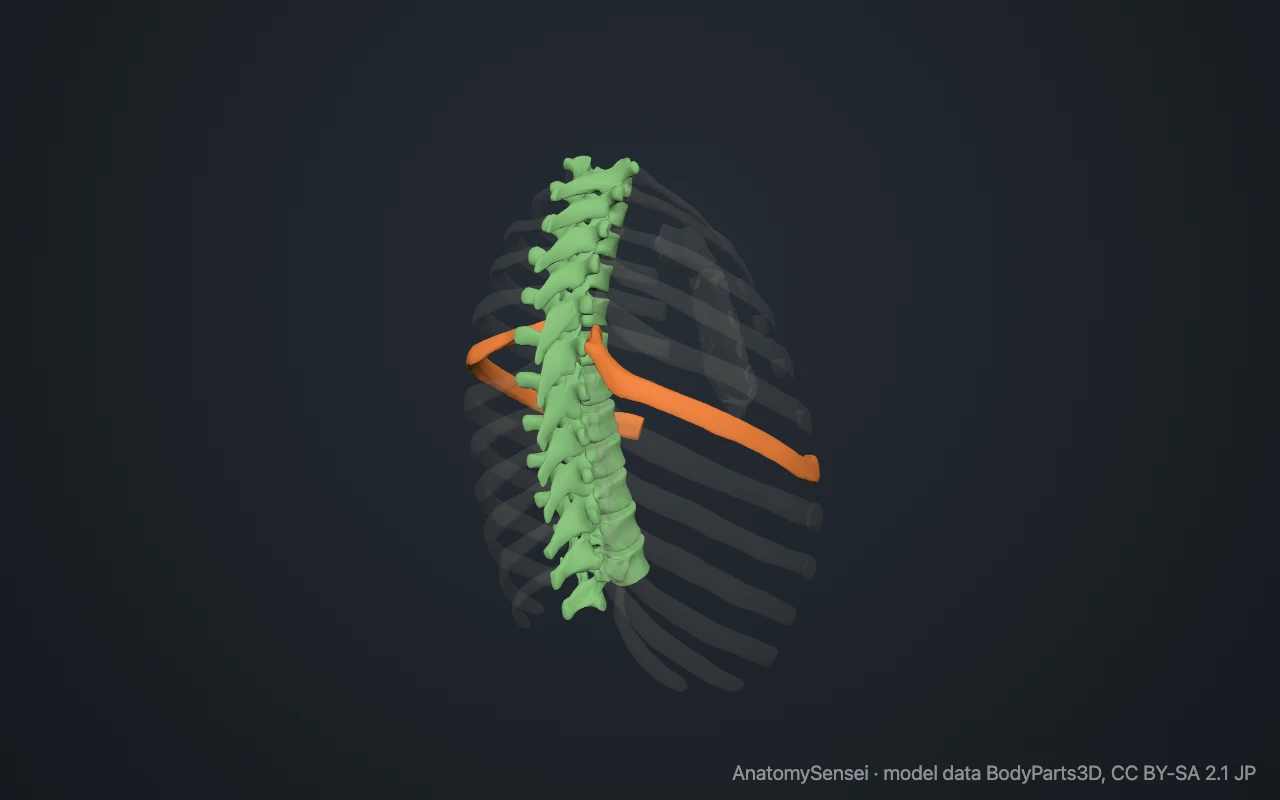
Where the neck meets the shaft there is a bump on the back of the rib, the tubercle. Part of it carries a joint surface and part of it is rough for a ligament.
The shaft, or body, is the long, thin, curved part. A short way beyond the tubercle it bends sharply forward at the angle. Along the lower inner edge of the shaft runs the costal groove, which shelters the vein, artery and nerve of that rib space.
How do the ribs attach to the spine?
The head of a typical rib fits between two vertebrae. It touches the vertebra of its own number and the one above, as well as the disc between them. The sixth rib, for example, joins the fifth and sixth thoracic vertebrae.
The tubercle forms a second joint with the transverse process, the side arm of the rib's own vertebra. The first rib and the last two or three are simpler. Their heads meet only their own vertebra.
How do the ribs attach at the front?
No rib touches the sternum bone to bone. The front end of each rib is a shallow cup that holds a bar of costal cartilage. The cartilages of ribs 1 to 7 carry on to the sternum.
The model on this page contains bones only, without cartilage. That is why the ribs in the model end a few centimetres short of the sternum and why the costal margin is not drawn.
Which ribs are different from the rest?
Ribs 1, 2, 10, 11 and 12 are called atypical ribs. The first is short, broad and flat. The second is longer and has a rough patch for the serratus anterior muscle.
The tenth usually has a single joint surface on its head. The eleventh and twelfth are short, have no tubercle and do not touch a transverse process.
What do the ribs do?
The ribs protect the heart and lungs and, lower down, the liver, spleen and kidneys. They also give attachment to the muscles of the chest, back, abdomen and shoulder.
Their other job is breathing. Three layers of intercostal muscles fill the spaces between the ribs. When the ribs are lifted they swing up and out, the chest expands and air enters the lungs.
How can you count your own ribs?
Start at the sternum. Slide a finger down from the notch between the collarbones until you feel a low ridge across the bone. This is the sternal angle, and the second rib is level with it on each side.
Move sideways onto the second rib and count down, feeling for each rib and the soft space below it. The first rib is tucked under the collarbone and is hard to feel.
Common problems with the ribs
Rib fractures are common after falls and impacts. The middle ribs are broken most often, and the usual site is near the angle, where the bone bends most sharply.
A cervical rib is an extra rib from the lowest neck vertebra that can crowd the nerves and vessels to the arm. Pain at the junction of a rib and its cartilage is called costochondritis. This page describes anatomy only.
Common questions
Which ribs are the true ribs?
Ribs 1 to 7. Each connects to the sternum through its own costal cartilage.
Which is the longest rib?
Usually the seventh. The ribs lengthen from the first to the seventh and then shorten toward the twelfth.
Are the ribs flat bones or long bones?
They are classed as flat bones, although they are long and narrow. They are thin, curved and protect the organs beneath them.
What runs under each rib?
An intercostal vein, artery and nerve run in the costal groove along the lower inner edge of the rib.
Is this 3D model of the ribs free?
Yes. The interactive 3D model on this page is free to view and use for study, with no account or download needed. Its geometry comes from the open BodyParts3D data set (CC BY-SA).
About this free 3D model of the ribs
The interactive 3D model on this page is free to use in your browser, with no sign-up. It is built from scan-based anatomy data, so every bone is a separate, correctly placed shape you can turn and inspect from any side.