
Hyoid bone
Os hyoideum
The hyoid is a small U-shaped bone in the front of the neck, between the lower jaw and the voice box. It does not form a joint with any other bone and is held in place by muscles and ligaments.
Loading 3D model…
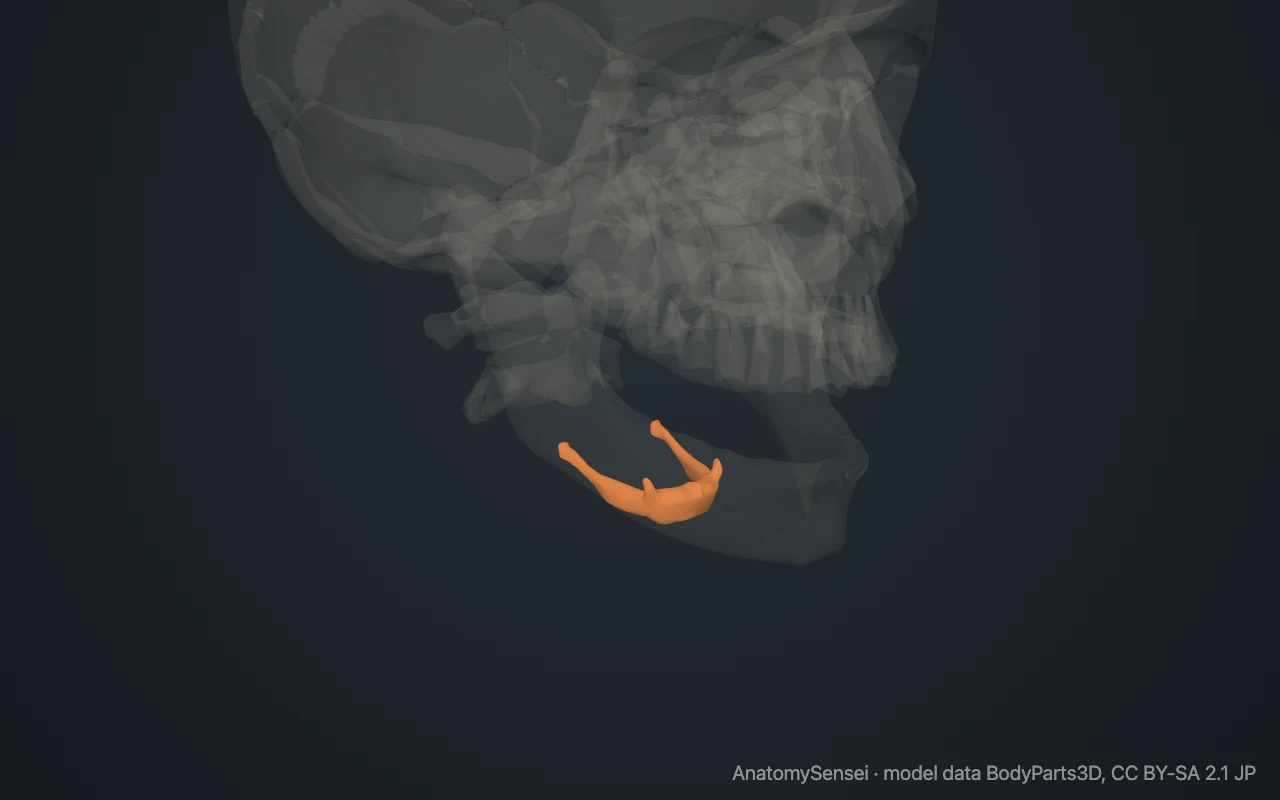
Free 3D model of the hyoid bone. Whole skull. Drag to rotate, zoom with + and − (or Ctrl + scroll), click a bone to highlight and name it.
Key points
- The hyoid is a U-shaped bone in the neck, below the mandible.
- It is the only bone in the body that does not articulate with another bone.
- It has a body, two greater horns and two lesser horns.
- It anchors the tongue and rises and falls with every swallow.
What is the hyoid bone?
The hyoid is a slender, horseshoe-shaped bone in the upper neck. Its name comes from the Greek letter upsilon, which it resembles.
It is not part of the skull and is not one of the 22 skull bones. It is usually grouped with the skull because it is linked to it by ligaments and works with the jaw and tongue.
Where is the hyoid bone?
It lies in the midline of the neck, in the angle between the chin and the throat. It is just above the thyroid cartilage of the voice box and level with the third neck vertebra.
You can feel it. Find the firm notch at the top of the Adam's apple, then move a finger about a finger-width higher. Grip gently there with a finger and thumb on either side of the neck. The hard bar that moves up when you swallow is the hyoid.
What are the parts of the hyoid?
The body is the central part at the front, a small curved bar of bone. It is the part that can be felt in the midline.
A greater horn runs backward from each end of the body, forming the two limbs of the U. Each ends in a small rounded tip.
A lesser horn is a small cone that points upward from the junction of the body and each greater horn. The horns are also known by their Latin name, cornua. In the model the hyoid is selected as a whole.
Does the hyoid articulate with any bone?
No. The hyoid is the only bone in the body that does not meet another bone at a joint. It is suspended in the neck.
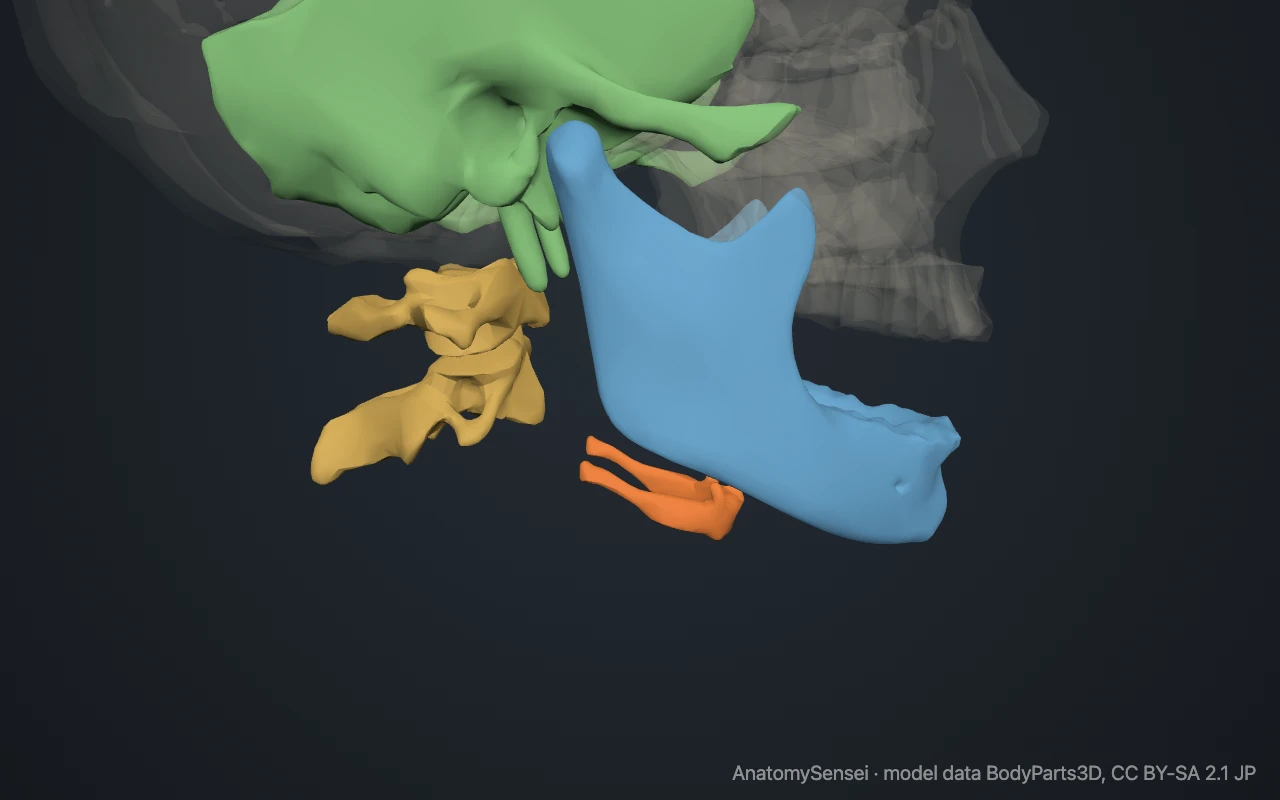
On each side a thin cord, the stylohyoid ligament, runs from the styloid process of the temporal bone down to the lesser horn. Below, a broad sheet called the thyrohyoid membrane connects the hyoid to the thyroid cartilage of the voice box.
The model shows this isolation clearly. The hyoid floats below the mandible and in front of the neck vertebrae without touching either.
What attaches to the hyoid?
Two groups of muscles hold it. The suprahyoid muscles run upward to the mandible and the base of the skull. They are the digastric, stylohyoid, mylohyoid and geniohyoid, and they form the floor of the mouth.
The infrahyoid muscles run downward to the breastbone, the shoulder blade and the thyroid cartilage. They are the sternohyoid, omohyoid and thyrohyoid.
The hyoglossus, a muscle of the tongue, arises from the hyoid, and one of the muscles of the throat wall attaches to its greater horn.
What does the hyoid do?
It is a movable anchor for the tongue and the voice box. Because it floats, the muscles above and below can pull it up, down, forward and back.
During swallowing it rises and moves forward, lifting the voice box and helping to close the airway while food passes. It also steadies the base of the tongue in speech and gives the muscles under the chin a fixed point when the mouth opens.
Common problems with the hyoid
The hyoid is well protected by the lower jaw, so hyoid fractures are uncommon. When they occur, they usually follow direct force to the front of the neck, including strangulation, and most often involve a greater horn.
The stylohyoid ligament can turn partly to bone. Together with a long styloid process this is associated with Eagle syndrome, a cause of throat and neck pain. This page describes anatomy only.
Common questions
Is the hyoid bone part of the skull?
No. It is a separate bone in the neck and is not counted among the 22 skull bones.
Why is the hyoid called a floating bone?
Because it forms no joint with any other bone. Muscles and ligaments hold it in place.
Does everyone have a hyoid bone?
Yes. Men and women both have one. It is separate from the Adam's apple, which is cartilage of the voice box below it.
At what level of the spine is the hyoid?
About the level of the third cervical vertebra, a little below the axis shown in the model.
Is this 3D model of the hyoid bone free?
Yes. The interactive 3D model on this page is free to view and use for study, with no account or download needed. Its geometry comes from the open BodyParts3D data set (CC BY-SA).
About this free 3D model of the hyoid bone
The interactive 3D model on this page is free to use in your browser, with no sign-up. It is built from scan-based anatomy data, so every bone is a separate, correctly placed shape you can turn and inspect from any side.