
Facial bones
Ossa faciei
The facial bones are the 14 bones that form the front and lower part of the skull. They build the upper and lower jaws, the cheeks, the nose and much of the eye sockets.
Loading 3D model…
Free 3D model of the facial bones. Whole skull. Drag to rotate, zoom with + and − (or Ctrl + scroll), click a bone to highlight and name it.
Key points
- There are 14 facial bones: six pairs plus the vomer and the mandible.
- The two maxillae are the centre of the face and touch almost every other facial bone.
- Together with the cranial bones, the facial bones form the orbits and the nasal cavity.
- The mandible is the only facial bone that moves.
What are the facial bones?
The skull has 22 bones. Eight of them surround the brain and are called the cranial bones. The other 14 are the facial bones, which hang from the front of the braincase and give the face its shape.
Anatomists also call this part of the skull the facial skeleton or viscerocranium. It frames the openings for the eyes, nose and mouth, and it carries the teeth. The model on this page shows bones only, so the teeth are not included.
Which bones make up the face?
Six of the facial bones come in left and right pairs. These are the maxilla (upper jaw), the zygomatic bone (cheekbone), the nasal bone, the lacrimal bone, the palatine bone and the inferior nasal concha. That makes twelve.
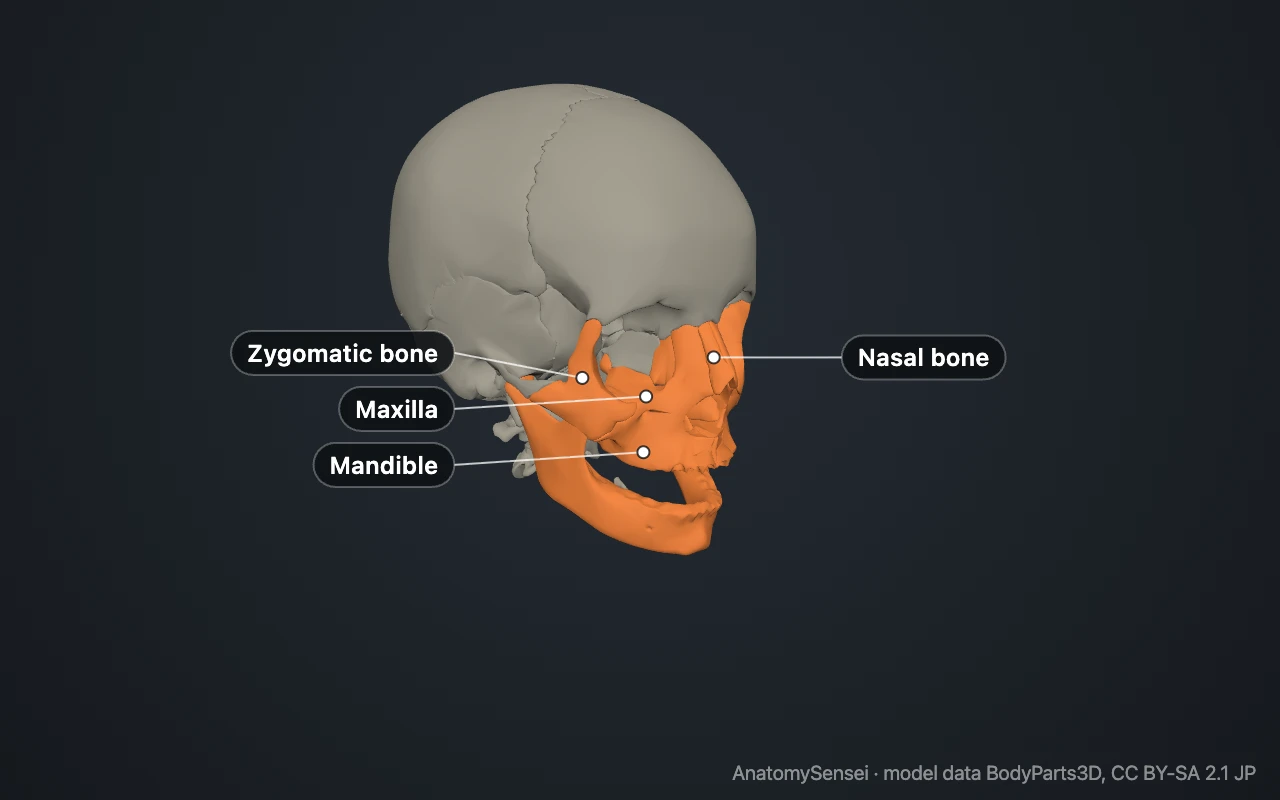
The last two are single bones that lie in the midline. The vomer forms the lower back part of the wall between the two sides of the nose. The mandible is the lower jaw.
Four of these can be seen easily on the outside of the skull: the maxilla, mandible, zygomatic and nasal bones. The other four are small and thin, and lie hidden inside the nose, the eye socket or the roof of the mouth.
Where are the facial bones?
They occupy the front and lower part of the skull, below the forehead and in front of the ears. The frontal bone of the forehead is a cranial bone, not a facial one, even though it is part of the face as people usually think of it.
Several can be felt on your own face. The firm upper part of the bridge of the nose is the two nasal bones. The prominence of each cheek is a zygomatic bone. The bone above the upper lip is the maxilla, and the whole of the chin and jawline is the mandible.
Which facial bones form the eye socket?
Each eye socket, or orbit, is built from seven bones. Four of them are facial bones: the maxilla, the zygomatic bone, the lacrimal bone and the palatine bone. The other three are cranial bones: the frontal, sphenoid and ethmoid.
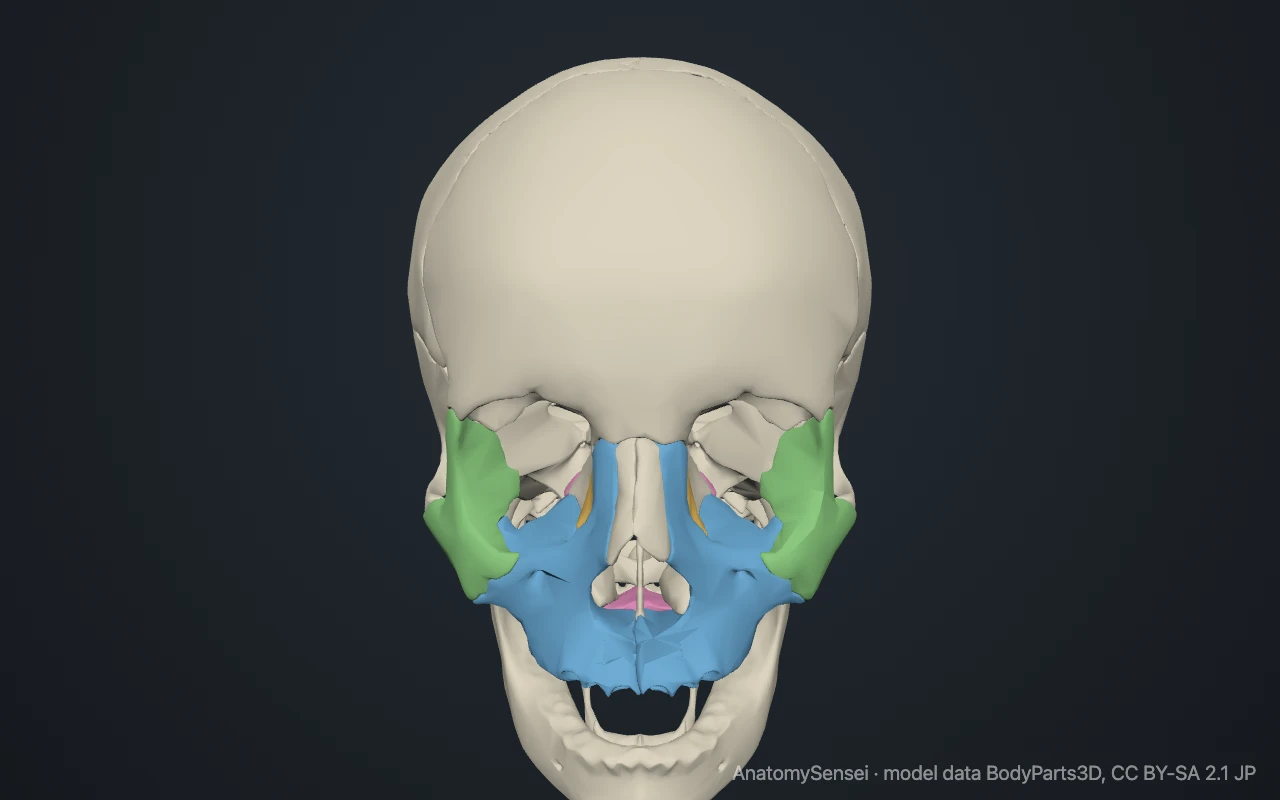
The maxilla forms most of the floor of the orbit. The zygomatic bone forms the outer wall and outer rim. The lacrimal bone sits in the inner wall, close to the nose, and the palatine bone adds a very small piece at the back of the floor.
Which facial bones form the nose?
The bony part of the outer nose is small. The two nasal bones form the bridge, and the maxillae form the sides of the pear-shaped opening below them. The rest of the outer nose is cartilage, which the model does not show.
Inside, the vomer forms the lower back part of the nasal septum, the wall that divides the nose into left and right. The maxilla, palatine bone and inferior nasal concha build the side wall of each half, and the maxilla and palatine bone form its floor.
Which bones form the jaws and the roof of the mouth?
The upper jaw is the two maxillae, joined in the midline. The lower jaw is the mandible. Both carry the teeth in a curved ridge of bone.
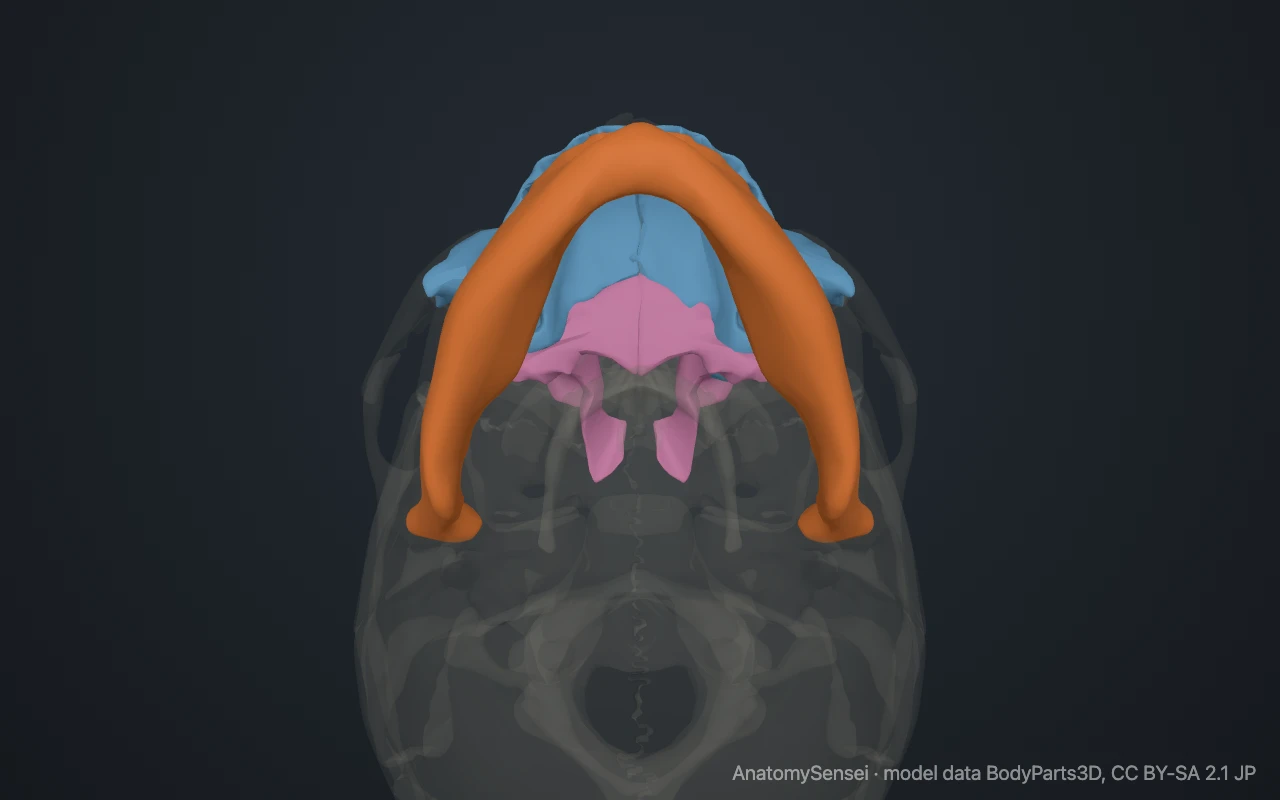
The hard palate, the bony roof of the mouth, is made of four pieces. The front and larger part comes from the two maxillae. The back part comes from the two palatine bones.
How are the facial bones joined?
Thirteen of the 14 facial bones are locked to each other and to the cranial bones by sutures, which are thin, immovable seams of fibrous tissue. The two maxillae are the centre of this framework and touch nearly every other facial bone.
The mandible is the exception. It meets the temporal bone on each side at the temporomandibular joint, just in front of the ear, and is the only facial bone that moves.
What do the facial bones do?
They support and protect the eyes, the nasal passages and the mouth. They hold the teeth and give the chewing muscles and the muscles of facial expression something to pull against.
They also shape the airway through the nose and contain air-filled spaces. The largest of these, the maxillary sinus, lies inside each maxilla.
Common problems with the facial bones
Fractures are the most frequent problem. The nasal bones, the zygomatic bone and the mandible are the facial bones broken most often, because they project furthest. Fractures that run across the middle of the face and separate the maxillae from the rest of the skull are known as Le Fort fractures.
A cleft palate occurs when the two halves of the hard palate do not join before birth. A bent nasal septum, which involves the vomer, is known as a deviated septum. This page describes anatomy only.
Common questions
How many facial bones are there?
Fourteen. Six are paired (twelve bones) and two, the vomer and the mandible, are single.
Is the frontal bone a facial bone?
No. The frontal bone forms the forehead but it is counted as a cranial bone, because it encloses the brain.
What is the largest facial bone?
The mandible, or lower jaw. It is also the strongest.
What is the smallest facial bone?
The lacrimal bone, a thin plate in the inner wall of each eye socket.
Is the hyoid a facial bone?
No. The hyoid lies in the neck below the mandible and is not counted among the 22 bones of the skull.
Is this 3D model of the facial bones free?
Yes. The interactive 3D model on this page is free to view and use for study, with no account or download needed. Its geometry comes from the open BodyParts3D data set (CC BY-SA).
About this free 3D model of the facial bones
The interactive 3D model on this page is free to use in your browser, with no sign-up. It is built from scan-based anatomy data, so every bone is a separate, correctly placed shape you can turn and inspect from any side.