
Nasal bone
Os nasale
The nasal bones are two small oblong bones that lie side by side and form the bridge of the nose. They are the only bony part of the outer nose apart from the edges of the maxillae.
Loading 3D model…
Free 3D model of the nasal bone. Whole skull. Drag to rotate, zoom with + and − (or Ctrl + scroll), click a bone to highlight and name it.
Key points
- The two nasal bones form the bony bridge of the nose.
- Each joins the frontal bone, the maxilla, the ethmoid and its partner.
- The lower part of the nose is cartilage, not bone.
- The nasal bones are among the most commonly broken bones of the face.
What is the nasal bone?
The nasal bone is a small, oblong facial bone. There are two, a left and a right, and they meet each other in the midline at the internasal suture.
Together they form the bridge of the nose. Each bone is thick and narrow at the top and becomes thinner and wider toward its lower edge.
Where is the nasal bone?
The nasal bones lie between the two eye sockets, below the forehead. They form the upper edge of the pear-shaped opening in the front of the skull, which is called the piriform aperture.
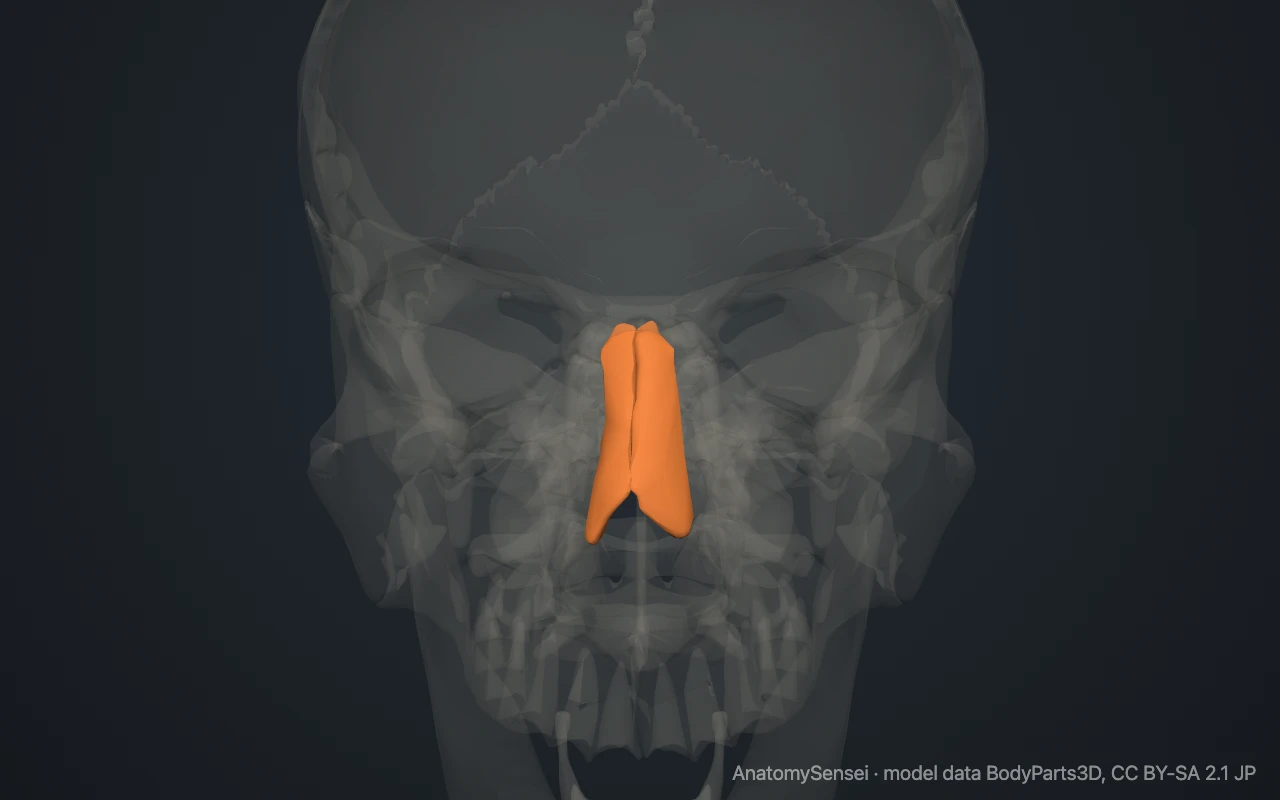
You can feel them on your own nose. Pinch the nose gently just below the level of the eyes. The hard part is the nasal bones. Move the fingers down and the nose becomes soft and can be bent. That lower part is cartilage, and it is missing from a bare skull and from the model.
What does a nasal bone look like?
Each nasal bone has two surfaces and four borders. The outer surface is smooth and slightly curved, and is covered by thin skin and two small muscles, procerus and nasalis. It usually has a tiny hole for a vein.
The inner surface faces the nasal cavity. It carries a narrow lengthwise groove for the anterior ethmoidal nerve, whose end branch passes out to the skin of the tip of the nose.
The point where the two nasal bones meet the frontal bone is a landmark called the nasion. It lies in the dip between the eyes.
What does the nasal bone articulate with?
Each nasal bone joins four bones. Its thick upper border meets the frontal bone. Its outer border meets the frontal process of the maxilla. Its inner border meets the other nasal bone.
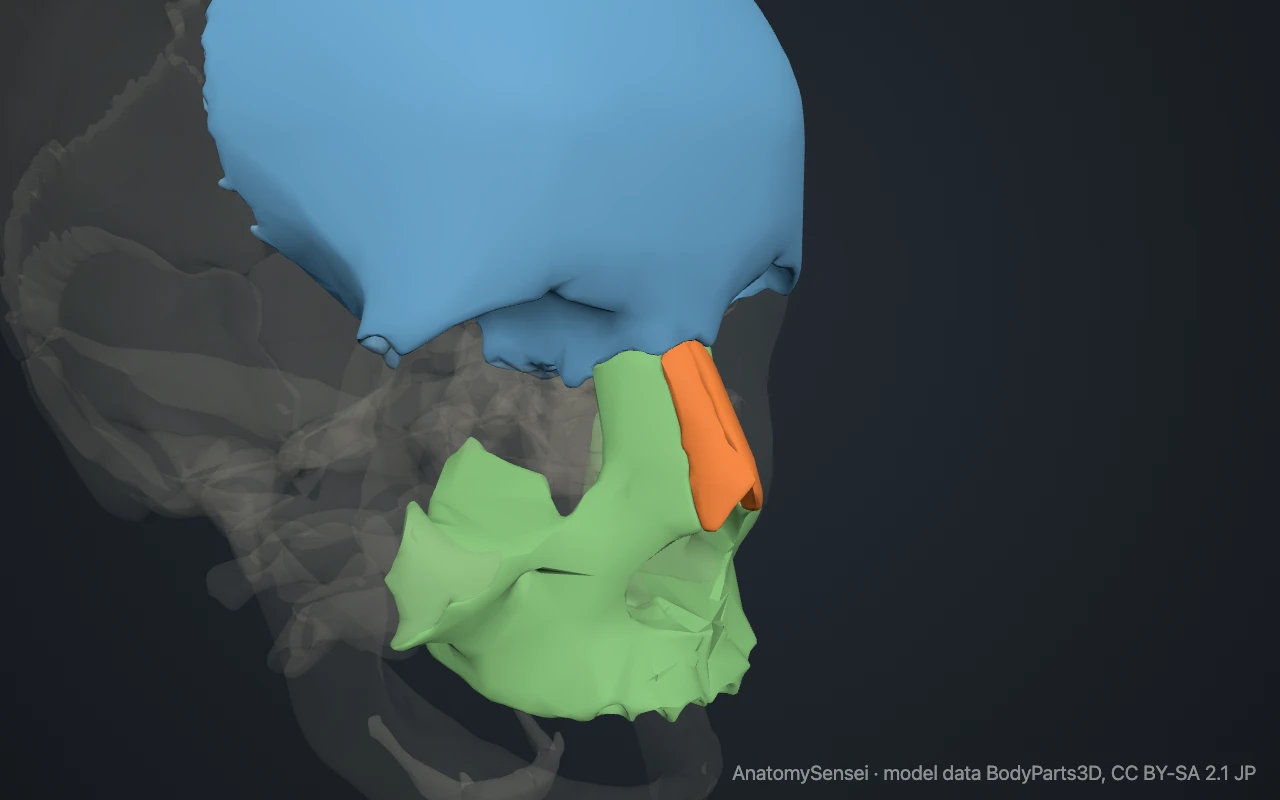
Behind the midline seam, the two bones together rest on the frontal bone and on the perpendicular plate of the ethmoid bone, which is part of the nasal septum. The thin lower border joins the cartilage of the nose.
What do the nasal bones form part of?
They form the bony roof of the front of the nasal cavity and the upper part of the external nose. The sides of the bony nose come from the frontal processes of the maxillae.
The shape of the nasal bones varies a good deal between people. Their length and angle set the profile of the upper part of the nose.
What do the nasal bones do?
They hold the upper airway open and protect the upper part of the nasal cavity. They also give a firm support to the nasal cartilages, which hang from their lower edges.
The bridge they form is where the pads of a pair of glasses rest.
Common problems with the nasal bones
The nose projects from the face and the nasal bones are thin, so a broken nose is one of the most common facial fractures. The break is usually in the thinner lower half of the bones.
A blow from the side can push the bones to one side, and a blow from the front can flatten them. The nasal septum behind them may be damaged at the same time. This page describes anatomy only.
Common questions
How many nasal bones are there?
Two. They sit side by side and meet in the midline.
Is the whole nose made of bone?
No. Only the upper part, the bridge, is bone. The lower part and the tip are cartilage.
Is the nasal bone a facial bone?
Yes. The two nasal bones are among the 14 facial bones.
What is the nasion?
The point in the midline where the nasal bones meet the frontal bone, in the dip between the eyes.
Is this 3D model of the nasal bone free?
Yes. The interactive 3D model on this page is free to view and use for study, with no account or download needed. Its geometry comes from the open BodyParts3D data set (CC BY-SA).
About this free 3D model of the nasal bone
The interactive 3D model on this page is free to use in your browser, with no sign-up. It is built from scan-based anatomy data, so every bone is a separate, correctly placed shape you can turn and inspect from any side.