
Palatine bone
Os palatinum
The palatine bone is an L-shaped bone at the back of the nasal cavity, one on each side. Its horizontal part forms the back of the hard palate and its upright part forms part of the side wall of the nose.
Loading 3D model…
Free 3D model of the palatine bone. Whole skull. Drag to rotate, zoom with + and − (or Ctrl + scroll), click a bone to highlight and name it.
- Maxilla
Key points
- The palatine bone is L-shaped, with a horizontal plate and a perpendicular plate.
- The two horizontal plates form the back part of the hard palate.
- The perpendicular plate forms part of the side wall of the nasal cavity.
- A small process at its top reaches the floor of the orbit.
What is the palatine bone?
The palatine bone is a paired, L-shaped facial bone. It lies deep in the face, wedged between the maxilla in front and the sphenoid bone behind.
Although it is small, it helps to form three spaces: the mouth, the nose and the eye socket. It is named after the palate, the roof of the mouth, of which it forms the back part.
Where is the palatine bone?
It lies at the back of the nasal cavity, behind the maxilla. Most of the bone is hidden. The only part that shows on the surface of the skull is the horizontal plate, which is seen from below at the back of the roof of the mouth.
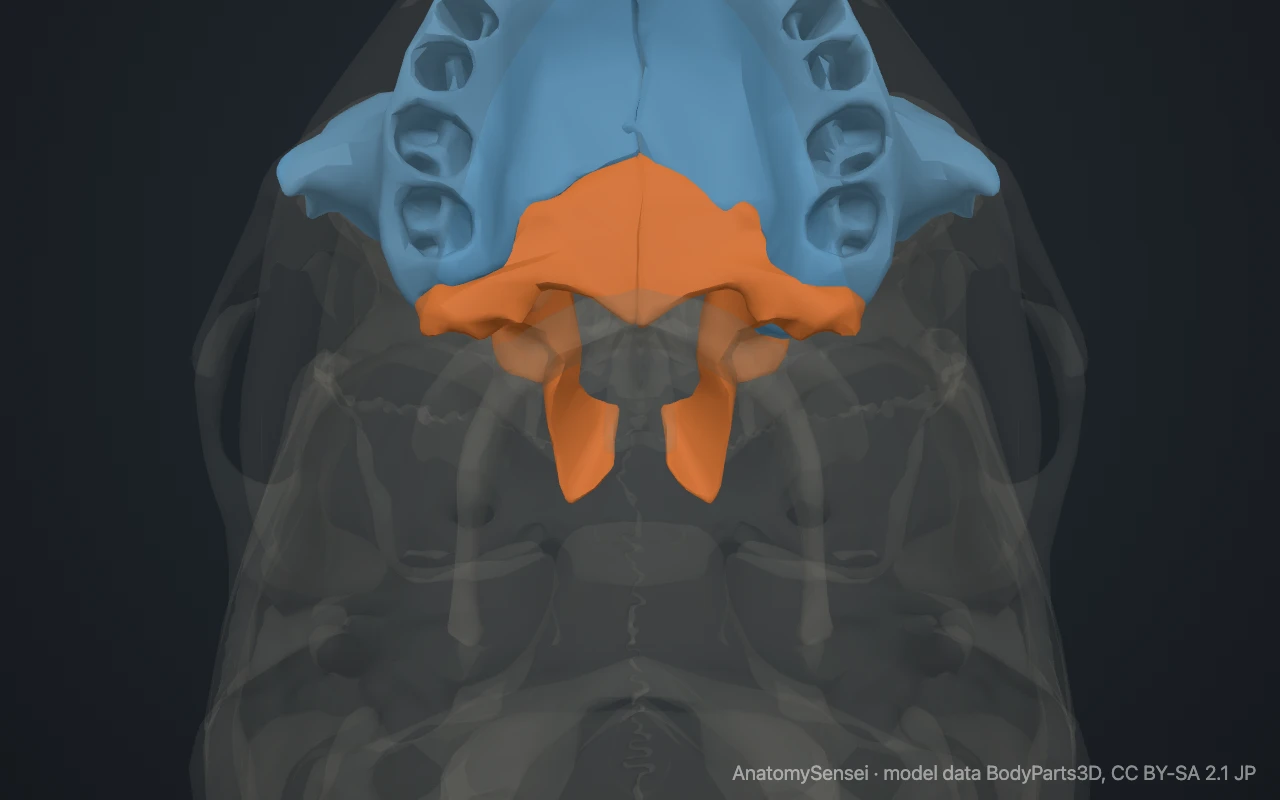
You can find this part with your tongue. Run the tip of the tongue backward along the roof of the mouth. The hard part is the hard palate. Its last centimetre or so, just before the roof turns soft, is the palatine bones.
What are the parts of the palatine bone?
The bone has two plates and three processes. The horizontal plate is the foot of the L. It meets its partner in the midline, and at the back the two together form a small point called the posterior nasal spine.
The perpendicular plate is the upright of the L. It is thin and stands against the inner side of the maxilla. Its inner face has two low ridges, one for the inferior nasal concha and one for the middle nasal concha of the ethmoid.
The pyramidal process projects backward from the corner of the L and fits into a notch in the sphenoid bone. At the top of the perpendicular plate are the orbital process in front and the sphenoidal process behind, with a notch between them.
What does the palatine bone articulate with?
Each palatine bone joins six bones. In front it meets the maxilla, and behind it meets the pterygoid process of the sphenoid bone. In the midline it meets the palatine bone of the other side.
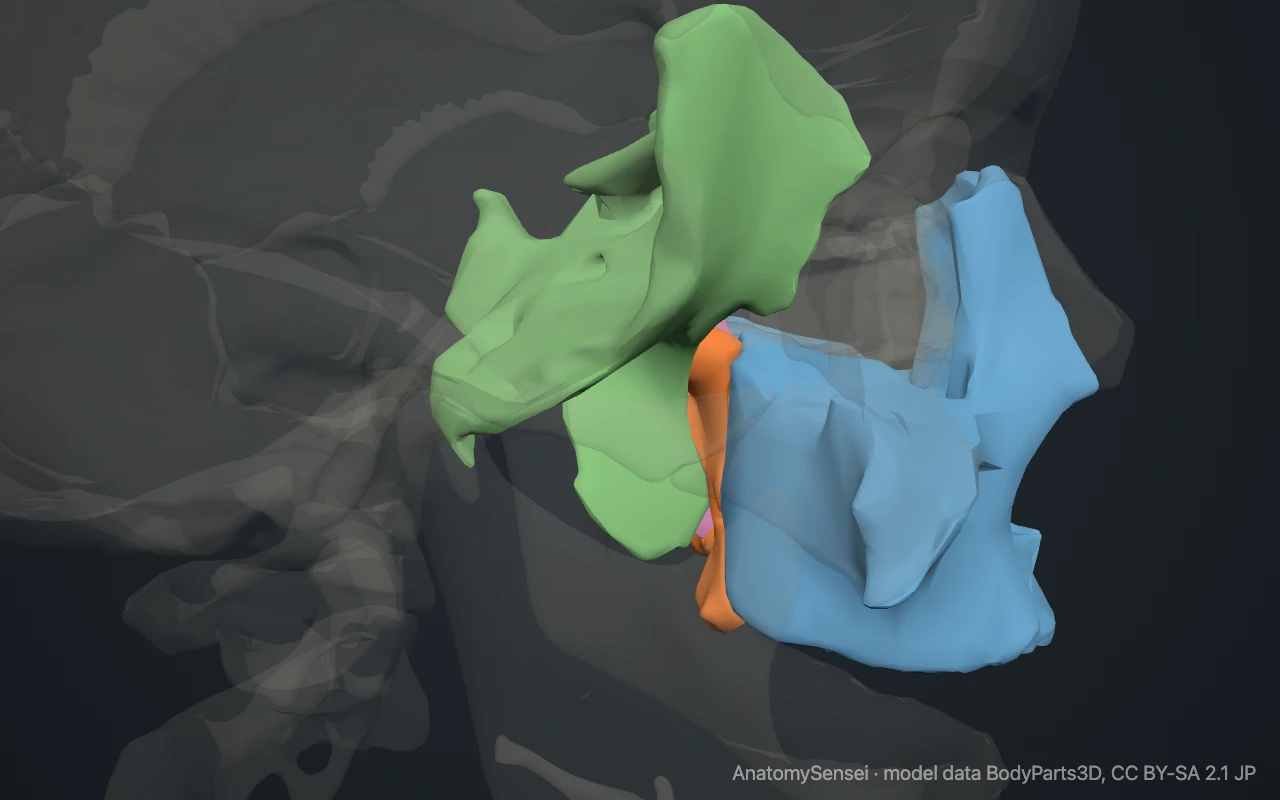
The vomer rests on the ridge where the two horizontal plates join. The inferior nasal concha attaches to the perpendicular plate, and the orbital process touches the ethmoid bone.
What does the palatine bone form part of?
The two horizontal plates form the back part of the hard palate, roughly its rear quarter. The same plates form the back of the floor of the nasal cavity. The soft palate hangs from their rear edge.
The perpendicular plate forms the back part of the side wall of the nasal cavity. The orbital process forms a very small area at the back of the floor of the orbit, which makes the palatine one of the seven bones of the eye socket.
What passes through and attaches to it?
Near the outer back corner of the hard palate is the greater palatine foramen. The greater palatine nerve and vessels come through it to supply the gum and lining of the hard palate. Just behind it, small lesser palatine foramina in the pyramidal process carry nerves to the soft palate.
The notch at the top of the perpendicular plate is closed by the sphenoid bone to make the sphenopalatine foramen. This is the main doorway for vessels and nerves entering the nasal cavity from behind the maxilla.
The muscle of the uvula attaches to the posterior nasal spine, and the fibrous sheet of the soft palate attaches to the rear edge of the horizontal plates.
Common problems with the palatine bone
In a cleft palate, the two halves of the palate do not join before birth. The gap may involve the horizontal plates of the palatine bones as well as the maxillae.
The greater palatine foramen is a landmark for numbing the palate in dentistry. The artery that passes through the sphenopalatine foramen is a source of nosebleeds from the back of the nose. This page describes anatomy only.
Common questions
Is the palatine bone the same as the palate?
No. The hard palate is made of four pieces. The palatine bones form only its back part. The front part is the maxillae.
How many palatine bones are there?
Two, a left and a right, which meet in the midline of the palate.
Is the palatine bone part of the eye socket?
Yes. Its small orbital process forms a tiny part of the floor of the orbit.
What shape is the palatine bone?
It is shaped like the letter L, with a horizontal plate and an upright perpendicular plate.
Is this 3D model of the palatine bone free?
Yes. The interactive 3D model on this page is free to view and use for study, with no account or download needed. Its geometry comes from the open BodyParts3D data set (CC BY-SA).
About this free 3D model of the palatine bone
The interactive 3D model on this page is free to use in your browser, with no sign-up. It is built from scan-based anatomy data, so every bone is a separate, correctly placed shape you can turn and inspect from any side.