
Inferior nasal concha
Concha inferior nasi
The inferior nasal concha is a thin, curled plate of bone that projects from the side wall of the nasal cavity. There is one on each side, and each is a separate bone of the face.
Loading 3D model…
Free 3D model of the inferior nasal concha. Whole skull. Drag to rotate, zoom with + and − (or Ctrl + scroll), click a bone to highlight and name it.
- Vomer
Key points
- The inferior nasal concha is a scroll-shaped bone on the side wall of the nose.
- It is a separate bone, unlike the middle and superior conchae, which are parts of the ethmoid.
- It joins the maxilla, palatine bone, lacrimal bone and ethmoid bone.
- The tear duct opens into the passage beneath it.
What is the inferior nasal concha?
The inferior nasal concha is a thin, curved plate of spongy bone that hangs into the nasal cavity from its side wall. Concha is Latin for a shell, which describes its curled shape. Its other common name is the inferior turbinate.
Each side of the nose has three conchae stacked one above the other. The superior and middle conchae are parts of the ethmoid bone. The inferior concha is a bone in its own right and is counted among the 14 facial bones.
Where is the inferior nasal concha?
It lies low on the side wall of the nasal cavity, running from front to back just above the floor of the nose. It is the largest and lowest of the three conchae.
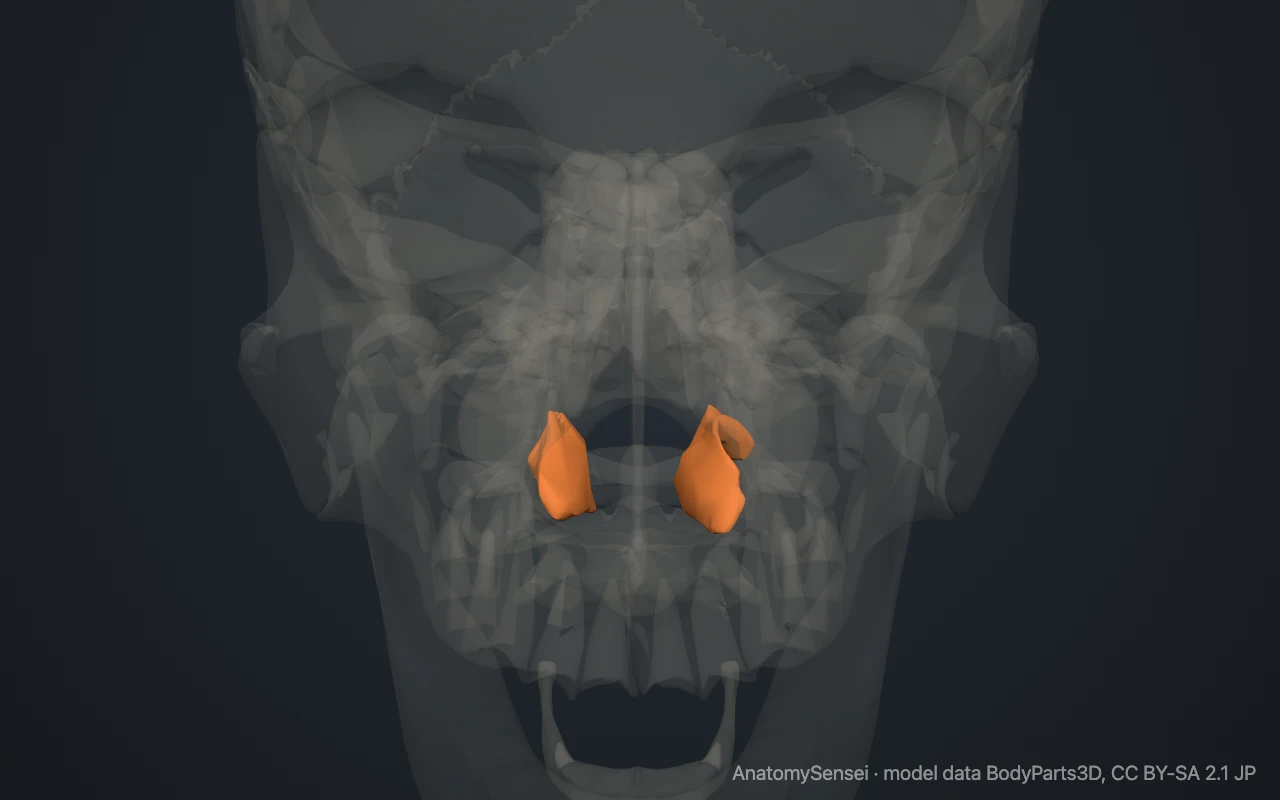
The bone cannot be felt from outside. In a bare skull it can be seen by looking into the nasal opening, as a curved shelf on each side. In a living person, its front end is the rounded swelling a clinician sees on the side wall when looking into the nostril.
What are the parts of the inferior nasal concha?
The bone is long from front to back and curls downward and inward like a scroll. It has two surfaces, two borders and two ends. The inner surface is convex and faces the nasal septum. The outer surface is concave and faces the side wall of the nose.
The lower border is free, thick and rounded. The upper border is thin and is attached to the side wall. Both surfaces are rough and pitted with small holes and grooves for blood vessels.
Three small processes rise from the upper border. The lacrimal process is at the front, the ethmoidal process is behind it, and the maxillary process curves downward and outward between them.
What does the inferior nasal concha articulate with?
Each inferior nasal concha joins four bones. The front of its upper border is fixed to a ridge on the inner side of the maxilla. The back of the border is fixed to a ridge on the perpendicular plate of the palatine bone.
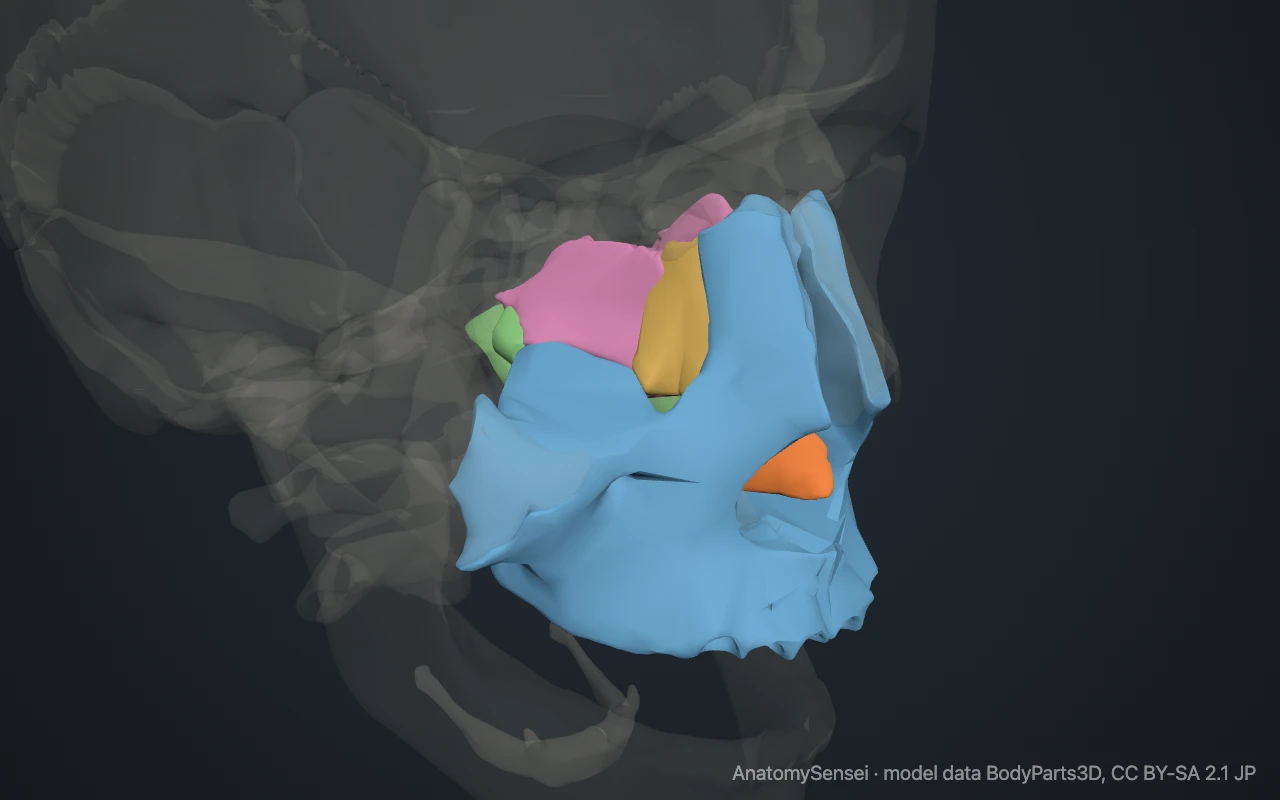
The lacrimal process reaches up to the lacrimal bone, and the ethmoidal process reaches up to the ethmoid bone. The maxillary process helps to close part of the large opening of the maxillary sinus.
What does the inferior nasal concha form part of?
It forms part of the side wall of the nasal cavity. The channel beneath it, between the concha and the floor of the nose, is the inferior nasal meatus. The channel above it is the middle meatus.
With the lacrimal bone and the maxilla, its lacrimal process also completes the wall of the nasolacrimal canal, the bony tube for the tear duct.
What opens beneath it and what covers it?
The nasolacrimal duct, which carries tears from the eye, opens into the inferior nasal meatus under the front part of the concha.
No muscles attach to the bone. It is covered by a thick lining that is rich in blood vessels and can swell and shrink. The holes and grooves on the bone carry the vessels that supply this lining.
What does the inferior nasal concha do?
The conchae increase the surface area inside the nose and steer the flow of air. As air passes over the warm, moist lining of the inferior concha, it is warmed, moistened and filtered before it reaches the throat and lungs.
Common problems with the inferior nasal concha
The lining over the inferior concha swells during a cold or an allergy, which is the usual cause of a blocked nose. Long-lasting enlargement of the concha and its lining is called turbinate hypertrophy.
When the nasal septum is bent to one side, the inferior concha on the wider side is often larger. The thin bone can also be damaged in fractures of the middle of the face. This page describes anatomy only.
Common questions
Is the inferior nasal concha the same as a turbinate?
Yes. Inferior turbinate is another name for the inferior nasal concha.
How many nasal conchae are there?
Three on each side: superior, middle and inferior. Only the inferior one is a separate bone.
Is the inferior nasal concha part of the ethmoid bone?
No. The superior and middle conchae belong to the ethmoid, but the inferior concha is its own bone.
Can the inferior nasal concha be seen in the model?
Yes. The model makes the surrounding bones see-through so that both conchae show inside the nose.
Is this 3D model of the inferior nasal concha free?
Yes. The interactive 3D model on this page is free to view and use for study, with no account or download needed. Its geometry comes from the open BodyParts3D data set (CC BY-SA).
About this free 3D model of the inferior nasal concha
The interactive 3D model on this page is free to use in your browser, with no sign-up. It is built from scan-based anatomy data, so every bone is a separate, correctly placed shape you can turn and inspect from any side.