
Sphenoid bone
Os sphenoideum
The sphenoid is a single, butterfly-shaped bone in the middle of the base of the skull. It touches every other cranial bone and holds the pituitary gland in a hollow called the sella turcica.
Loading 3D model…
Free 3D model of the sphenoid bone. Whole skull. Drag to rotate, zoom with + and − (or Ctrl + scroll), click a bone to highlight and name it.
Key points
- The sphenoid lies deep in the skull, behind the eyes and nose.
- It has a central body, two pairs of wings and two pterygoid processes.
- It articulates with all seven other cranial bones.
- The pituitary gland sits in the sella turcica on top of its body.
What is the sphenoid bone?
The sphenoid is the cranial bone at the centre of the skull base. Seen on its own it looks like a butterfly or a bat with its wings spread.
It is often called the keystone of the skull, because it wedges between the other bones and binds the braincase to the face.
Where is the sphenoid bone?
It lies behind the eye sockets and the nose, and in front of the temporal and occipital bones. It stretches across the full width of the skull, from one temple to the other.
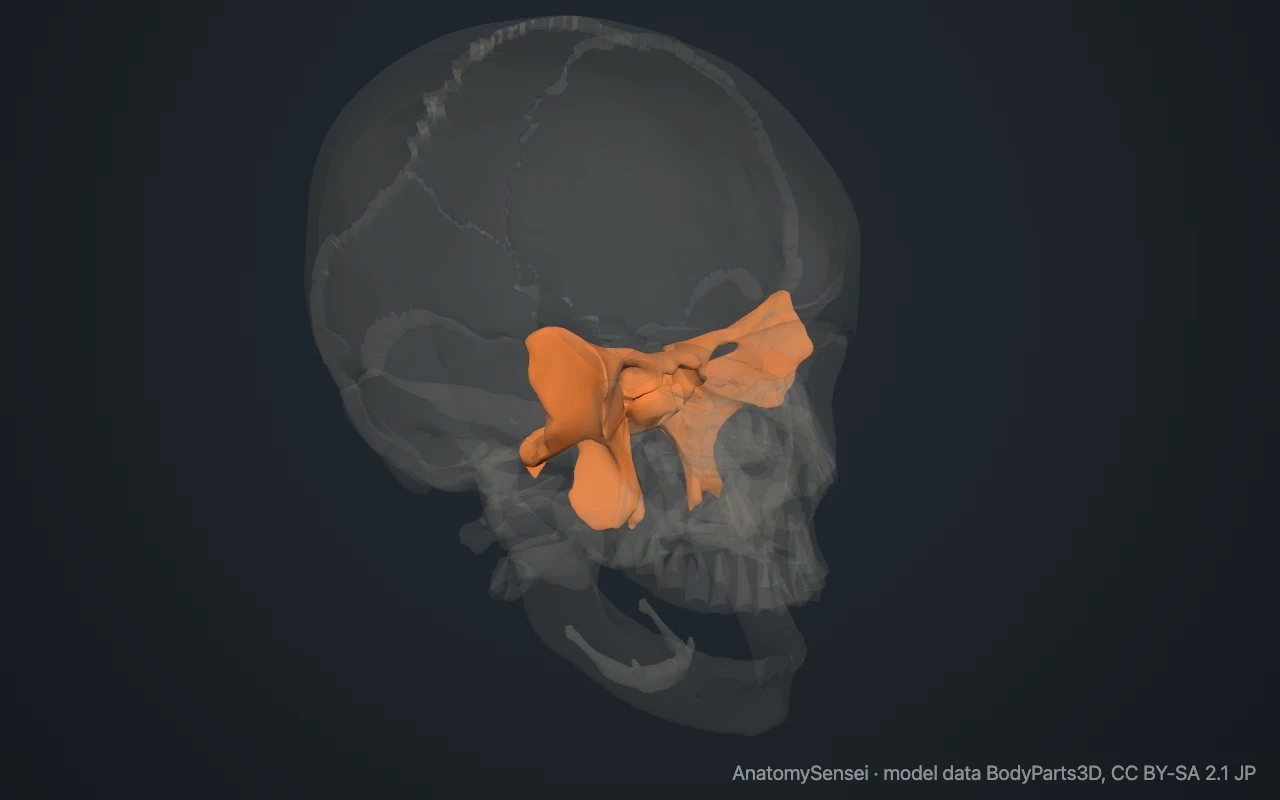
Most of it is hidden. That is why the model on this page opens with the other bones see-through. The only part near the surface is in the temple, about two finger-widths behind the outer rim of the eye socket, and it is covered there by a thick chewing muscle.
What are the parts of the sphenoid?
The central body is a cube of bone that contains two air spaces, the sphenoidal sinuses. Its upper surface is shaped like a saddle and is called the sella turcica, or Turkish saddle. The pituitary gland rests in its hollow.
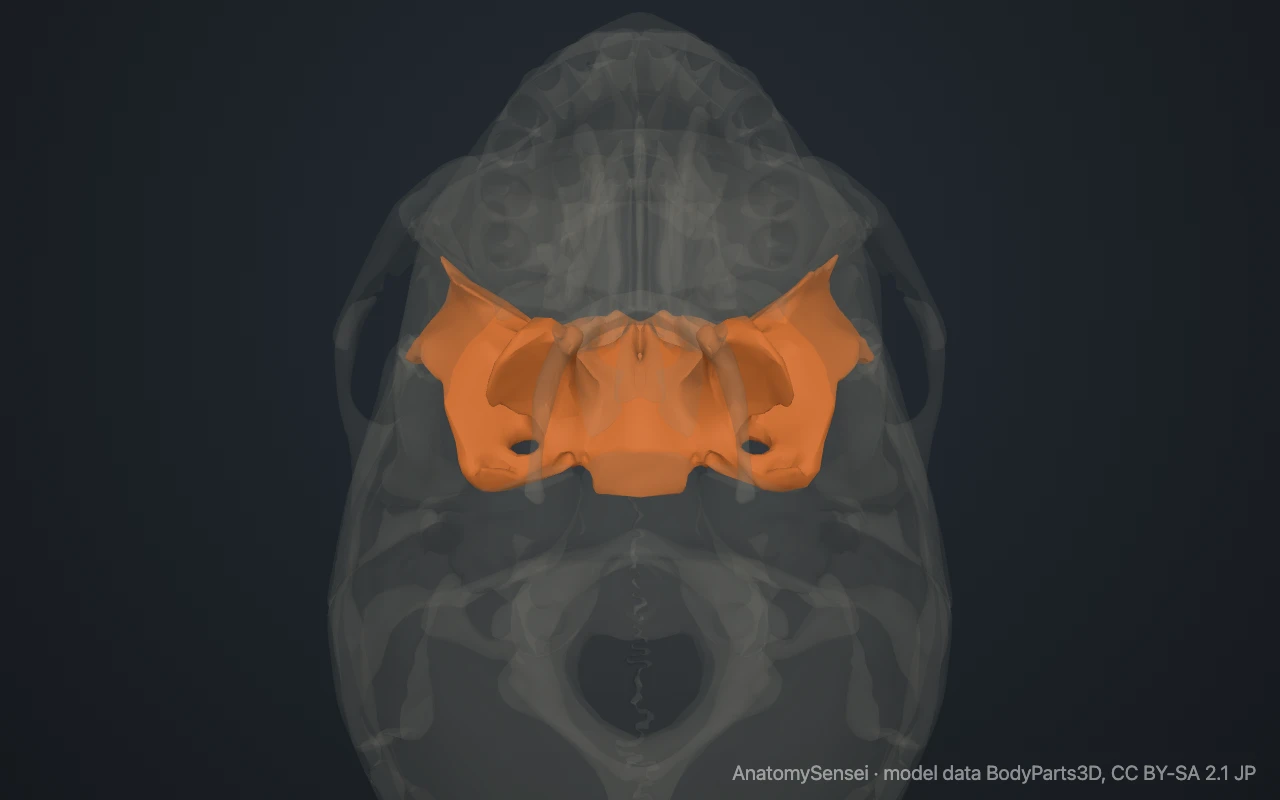
Two pairs of wings spread from the body. The greater wings are large and curve outward and upward to reach the temples. The lesser wings are small, flat triangles above them that form the back of the roof of each eye socket.
Two pterygoid processes hang down from the junction of the body and greater wings, behind the upper jaw. Each has a medial and a lateral plate.
What passes through the sphenoid?
The sphenoid has more named openings than any other skull bone. The optic canal, at the root of each lesser wing, carries the nerve of sight to the eye.
Between the lesser and greater wings is a slit, the superior orbital fissure, for the nerves that move the eye. Three holes in each greater wing, the foramen rotundum, foramen ovale and foramen spinosum, carry branches of the main sensory nerve of the face and an artery to the coverings of the brain.
What does the sphenoid articulate with?
It joins all seven other cranial bones: the frontal, the two parietal, the two temporal, the occipital and the ethmoid.
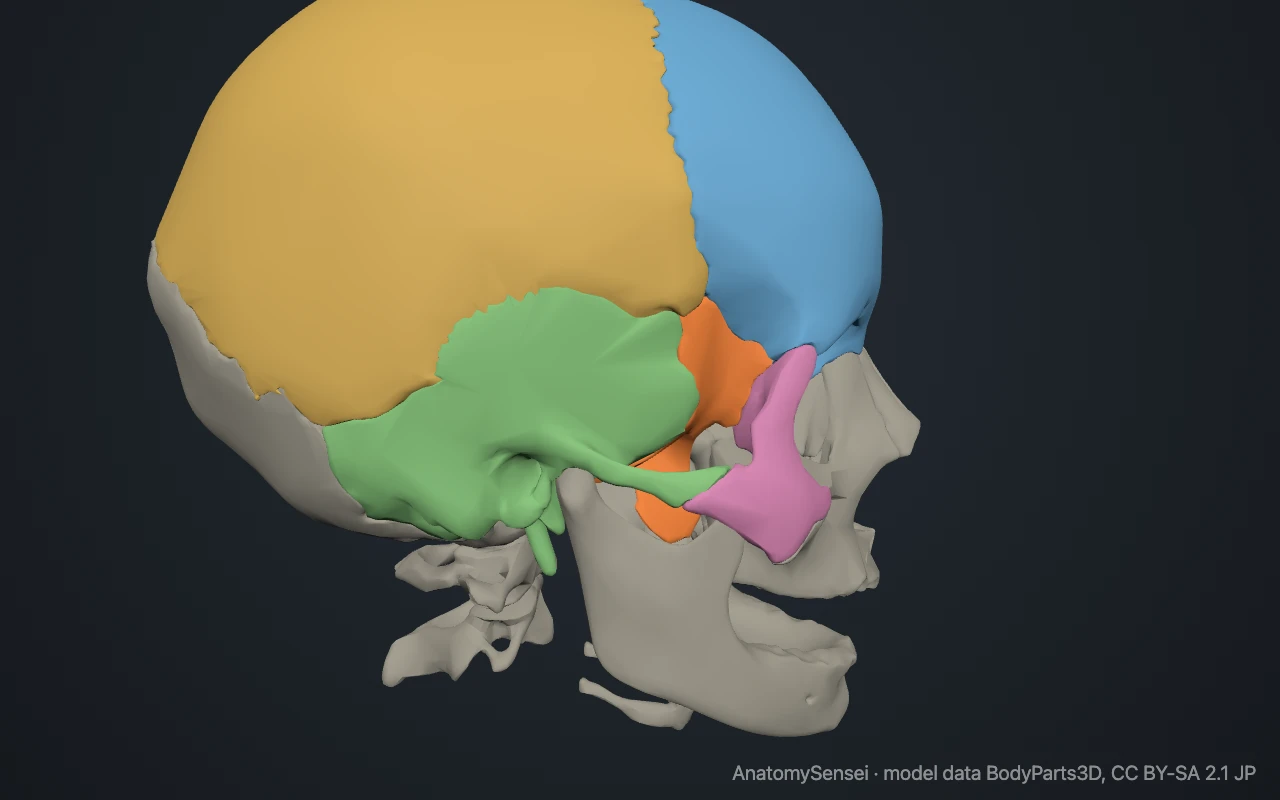
It also joins five facial bones. These are the vomer, the two zygomatic bones and the two palatine bones. In total it is usually described as meeting twelve bones.
In the temple its greater wing meets the frontal, parietal and temporal bones at the pterion.
What attaches to the sphenoid?
The two pterygoid muscles, which move the jaw from side to side and help to close and open it, arise from the lateral plate of the pterygoid process. Part of the temporalis muscle arises from the greater wing.
Several of the small muscles that move the eyeball arise from a ring of tendon fixed to the sphenoid around the optic canal.
What does the sphenoid do?
It locks the cranial and facial bones together and forms the central part of the floor on which the brain rests. Its wings form parts of the back and side walls of each eye socket.
It also protects the pituitary gland and gives a safe passage to the nerves of sight, eye movement and facial sensation.
Common problems with the sphenoid
Fractures of the skull base may run through the sphenoid and can involve the optic canal or the sphenoidal sinuses. A blow to the temple can break the thin bone at the pterion.
A pituitary tumour can enlarge the sella turcica. Sphenoid sinusitis is inflammation of the lining of the sphenoidal sinuses. This page describes anatomy only.
Common questions
Why is the sphenoid called the keystone of the skull?
Because it sits in the centre of the skull base and articulates with every other cranial bone.
What is the sella turcica?
The saddle-shaped hollow on top of the body of the sphenoid. It holds the pituitary gland.
Can you feel the sphenoid bone?
Hardly. A small part of its greater wing lies in the temple, but it is covered by muscle.
What does sphenoid mean?
Wedge-shaped, from the Greek word for a wedge.
Is this 3D model of the sphenoid bone free?
Yes. The interactive 3D model on this page is free to view and use for study, with no account or download needed. Its geometry comes from the open BodyParts3D data set (CC BY-SA).
About this free 3D model of the sphenoid bone
The interactive 3D model on this page is free to use in your browser, with no sign-up. It is built from scan-based anatomy data, so every bone is a separate, correctly placed shape you can turn and inspect from any side.